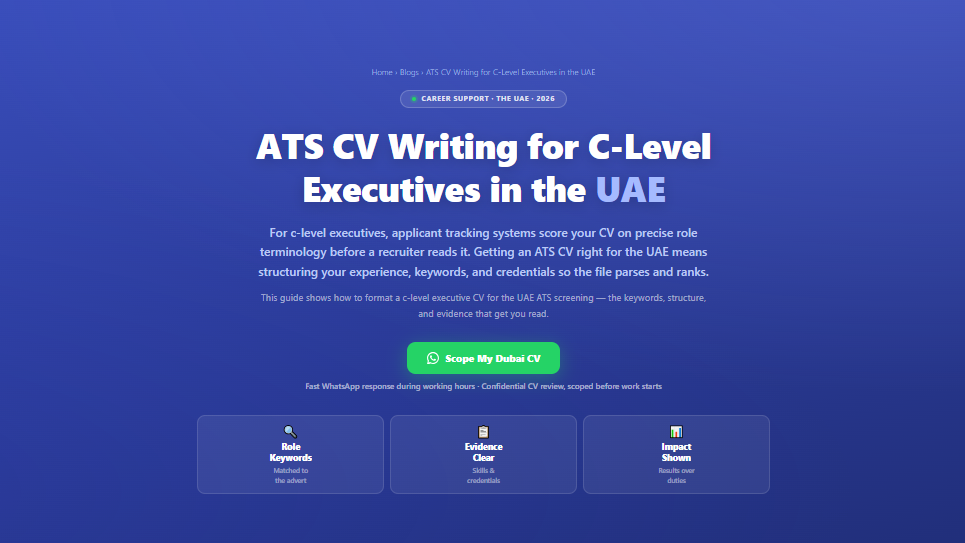

Executive Search Firms in the UAE:
How Senior C-Suite Hiring
Really Works
in 2026
A retained-search insider’s guide for CEOs, CFOs, COOs, CHROs, and managing directors targeting roles across DIFC, ADGM, family offices, sovereign-wealth entities, and multinational regional headquarters — covering mandate flow, candidate-screening logic, and confidential placement processes.
UAE senior hiring rarely runs through public job portals. The most consequential C-suite mandates — from group CEO appointments to regional CFO transitions — are sourced, screened, and closed through retained executive search firms operating quietly between boards, sovereign entities, and global headhunters. This guide breaks down how that ecosystem actually works in 2026, who the gatekeepers are, and what positions senior candidates for shortlist consideration.
energy, healthcare, real estate & tech
MD-level mandate flow
longlist & shortlist senior talent
What Senior Professionals Must Understand About C-Suite Hiring in the UAE
The UAE executive hiring market in 2026 operates on a parallel track to the public job-portal landscape. C-suite, board, and senior leadership appointments at major UAE entities are almost entirely run through retained executive search relationships, not advertised roles. For senior professionals targeting CEO, CFO, COO, CHRO, CTO, or Managing Director positions, the rules of visibility, candidacy, and selection are fundamentally different from mid-management hiring. Below are five realities that define how senior careers actually move at the top of the UAE market.
Retained Search Dominates Senior UAE Hiring
Most CEO, CFO, COO, and Managing Director appointments at UAE banks, sovereign-wealth entities, listed corporates, and DIFC and ADGM-licensed firms are filled through exclusive retained mandates. Understanding the executive search firms vs recruitment agencies in Dubai distinction is the first orientation point for any candidate operating at this level.
Mandate Cycles Run 8 to 16 Weeks, Not Days
A retained C-suite mandate moves through research, market mapping, calibration, longlist of 15–25 names, shortlist of 3–6, board interviews, and offer across two to four months. Contingency timelines do not apply — candidates pushed for fast decisions on senior roles are usually being processed outside a retained search.
Family Offices, GREs & Sovereigns Hire Quietly
UAE family offices, Government-Related Entities, and sovereign-wealth platforms including Mubadala, ADQ, and the ADIA portfolio run senior hires through retained search to preserve confidentiality during succession planning, restructures, and new venture launches. These mandates rarely surface publicly until an appointment is announced.
Boards Screen for Governance, Not Just Performance
Search consultants evaluate against board-level fit: governance instinct, regulatory familiarity (CBUAE, SCA, DFSA, ADGM FSRA), multicultural team leadership, and conduct under public scrutiny. P&L metrics alone are insufficient — the question is whether the candidate can hold the role in front of a board, regulator, and public stakeholders.
Candidate Visibility Now Depends on Search-Firm Mapping
Executive search firms in the UAE maintain proprietary candidate maps of every senior professional in their sector, updated continuously through targeted outreach, referrals, and market intelligence. If you are not in their research, you are not in the consideration set — regardless of how strong your CV reads or how active you are on LinkedIn. Strategic positioning for UAE senior roles in 2026 requires deliberate, sustained engagement with the firms that hold mandates in your industry, typically over 12 to 24 months before the role you actually want is briefed. The candidates who move into the best C-suite appointments are rarely the ones applying — they are the ones already mapped.
How does executive search in the UAE actually work in 2026?
Executive search firms in the UAE work on retained, confidential mandates from boards, sovereign-wealth entities, family offices, and multinational regional headquarters to fill C-suite, VP, and director-level roles. They build research-driven longlists, screen candidates against board-level fit and regional commercial judgment, and present 3–6 shortlisted finalists across an 8 to 16-week cycle. Most senior UAE hires never appear on job portals — candidate visibility depends on being on the search firm’s map before the mandate is briefed.
How Executive Search Actually Works in the UAE — and Why It Differs From Recruitment
Senior hiring in the UAE in 2026 is concentrated inside a small, relationship-driven ecosystem of retained executive search firms, in-house talent functions at sovereign-wealth entities, and a tight network of board members, regulators, and family-office principals who quietly shape every meaningful C-suite appointment. The mechanics are different from contingency recruitment in almost every respect — fee structure, candidate sourcing, mandate exclusivity, process depth, and confidentiality all operate on separate logic.
For senior candidates, the practical implication is that most of the roles worth taking are filled before they are visible. Industry research consistently shows that a significant majority of director-and-above appointments in Dubai and Abu Dhabi never reach a job portal. For a structural view of that pattern, the hidden job market in Dubai and Abu Dhabi outlines how this filtering happens before candidates are even aware a mandate exists.
The UAE Executive Search Landscape — Four Distinct Tiers
The firms holding senior mandates in the UAE are not interchangeable. They differ by mandate type, sector specialisation, geographic reach, and the level of seniority they routinely cover. Senior candidates targeting the right firms must understand which tier holds the mandates relevant to their profile — addressing a sovereign-wealth CFO move through a generalist contingency agency is one of the most common positioning errors at this level.
- Korn Ferry, Heidrick & Struggles, Spencer Stuart, Russell Reynolds, Egon Zehnder with Dubai and Riyadh offices
- Hold most board-level and group CEO mandates across listed UAE corporates
- Cross-border mandates: regional CEO appointments spanning UAE, KSA, and wider GCC
- Engage candidates 12–24 months ahead of role briefings through structured market mapping
- Regional retained practices with deep DIFC, ADGM, and family-office networks
- C-suite and senior VP mandates for mid-cap UAE corporates and family conglomerates
- Stronger reach into Arabic-speaking leadership talent across GCC markets
- Often retained on confidential succession and restructure mandates
- Financial services boutiques specialising in DFSA / ADGM authorised individual roles
- Energy and infrastructure firms aligned to ADNOC, TAQA, and Masdar mandate flow
- Healthcare leadership boutiques for SEHA, Mubadala Health, and PureHealth portfolios
- Tech and digital boutiques sourcing for Hub71, e&, du, and sovereign tech platforms
- Mubadala, ADQ, ADIA, and PIF UAE-portfolio in-house executive talent functions
- DP World, Emaar, Aldar, and Etihad Group internal succession and leadership teams
- Combine in-house mapping with external retained partners for confidential mandates
- Direct outreach to candidates already mapped through portfolio company performance
Retained Executive Search vs. Contingency Recruitment — Where the Real Difference Sits
Candidates often conflate executive search with senior-level recruitment. The two operate under fundamentally different commercial models, mandate structures, and candidate-engagement approaches. The table below shows where the practical differences appear — and why senior professionals need to recognise which model is actually being applied to a given conversation.
Contingency Recruitment vs Retained Executive Search
High-Value Executive Search Keywords UAE Consultants Filter On
Executive search consultants and their research teams build candidate longlists by running structured database and LinkedIn searches against UAE-specific seniority, sector, and governance keywords. Generic "senior leader" terminology rarely surfaces in their mapping. The terms below are what gets profiles into retained-search consideration sets across DIFC, ADGM, and sovereign-entity sectors.
High-Value Keywords for UAE Executive Search Visibility
How a UAE Executive Search Mandate Actually Moves — From Brief to Offer
A retained C-suite mandate in the UAE follows a structured eight-stage workflow across 8 to 16 weeks, end to end. Each stage carries its own engagement protocol, confidentiality posture, and candidate expectation. Senior professionals often misread which stage they are entering when first contacted — producing one of two avoidable errors: overcommitting too early, or treating a calibration call as a casual catch-up.
The workflow below shows what is happening on the search firm’s side of the table at each step. Knowing the stage you are in changes how to respond, what to disclose, and what to ask. For the broader question of when to use a headhunter vs applying directly in UAE, the stage map below is the practical input that decision turns on.
The 8-Stage UAE Retained Search Workflow
Client Briefing & Mandate Calibration
Week 0The search firm meets with the client board, hiring committee, or CHRO to define the mandate. This is where the real specification is built — far beyond the published job description. Compensation parameters, succession context, board chemistry expectations, and diversity outcomes are agreed before any candidate is approached.
- Role specification finalised with detailed governance, regulatory, and cultural fit criteria
- Compensation envelope agreed: base, performance bonus, LTI, sign-on, and relocation
- Diversity targets, regional mobility, and language requirements (Arabic preferred or required) confirmed
- Engagement letter signed with first-stage retainer typically released
Market Mapping & Research
Weeks 1–3The research team builds a comprehensive industry map — every senior professional matching the specification across the UAE, GCC, and relevant international markets. This is the stage at which candidate visibility is decided. Profiles not surfaced in mapping never reach the longlist conversation, regardless of credentials.
- Initial universe of 80–150 names built from databases, LinkedIn, and proprietary research
- Cross-referenced against referrer network: board members, regulator contacts, sector advisors
- Direct competitor and adjacent-sector talent assessed for transferable capability
- Geographic mapping covers UAE, KSA, Doha, London, Singapore, and home markets of expatriate talent
Longlist Construction & Initial Approach
Weeks 2–4The consultant filters the research universe down to a 15–25 candidate longlist and begins discreet outreach. First contact is typically a short call gauging openness, availability, and broad alignment. The client name is usually withheld at this stage — mandates are described by sector, geography, and scope.
- Initial approach via LinkedIn InMail, email, or warm referrer introduction
- 15–25 minute screening call to test interest and gather positioning information
- Candidates who decline are noted for future mandates; relationship is preserved
- Confidentiality framework agreed before any further dialogue: no client name, no firm-specific detail
Calibration Interviews
Weeks 4–6Engaged candidates progress to a structured 60–90 minute calibration interview with the lead consultant. This is the most consequential conversation in the entire process: it determines shortlist inclusion. The consultant assesses leadership philosophy, governance instincts, regional context, and articulation under pressure.
- Career narrative reviewed for coherence, judgment, and progression logic
- Leadership style, team-building approach, and crisis-management examples probed
- Regulatory familiarity tested: CBUAE, SCA, DFSA, FSRA, MoHRE depending on sector
- Compensation expectations, notice period, restrictive covenants, mobility validated
Shortlist Presentation to Client
Weeks 6–8The consultant presents a 3–6 candidate shortlist to the client board or hiring committee. Each candidate is documented in a detailed dossier covering career narrative, governance fit, motivation analysis, and risk flags. The client typically reviews dossiers in confidence before agreeing on which candidates to meet.
- Candidate dossiers: 4–8 pages each, structured to board reading standards
- Comparative shortlist matrix prepared against weighted role criteria
- Client name and role context formally disclosed to candidates progressing
- Reference checking starts in parallel for top candidates
Client Interviews & Assessment
Weeks 8–12Shortlisted candidates progress through multi-stage interviews: CHRO, CEO, sitting board members, and where applicable, regulator nominees. Senior mandates almost always include psychometric assessment and a strategy presentation for the role. Cultural and governance calibration with the sitting board is decisive.
- 3–5 interview rounds typical, often combining in-person and video formats
- Psychometric tools used: Hogan, SHL, Korn Ferry Architect, Egon Zehnder PEM
- Strategy or case-study presentation required for CEO, CFO, and COO-level mandates
- Board chemistry sessions held with two to three sitting non-executive directors
Referencing & Due Diligence
Weeks 11–14Final candidates undergo structured referencing across the past 10–15 years of career, regulator authorisation history checks, and full background due diligence. UAE regulator-facing roles include CBUAE Senior Approval, DFSA Authorised Individual, or FSRA Approved Person history reviews. Discreet market reputation soundings are common at this stage.
- 6–8 structured references: peers, direct reports, board members, regulators
- Background screening: qualifications verification, criminal record, financial integrity, AML history
- Regulator authorisation status reviewed where applicable (banking, insurance, capital markets)
- Off-the-record reputation soundings through trusted sector network
Offer, Negotiation & Onboarding Support
Weeks 14–16The consultant typically brokers the offer negotiation — compensation benchmarking, sign-on, LTI vesting, restrictive covenant treatment, notice period management, and visa or regulatory approval coordination. Search engagement usually continues through the first 90 days post-placement for board induction and stakeholder onboarding support.
- Compensation package benchmarked against current UAE peer data and prior placements
- Restrictive covenant review, garden leave terms, and notice-period negotiation
- Visa, work permit, and regulator approval coordination (CBUAE / DFSA / FSRA where required)
- Board induction planning, 30/60/90-day priority mapping, and stakeholder introductions
Which Search Firms Hold Which Mandates — A UAE Sector-to-Firm Map
Targeting the right firms matters as much as having the right profile. The table below maps UAE sectors to the search firm tier most likely to hold the senior mandates — and the engagement approach that builds visibility into those mandate flows over time.
| UAE Sector | Typical Mandate | Search Firm Tier | Engagement Approach |
|---|---|---|---|
| Banking & Asset Management(DIFC, ADGM) | Group CFO, CRO, Subsidiary CEO, Head of Wealth | Global Big Five + FS Boutiques | Build relationships 18–24 months ahead via sector forums and AESC firms |
| Sovereign Wealth & GREs | Portfolio CEO, MD Investments, CIO, Chief Strategy Officer | Global Big Five + Internal Talent | Visibility via portfolio-company performance and board-level referrers |
| Family Office & Conglomerates | Group CEO, Family Office Principal, Chief Investment Officer | Regional Retained + Global Boutiques | Referrer networks, advisor introductions, discretion-first engagement |
| Healthcare & Pharma | Hospital CEO, CMO, Group CFO, Network MD | Healthcare-Specialist Boutiques | Clinical board networks and sector conference visibility |
| Energy, Utilities, Infrastructure | CEO, COO, Chief Sustainability Officer, Programme MD | Global Big Five + Energy Boutiques | Industry body presence, technical credentials, project track record |
| Real Estate & Hospitality | Group CEO, CFO, Chief Development Officer | Regional Retained + Global Big Five | Major project association and demonstrated GCC mobility |
| Technology & Digital | CEO, CTO, Chief Product Officer, Head of AI | Tech Boutiques + Global Big Five | Hub71 / DIFC tech ecosystem visibility and open-source presence |
| Government Authorities & Semi-Gov | Director-General, Executive Director, Authority CEO | Internal Talent + Regional Partners | Nafis-aligned UAE National prioritisation and federal authority visibility |
Mandate Cycle Depth — Three Engagement Horizons
The single most useful question for senior candidates is “which horizon am I on with this search firm?” The answer determines what to invest, what to disclose, and how to position for the next 12–24 months.
Eight Things That Position You for UAE Retained Search Engagement
The candidates who move into the best C-suite seats in the UAE are not the ones applying to advertised roles. They are the ones already mapped, already credible to two or three trusted consultants, and already known inside a tight referrer network by the time a board signs off on a mandate. The eight adjustments below are what consistently separates pre-mapped candidates from generically qualified ones — built from how UAE retained search firms actually screen senior talent in 2026.
-
Lead with regulator authorisations and board roles in the LinkedIn headline — not job titles
UAE search consultants run keyword filters on LinkedIn for regulator authorisations, board appointments, and sector-specific governance credentials — not generic "Senior Finance Leader" descriptors. A headline reading “Group CFO · DFSA Senior Executive Officer · Board Member, DIFC-Licensed Asset Manager” surfaces in mapping searches that “Strategic Finance Executive with 20+ Years” does not. State the authorisation, the regulator, and the board appointment by name. Generic seniority signals get filtered out at the first research pass.
-
Build a target list of 5–8 retained firms in your sector — engage selectively, not broadly
Retained executive search firms do not value broadcast outreach. A focused list of 5–8 firms holding mandates in your specific sector — banking, sovereign wealth, healthcare, energy — produces materially better engagement than 30 generic introductions. Research who holds the mandates: read the placement announcements on firm websites, track LinkedIn activity from named consultants in your space, and identify the two or three lead partners who own your sector at each firm before reaching out.
-
Treat the calibration interview as the decisive event — not a casual conversation
The 60–90 minute calibration interview with a retained consultant is where shortlist decisions are effectively made. By the time the dossier reaches the client board, the consultant’s judgment of the candidate is already locked in. Treat it with the preparation rigour of a final-round client interview: career narrative coherence, leadership philosophy clarity, regulatory familiarity, compensation realism, and articulation under pressure all get assessed in a single conversation.
-
Develop a 60-second strategic narrative for your last five years — refined in advance
Every senior candidate is asked some version of “walk me through your career” in the first calibration call. An unrehearsed answer is the single most common reason a strong profile fails to convert into shortlist consideration. The narrative needs to cover trajectory, key transitions, decisions made, results delivered, and current ambition — in 60–90 seconds, coherently, without filler. Senior professionals investing in career consultation in UAE typically work on this narrative structure first; it is the highest-leverage preparation item before any retained-search engagement.
-
Cultivate board-grade references 12+ months before you need them — not at offer stage
Retained search referencing is structured, traceable, and forensic. Consultants take 6–8 references across the past 10–15 years — including peers, direct reports, board members, and where applicable, regulator contacts. Reference relationships built reactively at offer stage lack the depth required to differentiate. Maintain active relationships with two former CEOs, one former chair, two non-executive directors, and at least one regulator-side contact in your career history. Refresh these annually. By the time a search firm calls them, your reference set should already be informed and aligned.
-
Track UAE compensation benchmarks by role — not by total package
Consultants benchmark candidates against current UAE peer compensation data the search firm holds from prior placements. Generic “competitive package” answers signal a lack of senior negotiation literacy. Know the typical base, performance bonus, LTI structure, sign-on, and relocation envelope for your role in the UAE: a DIFC Group CFO sits in a different band from a privately-held conglomerate CFO; a Mubadala portfolio MD sits in a different band again. Compensation realism in the calibration call signals senior credibility — vagueness signals the opposite.
-
Sustain a referrer network of 8–12 trusted GCC operators — search firms verify through it
Search consultants validate candidate reputation through their trusted referrer network — sector advisors, retired regulators, sitting board members, and former CEOs. Off-the-record soundings on professional reputation, conduct under pressure, and stakeholder behaviour happen routinely before a candidate is shortlisted. A senior career in the UAE without 8–12 actively maintained referrer relationships is operationally exposed: the consultant will reach someone who knows you, and the question is only whether what they say lines up with the dossier.
-
Maintain regulator-history hygiene — CBUAE, DFSA, FSRA, and SCA records get verified at offer
For roles requiring regulatory approval — banking, insurance, asset management, capital markets — the search firm verifies prior Senior Approved Person history, CBUAE supervisory record, DFSA Authorised Individual status, FSRA Approved Person designations, and any past enforcement or fitness-and-propriety actions. Issues here surface at the referencing stage and routinely derail otherwise concluded mandates. Maintain clean documentation, current authorisations, and clear records of any past supervisory interactions. Where past issues exist, disclose proactively in the calibration interview — never let it surface in referencing.
Before / After — Reframing a Senior LinkedIn Summary for Executive Search Visibility
Accomplished senior finance leader with over 20 years of experience across banking and financial services. Proven track record of delivering results in fast-paced, multicultural environments. Passionate about leadership, transformation, and driving organisational growth. Open to executive opportunities across the GCC region.
Group CFO of a DIFC-licensed asset manager (AUM USD 4.2B). DFSA Senior Executive Officer authorisation since 2019; non-executive director on the audit committee of a CBUAE-licensed sister entity. Delivered 3.5x EBITDA growth across 2021–2025 through restructure, Shariah-compliant fund launches, and Middle East family-office mandate wins. Prior: Regional Finance Director, Tier-1 GCC bank (KSA & UAE coverage). Open to Group CFO and CEO-of-Asset-Management mandates across DIFC, ADGM, and Riyadh.
Pre-Engagement Checklist
Before reaching out to any retained executive search firm in the UAE, confirm:
- LinkedIn headline leads with regulator authorisation, board role, and sector-specific seniority — not generic descriptors
- LinkedIn About section states current scope, P&L ownership, regulatory authorisations, and confirmed open horizon
- Executive CV is a single-column, ATS-clean PDF — no infographic layouts, no graphical scorecards, no multi-column designs
- Current and prior regulatory authorisations(CBUAE, DFSA, FSRA, SCA) stated with dates, scope, and reference numbers
- Board, committee, and regulatory liaison roles named explicitly with entity, frequency, and outcome where possible
- Target list of 5–8 retained firms identified, with named lead partners for your sector at each
- 60-second strategic narrative for the last five years rehearsed and refined — trajectory, transitions, results, current ambition
- Compensation envelope known: base, performance bonus, LTI structure, sign-on, COLA, relocation — benchmarked against current UAE peer data
- Reference set of 6–8 board-grade contacts maintained, informed, and aligned — refreshed in the last 12 months
- Notice period, restrictive covenants, and garden leave reviewed in current contract — positions and constraints clear before any conversation
- Past regulator interactions, fitness-and-propriety items, and enforcement history documented and disclosure-ready
- For UAE Nationals: Emirates ID, Khulasat Al Qaid, and National Service status ready for Nafis-aligned senior mandates
- For male Emirati applicants: “UAE National Service — Completed [Year]” stated in CV header — never omitted
What UAE Executive Search Consultants Are Actually Assessing
UAE retained search consultants are not assessing whether a senior candidate has done the job before. At C-suite level, that is the entry condition, not the differentiator. They are assessing whether the candidate can hold the role under board scrutiny, regulator review, public stakeholder pressure, and Gulf market complexity — without producing the kind of governance, reputational, or operational risk that costs a sitting board its time, capital, and credibility.
The four strategic considerations below reflect what senior consultants at global retained firms (Korn Ferry, Heidrick & Struggles, Spencer Stuart, Russell Reynolds, Egon Zehnder) and regional retained boutiques weight most heavily when calibrating UAE C-suite mandates — and the dimensions strong candidates routinely underweight in self-positioning.
Board Chemistry Outweighs Pure Performance Metrics
Strong P&L numbers, deal track records, and growth multiples are necessary but no longer sufficient at UAE C-suite level. Consultants screen heavily for board chemistry signals: how the candidate carries themselves under sustained scrutiny, how they discuss governance disagreements with previous boards, and whether their judgment under pressure aligns with the sitting board’s working style. Senior candidates working on this dimension benefit from professional executive CV writing for GCC professionals that frames experience around board accountability and governance ownership rather than functional delivery alone.
GCC Mobility & Regional Commercial Judgment
UAE senior roles increasingly require cross-market commercial fluency — UAE, KSA Vision 2030 delivery markets, Doha, Riyadh-Abu Dhabi corridor. Consultants assess whether the candidate understands GCC family-office dynamics, sovereign-wealth governance, and cross-border deal flow with the same depth as their home market. Pure UAE experience without demonstrated regional judgment is now a positioning ceiling at Group CEO, Regional MD, and Portfolio CIO levels — particularly for sovereign-platform mandates.
Regulator Posture Matters More Than Regulator Knowledge
Framework theory is widely held at senior level. What separates candidates is past conduct in front of CBUAE, DFSA, FSRA, or SCA examiners: how the candidate managed enforcement reviews, supervisory action plans, fitness-and-propriety interactions, and post-examination remediation. Consultants assess regulator posture through reference checks with former CHROs, audit committee chairs, and where possible, retired regulator contacts. A history of constructive regulator dialogue carries more shortlist weight than an additional qualification or framework certification.
Confidentiality & Discretion Track Record
Retained search runs on controlled disclosure and confidentiality. Candidates who casually disclose past confidential mandates, breach NDAs, or speak loosely about prior employer strategic information during calibration calls are de-prioritised immediately — regardless of credentials. Family-office, sovereign-wealth, and GRE mandates are particularly sensitive: discretion is assessed as a leadership trait, not a soft skill. How a candidate handles the first calibration conversation is itself a discretion test.
Executive Search Mandate Focus — By Seniority Level
Retained search assessment criteria shift materially across seniority tiers. Senior Director and VP mandates remain delivery-anchored; C-suite mandates pivot to governance and stakeholder management; CEO and board mandates run almost entirely on institutional reputation and public stakeholder capability. The table below maps the assessment shift and the CV framing each tier requires.
UAE Executive Search — Assessment Focus by Seniority
Assessment focus: P&L ownership scope, delivery track record, sector specialisation depth, and demonstrated team leadership across UAE multicultural environments. Retained mandates at this level are usually held by sector boutiques or regional retained firms. CV framing must lead with quantified delivery, regulatory authorisations where applicable, and clear progression logic.
Assessment focus: Multi-market commercial scope, regulator-facing experience, cross-border governance exposure, and Gulf market mobility. Mandates split between regional retained boutiques and the Big Five global firms. CV framing pivots from delivery metrics to multi-market judgment and stakeholder management at scale.
Assessment focus: Board-grade governance, regulator posture, executive committee leadership, public stakeholder management, and institutional reputation. Mandates are predominantly held by global Big Five and senior regional retained partners. CV framing reads as a governance leadership document; functional delivery is assumed and de-emphasised in favour of board and regulatory accountability evidence.
Assessment focus: Institutional reputation, public stakeholder capability, strategic capital judgment, regulator and government access, and proven board-management track record. Mandates are concentrated within global Big Five firms and senior in-house talent teams at sovereign entities. CV framing is short, reputation-led, and oriented around institutional accountability — quantified delivery is supporting evidence, not the headline.
Why Choose Labeeb for Senior Career Positioning in the UAE?
Labeeb Writing & Designs builds board-grade career assets for senior professionals targeting C-suite, MD, and director-level roles across DIFC, ADGM, family offices, sovereign-wealth platforms, and multinational regional headquarters. For senior candidates engaging retained executive search firms, that means CVs, LinkedIn profiles, and executive bios structured around governance ownership, regulator posture, and board accountability — not generic seniority language.
- Executive CV writing built for retained-search shortlisting — governance, regulator posture, and board-grade framing for C-suite, MD, and director-level professionals
- LinkedIn positioning structured for search-firm mapping — headline, About section, and experience optimised against the keywords UAE retained consultants actually filter on
- Executive bios for board, regulator, and family-office contexts — concise, reputation-led narratives suitable for board induction, regulator submissions, and confidential mandate dossiers
- Calibration-interview preparation — 60-second strategic narrative refinement, career-trajectory coherence work, and pre-engagement positioning for retained search conversations
- Confidential, premium-tone process built around the discretion senior UAE mandates require — no template-driven output, no generic seniority language
How to Position Your Senior Career for UAE Executive Search Engagement
The senior professionals who move into the best UAE C-suite seats are not the ones who decide to look for a new role and then start engaging executive search firms. They are the ones who have built deliberate visibility with two or three trusted retained consultants over 18–36 months, before any specific opportunity is briefed. Executive search engagement is a relationship category, not a transactional one — and that distinction shapes every step of how senior careers should be positioned in 2026.
The five-step framework below maps how that visibility is built sustainably. For a wider view of how the same logic applies across the full senior career arc, the playbook on scaling your job search from entry level to executive strategy covers the structural shift in approach required as candidates move from mid-management into C-suite candidacy.
Map your sector’s retained firm landscape — identify 5–8 firms and 2–3 named lead partners at each
Most retained executive search firms in the UAE operate by sector specialisation. A senior banking professional and a healthcare CEO candidate are looking at two largely non-overlapping firm landscapes. Begin by mapping which firms hold the senior mandates in your sector across the past 24 months — placement announcements, LinkedIn posts from named partners, AESC member directories, and sector press coverage all surface this information. Identify the two or three lead partners at each firm who own your specific space, and prioritise relationship-building with them. Generic outreach to a firm without a named partner relationship is almost always discarded at intake.
Build verifiable governance and regulator-facing credentials — not just functional delivery
At senior level, retained consultants weight board roles, committee chairmanships, regulator interactions, and institutional governance exposure at least as heavily as functional P&L results. The professionals who progress consistently into C-suite mandates are those who have actively pursued audit committee seats, risk committee chairmanships, industry body roles, and regulator-facing assignments — including those outside their immediate functional remit. These credentials are demonstrable, verifiable through references, and difficult to acquire reactively. Build them deliberately over years, not at the point of needing them.
Cultivate a referrer network of 8–12 trusted senior operators across UAE and GCC
Search consultants verify reputation through their trusted referrer network — not only through formal references. Sitting board members, retired regulators, sector advisors, former CEOs, and senior partners at advisory firms all play this role. Identify the 8–12 senior operators in your sector whose judgment is sought by retained search firms. Maintain genuine, active professional relationships with them — regular dialogue, mutual support on industry questions, occasional in-person contact. By the time a consultant calls them about you, the relationship should already be substantive, not a cold-reference request.
Maintain a board-grade professional dossier — updated quarterly, not annually
Senior candidates approached for retained search engagement are routinely asked to provide a current CV, LinkedIn profile review, executive bio, and (for regulated roles) regulator-history record within 48 hours of initial contact. A documented dossier maintained continuously through the year prevents the avoidable failure of arriving at a calibration call with stale or hastily-prepared materials. Refresh the CV every quarter with new role outcomes, board exposures, and regulator interactions. Update the LinkedIn About section twice a year. Keep the executive bio in a board-ready format at all times.
Engage selectively, sustain dialogue, accept calibration roles — build visibility over 18–36 months
Retained search visibility is built through multiple low-stakes interactions over an extended horizon — not a single high-stakes pitch. Accept calibration calls on roles you would not personally take, where you can credibly suggest other senior names from your network. This signals seniority, market judgment, and reciprocity to the consultant — and earns shortlist consideration on the next mandate that does fit. Senior careers in the UAE are built on this sustained dialogue with three to five retained consultants over multi-year periods. The candidates who get the best mandates are usually the ones who were already known well before the mandate was briefed.
Executive Search Positioning by Career Stage
- Begin building search-firm visibility in your sector now
- Pursue first audit, risk, or industry committee seats
- Document quantified P&L delivery, sector specialisation, team scope
- Identify 5 retained boutiques in your sector and named partners
- LinkedIn positioning: regulator authorisations, scope, and trajectory
- Cross-market commercial scope — UAE plus one other GCC market documented
- Regulator-facing experience evidenced per regulated role
- 2–3 board or committee appointments active or recent
- Active dialogue with 3–5 retained consultants across your sector
- Executive bio prepared in board-induction format
- Governance ownership and regulator posture documented across recent roles
- Public stakeholder management evidence: investors, regulators, media
- Board chemistry signals: prior board chair and NED relationships maintained
- Mapped by the Big Five global retained firms in your sector
- Referrer network of 8–12 senior operators sustained and current
- Institutional reputation and public-stakeholder capability as headline positioning
- Demonstrated track record on prior board, regulator, and government access
- Authority profile or board bio in continuous circulation
- Dialogue with senior partners at the Big Five and sovereign in-house teams
- Strategic capital and regulator judgment evidenced through prior mandates
Fatal Mistakes That Cost Senior Candidates UAE Retained Search Visibility
Common Failures in Senior Engagement With UAE Executive Search Firms
-
Treating retained search as one-shot applications instead of multi-year relationship building
Senior candidates who only contact retained firms when actively looking are at a structural disadvantage. Mandates are awarded to firms quietly, candidates are mapped continuously, and shortlists are largely built before mandates are even briefed. Cold outreach to a search firm at the point of needing a role usually results in being added to a database, not a longlist. Sustained dialogue over 18–36 months is what generates shortlist consideration.
-
Generic LinkedIn positioning that fails sector mapping searches
A LinkedIn headline reading “Senior Finance Executive with 20+ Years of GCC Experience” does not surface in retained-search research filters. Consultants search on specific regulator authorisations, named entity scope, and sector-specialist seniority terms — not generic descriptors. Profiles without the surfacing language remain invisible regardless of credentials. This is the single most common reason qualified senior candidates are never approached by retained firms despite strong careers.
-
Approaching multiple search firms with identical pitches in the same week
The UAE retained search market is tightly networked. Lead partners at different firms routinely cross-check candidate activity, particularly at C-suite level. A senior candidate appearing in three or four firms’ inboxes in the same week signals desperation, lack of strategic judgment, or a candidacy already shopped elsewhere. The result is reduced engagement from all of them. Sustained, selective engagement with a small group of firms over time consistently outperforms parallel broadcast outreach.
-
Disclosing confidential past employer information during calibration calls
Casual disclosure of past confidential mandates, internal strategic information, regulator dialogue details, or board-level discussions during calibration calls signals to the consultant that the same will happen with the next employer. Retained search runs on discretion; how a candidate handles confidentiality in the first conversation is itself an assessed trait. De-prioritisation after this kind of disclosure is rarely communicated to the candidate but is well documented as a shortlist failure point at senior level.
-
Unrehearsed career narrative producing incoherence in the first 60 seconds
Calibration consultants assess narrative coherence, judgment under articulation pressure, and articulation of career rationale within the opening minutes of the conversation. Senior candidates who improvise their career walk-through routinely produce a jumbled version of strong careers — and the consultant’s impression is anchored before any deeper discussion begins. A refined 60–90 second career narrative, rehearsed and current, is the single highest-leverage preparation item for any retained-search engagement.
-
Compensation vagueness signalling lack of senior negotiation literacy
Answering “competitive package” or “open to discussion” when a calibration consultant asks about compensation envelope tells the consultant that the candidate either does not know their market band or is uncomfortable discussing senior-level commercial detail. Both are credibility signals at C-suite level. Know your sector’s current UAE base, performance bonus, LTI, sign-on, and relocation envelope — and discuss it with the same confidence used to discuss a P&L outcome. Vagueness here scales down the consultant’s assessment of senior negotiation literacy — a tested C-suite trait.
What UAE Senior Career Visibility Actually Requires in 2026
The gap between a strong senior career and a shortlisted UAE C-suite candidate is rarely a credentials gap. It is a visibility gap, a positioning gap, and a relationship gap — and each can be closed deliberately. Retained search firms in the UAE operate on predictable rhythms: continuous candidate mapping, multi-stage mandate workflows, structured calibration interviews, and trusted referrer networks. The C-suite professionals who progress consistently are the ones who align their visibility and positioning to that operating logic before the role they actually want is briefed.
Apply the principles in this guide — sector-firm mapping with named lead partners, board-grade governance positioning, sustained dialogue with 3–5 retained consultants, a refined 60-second career narrative, current compensation literacy, and a maintained referrer network of senior operators — and your visibility in UAE retained search will compound materially over 18 to 36 months. For senior professionals who want their dossier to perform at this level from day one, structured executive bio writing services are typically the highest-leverage first step before any retained-search engagement.
Search firms map continuously, not at briefing
Visibility is built 18–24 months ahead of any specific mandate — not the week you decide to look. Candidates not already in research are not in the consideration set.
Retained vs. contingency — know which model applies
Exclusive retained mandates run on confidentiality, research-driven longlists, and multi-stage retainers — not the speed-led logic of contingency recruitment. Misreading the model leads to mispositioning.
The 8-stage mandate cycle runs 8–16 weeks
Brief, mapping, longlist, calibration, shortlist, client interviews, referencing, offer. The calibration interview is the decisive event — shortlist inclusion is effectively decided there.
Sector-firm mapping matters more than firm volume
Target 5–8 retained firms holding senior mandates in your sector, with 2–3 named lead partners at each. Selective engagement outperforms broadcast outreach at C-suite level.
Board-grade positioning at C-suite level
Governance ownership, regulator posture, public stakeholder management, and confidentiality track record outweigh functional delivery. Reframe the CV and bio around these dimensions.
Maintain a referrer network of 8–12 senior operators
Search firms verify reputation through their trusted referrer network. Active relationships with sitting board members, retired regulators, and sector advisors anchor every senior candidacy.
Build Senior Career Assets That Get You on UAE Retained Search Shortlists
Labeeb Writing & Designs builds board-grade executive CVs, search-firm-mappable LinkedIn profiles, and confidential-mandate-ready executive bios for senior professionals targeting C-suite, MD, and director-level roles across DIFC, ADGM, family offices, sovereign-wealth platforms, and multinational regional headquarters. Premium, discreet, and structured around the way UAE retained search actually works in 2026.
Start Your Executive Career Plan on WhatsApp Replies within 15 minutes during working hours (Dubai time)Frequently Asked Questions
Common questions from senior professionals engaging UAE executive search firms for C-suite, director, and board-level mandates in 2026.
-
Executive search and recruitment operate under fundamentally different commercial models. Retained executive search firms work on exclusive C-suite, board, and senior director mandates — one firm holds the mandate, paid through a three-stage retainer (engagement, mid-process milestone, completion) typically 30–33% of total first-year compensation. They build research-led longlists of 15–25 names, calibrate candidates through structured interviews, and present shortlists of 3–6 finalists across an 8 to 16-week cycle. Contingency recruitment operates on a success-fee model (15–25% of first-year salary, paid only on placement), with multiple agencies often briefed in parallel on mid-management roles, sourced from databases, LinkedIn applications, and inbound CVs. Retained search runs on confidentiality, depth, and exclusivity; contingency runs on speed and volume. At C-suite level in the UAE, almost all senior mandates are retained.
-
The UAE C-suite mandate landscape sits across four tiers in 2026. The Big Five global retained firms — Korn Ferry, Heidrick & Struggles, Spencer Stuart, Russell Reynolds, and Egon Zehnder — hold most board-level and group CEO mandates across listed corporates, sovereign-wealth platforms, and major UAE banks. Regional retained firms with deep DIFC, ADGM, and family-office networks cover the senior VP and C-suite mandates for mid-cap UAE corporates and conglomerates. Sector-specialist boutiques dominate financial services (DFSA/ADGM authorised individual roles), healthcare leadership (SEHA, Mubadala Health, PureHealth), energy (ADNOC, TAQA, Masdar), and technology (Hub71, e&, du). In-house executive talent teams at Mubadala, ADQ, the ADIA portfolio, DP World, Emaar, Aldar, and Etihad Group run internal succession alongside external retained partnerships for confidential mandates. Which tier holds your sector’s mandates depends on industry and seniority — targeting the right tier is essential.
-
Retained search firms source candidates through proprietary candidate maps maintained continuously across every senior professional in their target sectors. Research teams build these maps using a combination of LinkedIn keyword filtering against regulator authorisations and named entity scope, proprietary databases held across prior placements, structured industry research, sector conference and forum visibility, and crucially, a trusted referrer network of board members, retired regulators, sector advisors, and former senior executives who validate reputation. Direct off-market outreach is then made to mapped candidates when a relevant mandate is briefed. Senior UAE hires are almost never sourced from job-portal applications. If you are not in research before the mandate is briefed, you are not in the consideration set — regardless of credentials.
-
A retained C-suite mandate in the UAE typically runs 8 to 16 weeks end to end across eight defined stages: client briefing and mandate calibration (Week 0); market mapping and research (Weeks 1–3); longlist construction and initial approach (Weeks 2–4); calibration interviews (Weeks 4–6); shortlist presentation to client (Weeks 6–8); client interviews and assessment with psychometric testing (Weeks 8–12); referencing and due diligence (Weeks 11–14); and offer, negotiation, and onboarding support (Weeks 14–16). The calibration interview at Weeks 4–6 is the decisive event — shortlist inclusion is effectively decided in that 60–90 minute conversation. Mandates running materially faster than this timeline are usually being processed outside a true retained search; mandates running materially slower typically indicate confidentiality, succession complexity, or board chemistry recalibration.
-
Both passive waiting and broadcast outreach underperform strategic, selective engagement. The strongest approach is to identify the 5–8 retained firms holding senior mandates in your specific sector, research the named lead partners at each who cover your space, and initiate considered, well-positioned introductions over time — supported by a board-grade CV, optimised LinkedIn profile, and clear current scope summary. Build relationships 18 to 24 months ahead of any specific opportunity, accept calibration calls on adjacent roles even where you would not personally take them, and contribute names from your network when consultants ask for referrals. This selective engagement signals seniority, market judgment, and reciprocity. Cold outreach to 20 firms in one week consistently underperforms sustained dialogue with three to five firms over a multi-year horizon.
-
No. Legitimate retained executive search firms in the UAE are paid entirely by the hiring client, not by the candidate. The retainer model means the client funds the engagement, milestone, and completion fees — typically totalling 30–33% of the placed candidate’s total first-year compensation. Any firm asking candidates to pay placement fees, registration fees, CV-distribution fees, or guarantee deposits is not operating as a retained executive search firm under standard global or UAE market practice. Candidates may legitimately invest in career assets that improve their candidacy — executive CV writing, LinkedIn positioning, executive bios, calibration preparation — but those services are provided independently by career specialists and writing firms, not by retained search firms themselves. If a firm presenting itself as an executive search firm asks for a candidate fee, treat it as a contingency or distribution operation rather than retained search.
-
A senior career dossier suitable for UAE retained search engagement includes seven core items: a board-grade executive CV structured around governance ownership, regulator posture, and quantified scope — not functional delivery alone; an optimised LinkedIn profile with regulator authorisations, board roles, and sector-specific seniority leading the headline (see LinkedIn profile optimization in UAE for the keyword strategies retained consultants actually filter on); a concise executive bio in board-induction format, suitable for confidential mandate dossiers; a references list of 6–8 board-grade contacts — peers, former CEOs, NEDs, regulators — maintained and current; a compensation envelope benchmarked against current UAE peer data covering base, performance bonus, LTI, sign-on, and relocation; a regulator-history record for licensed roles (CBUAE, DFSA, FSRA, SCA authorisations and any past supervisory interactions); and a refined 60-second career narrative rehearsed for the calibration call. Together, these are the senior dossier consultants expect to receive within 48 hours of engagement.
البحث التنفيذي والتوظيف القيادي في الإمارات: كيف تُسند مناصب الإدارة العليا فعلياً في عام 2026
التوظيف القيادي في دولة الإمارات في عام 2026 يجري في منظومة موازية لبوابات الوظائف العامة. التعيينات على مستوى الإدارة التنفيذية ومجالس الإدارة في الكيانات الإماراتية الكبرى — من بنوك مركز دبي المالي العالمي وسوق أبوظبي العالمي، إلى صناديق الثروة السيادية والمكاتب العائلية والمقرات الإقليمية للشركات متعددة الجنسيات — تُسنَد بشكل شبه كامل عبر تفويضات حصرية لشركات البحث التنفيذي المتعاقدة (Retained Executive Search). هذه الأدوار نادراً ما يتم الإعلان عنها، وأغلب المرشحين الذين يحصلون عليها يكونون قد رُسموا في أبحاث الشركات قبل بدء التفويض بأشهر.
الفارق بين التوظيف التنفيذي وتوظيف الإدارة الوسطى ليس فارقاً في الدرجة، بل في النموذج التشغيلي. شركات البحث التنفيذي المتعاقدة تعمل بنظام الحصرية والسرية والبحث المنهجي — وليس بأسلوب التوظيف القائم على رسوم النجاح. التفويض الواحد يمر بثماني مراحل تمتد من ٨ إلى ١٦ أسبوعاً: التكليف، رسم خريطة السوق، بناء القائمة الطويلة (١٥–٢٥ اسماً)، مقابلات المعايرة، عرض القائمة القصيرة (٣–٦ مرشحين) على مجلس الإدارة، المقابلات مع العميل، التحقق من المراجع، ثم العرض والمفاوضات.
أبرز الحقائق العملية للمهنيين الإماراتيين والمقيمين الذين يستهدفون مناصب الإدارة التنفيذية والمدير الإقليمي ومجالس الإدارة:
- البحث التنفيذي المتعاقد هو المسار السائد — معظم تعيينات الرئيس التنفيذي والمدير المالي ومدير العمليات والمدير الإداري في البنوك الإماراتية وصناديق الثروة السيادية والشركات المُدرَجة تُسنَد عبر هذا المسار، وليس عبر الإعلانات أو بوابات الوظائف
- التفويضات تُسنَد لشركات بعينها — Korn Ferry وHeidrick & Struggles وSpencer Stuart وRussell Reynolds وEgon Zehnder للأدوار على مستوى مجلس الإدارة والرئيس التنفيذي، إلى جانب شركات متعاقدة إقليمية وبوتيكات قطاعية متخصصة، وفرق المواهب الداخلية في مبادلة وADQ ومحفظة جهاز أبوظبي للاستثمار
- مقابلة المعايرة (Calibration Interview) هي الحدث الفاصل — جلسة من ٦٠ إلى ٩٠ دقيقة مع الشريك القيادي في شركة البحث، تُحدَّد فيها فعلياً فرص الإدراج في القائمة القصيرة قبل أن يصل الملف إلى العميل
- المعيار الحاسم على مستوى الإدارة التنفيذية هو ملاءمة الحوكمة لا أداء الربحية وحده — التفاعل البنّاء مع الجهات الرقابية (مصرف الإمارات المركزي، DFSA، FSRA، هيئة الأوراق المالية والسلع)، والقدرة على التواجد أمام مجلس الإدارة والجهات التنظيمية والمساهمين تحت الضغط
- السرية والكتمان من السمات القيادية المُقيَّمة — أي إفصاح غير لائق عن معلومات صاحب العمل السابق خلال مقابلة المعايرة يؤدي عملياً إلى استبعاد المرشح، بغض النظر عن المؤهلات
- المرئية في الأبحاث تُبنى قبل ١٨ إلى ٢٤ شهراً من التفويض الفعلي — المرشحون الذين لا تعرفهم شركة البحث قبل بدء التفويض لا يدخلون فعلياً ضمن مجموعة الاختيار، أياً كانت قوة سيرتهم الذاتية
- شبكة المُعرّفين من ٨ إلى ١٢ شخصية قيادية موثوقة في السوق — أعضاء مجالس إدارة، خبراء قطاعيين، مستشارين تنفيذيين سابقين، ورؤساء تنفيذيين متقاعدين — هم من تتحقق شركات البحث عبرهم من سمعة المرشح ومسلكه المهني
- القدرة على الحديث في تفاصيل التعويضات — الراتب الأساسي، المكافأة المرتبطة بالأداء، الحوافز طويلة الأجل، التعويضات المُتفق عليها عند التوقيع، وبدلات الانتقال — تُعدّ من مؤشرات النضج القيادي التي تُقيَّم في أول مكالمة
بالنسبة للمتخصصين الإماراتيين الذين يستهدفون مناصب قيادية في القطاع الحكومي والاتحادي، فإن التكامل مع منصة نافس واستيفاء بيانات الهوية الإماراتية وخلاصة القيد وحالة الخدمة الوطنية للذكور يبقى متطلباً أساسياً، إلى جانب الصياغة الحوكمية والتنظيمية المتقدمة المتوقعة من المرشحين على مستوى C-Suite وما فوق. كما أن السيرة الذاتية ثنائية اللغة عربي–إنجليزي تُحسّن بشكل ملموس فرص الإدراج في القائمة القصيرة للأدوار التي تعمل في بيئات يكون فيها العربية لغة الحوكمة الرسمية.
لبيب رايتينج آند ديزاينز متخصصة في إعداد الأصول المهنية الموجَّهة لشركات البحث التنفيذي في الإمارات: سير ذاتية بمستوى مجلس الإدارة، تحسين ملفات LinkedIn بما يتلاءم مع منهجية رسم الخرائط لدى المستشارين المتعاقدين، صياغة السير التنفيذية المختصرة (Executive Bios) المناسبة لملفات التفويض السرية، والتحضير الاستراتيجي لمقابلات المعايرة — بأسلوب احترافي راقٍ ومكتوم يتناسب مع طبيعة التفويضات القيادية في السوق الإماراتي.