
Can You Use AI Tools
in
Assignments in UAE Universities?
The definitive 2026 policy guide for UAE postgraduate and MBA students — covering official MoE and CAA positions, university-by-university AI rules, Turnitin AI detection thresholds, permitted vs. prohibited uses, and what to do if you are falsely flagged.
The answer is not a simple yes or no. UAE universities in 2026 operate under differentiated AI policies — and the gap between permitted use and an academic integrity referral is narrower than most students realise. This guide clarifies exactly where the line sits, institution by institution.
Zayed & Sharjah compared
vs. similarity score
flags — step-by-step fix
What UAE Students Must Know About AI in Assignments Before Submitting
The question is no longer whether AI exists in academic work — it is whether your use of it falls within or outside your institution's defined boundaries. In 2026, UAE universities have moved from general warnings to specific, enforceable AI policies backed by Turnitin's dual detection system. Understanding exactly what is permitted — and what triggers a referral — is now a prerequisite for any academically compliant submission at postgraduate and MBA level.
Yes — UAE universities permit AI for brainstorming, outlining, and proofreading. However, using AI to draft, generate, or paraphrase submitted text without disclosure is classified as academic misconduct under MoE 2026 guidelines and is actively detected by Turnitin's AI Writing Indicator, independent of the similarity score.
Most UAE universities allow AI as a thinking aid — brainstorming, outlining, grammar review. The moment AI generates any submitted text — drafted, translated, or paraphrased — without explicit disclosure, the policy line has been crossed.
Turnitin runs the Similarity Score and the AI Writing Indicator simultaneously. A 0% plagiarism score does not mean a clean submission — AI-generated content can score 0% for similarity and 85% for AI writing at the same time.
There is no single UAE-wide AI policy for assignments. UAEU, Khalifa University, AUD, Zayed University, and the University of Sharjah each operate under distinct frameworks — and some programmes within the same university apply stricter rules than others.
Non-native English speakers who write in grammatically uniform, formal structures — or who use Grammarly for proofreading — are being flagged by the AI Writing Indicator for authentic work. This is a documented 2026 issue at multiple UAE institutions and requires a structured defence response.
UAE Universities' Official AI Policies — and How Turnitin Enforces Them in 2026
Policy fragmentation is the defining challenge for UAE students navigating AI in 2026. The UAE Ministry of Education and the Commission for Academic Accreditation have issued overarching guidance — but individual universities have translated that guidance into their own enforceable frameworks at programme level. What is permitted at one institution may trigger a formal academic integrity referral at another. Understanding where your institution sits on this spectrum is not optional — it is the first step in any compliant submission strategy.
The MoE and CAA Stance on AI in Higher Education
The UAE Ministry of Education's 2026 framework positions AI as a tool that must serve — not replace — student learning. The guiding principle across all accredited institutions is that submitted academic work must reflect the student's own cognitive process, analytical judgement, and original argumentation. AI may support the process; it cannot produce the output.
The Commission for Academic Accreditation reinforces this by requiring that all CAA-accredited programmes maintain academic integrity policies explicitly addressing AI-generated content. Institutions that fail to demonstrate active enforcement risk accreditation review — which is why UAE universities have moved decisively from advisory language to enforceable detection in 2026.
AI tools may be used to support ideation, research organisation, and language review. Any AI-generated content included in a final submission — without explicit disclosure and supervisor approval — constitutes academic misconduct under UAE MoE 2026 higher education guidelines.
UAE University AI Policy Matrix — 2026
The table below reflects the general policy positioning of major UAE universities as of 2026. Individual faculties and programmes may apply stricter controls — always verify your specific course handbook before submission.
| Institution | AI for Brainstorming | AI for Drafting | Disclosure Required | Policy Stance |
|---|---|---|---|---|
| UAEU | Permitted | Prohibited | Required | Strict — active Turnitin AI detection applied across faculties |
| Khalifa University | Permitted | Prohibited | Required | Strict — engineering and science programmes enforce zero-tolerance for AI drafting |
| American University in Dubai | Permitted | Case-by-Case | Required | Moderate — some MBA modules permit declared AI use; check course syllabus |
| Zayed University | Permitted | Prohibited | Required | Strict — AI brainstorming encouraged; AI drafting prohibited without explicit approval |
| University of Sharjah | Permitted | Prohibited | Required | Strict — academic integrity policy updated 2026 to explicitly address generative AI |
Turnitin AI Detection vs. Similarity Score — Two Separate Systems
The most dangerous misconception among UAE students in 2026 is the assumption that a low Turnitin similarity score confirms a clean submission. It does not. Turnitin now operates two completely independent detection engines, and both results are visible to your assessor simultaneously.
Compares your submitted text against Turnitin's database of web content, academic publications, and previously submitted student work. Detects copied or patchwritten text. Threshold: 15–20% at most UAE universities. Does not detect AI-generated content.
Analyses statistical patterns in sentence rhythm, vocabulary distribution, and linguistic uniformity across the full document. Identifies text generated or substantially rewritten by AI tools. Operates independently — a 0% similarity score offers no protection against an AI writing flag.
A submission with 4% similarity and 78% AI writing score will be referred to an academic integrity panel at UAEU, Khalifa University, and Zayed University. Both scores appear on the assessor's dashboard. Neither score alone determines the outcome — both are evaluated together.
The Red & Green Light Framework — Permitted vs. Prohibited AI Use in UAE Assignments
This framework translates UAE university AI policy into a practical decision tool. It applies to all assignment types — essays, reports, case studies, dissertation chapters, and MBA capstones — and maps directly to the MoE 2026 guidance and Turnitin enforcement criteria active across UAEU, Khalifa University, AUD, Zayed University, and the University of Sharjah.
Green Light — Generally Permitted
Brainstorming & Topic Exploration — Using AI to generate initial ideas, research angles, or topic variations before you begin writing.
Outline & Structure Planning — Asking AI to suggest a chapter structure or argument sequence that you then develop independently in your own voice.
Grammar & Clarity Review — Using Grammarly or similar tools to identify grammatical errors in text you have already written. The writing must be yours.
SPSS / Excel Syntax Assistance — Asking AI to explain statistical syntax or troubleshoot code errors for data analysis tools you are operating yourself.
Research Source Discovery — Using AI to identify relevant topic areas or journal keywords, which you then verify and locate independently through Scopus or Google Scholar.
Translation of Personal Notes — Using AI to translate your own handwritten notes or voice memos from Arabic to English as a starting point, with full rewriting in your academic voice thereafter.
Red Light — Prohibited Without Disclosure
AI-Drafted Body Text — Submitting paragraphs, sections, or full drafts generated by ChatGPT, Gemini, Claude, or similar tools without disclosure and supervisor approval.
AI Paraphrasing of Source Material — Using AI to rewrite or paraphrase literature review content, methodology descriptions, or findings for submission. Turnitin's AI indicator detects this independently of similarity scores.
AI-Generated References — Submitting a reference list or in-text citations produced by AI. AI tools hallucinate Scopus DOIs and fabricate author details — these are flagged as academic fraud, not just plagiarism.
Undisclosed AI Translation — Submitting AI-translated passages as your own English academic writing without disclosure. This misrepresents your language ability and academic voice.
AI-Generated Data Interpretation — Asking AI to interpret your SPSS or NVivo output and submitting that interpretation verbatim as your analytical findings chapter.
Prompt-to-Submission Workflow — Any workflow where an AI prompt output is submitted directly with minimal or no human intellectual contribution — regardless of how many edits are made to surface wording.
Ethical AI Use by Task Type — Dissertation, Data Analysis & Referencing
The permitted/prohibited boundary shifts depending on the task. The three highest-risk areas for UAE postgraduate students — where AI misuse is most commonly detected — are dissertation writing, data analysis interpretation, and reference list generation.
Dissertations & MBA Capstones
AI may be used to help you understand complex theories, generate a reading list, or review your argument structure. At UAEU and Khalifa University, MBA capstone submissions are subject to the same AI detection standards as full dissertations — there is no leniency for shorter formats.
Using AI to map your chapter structure, then writing every section independently in your own analytical voice.
Submitting AI-drafted literature review paragraphs, discussion sections, or conclusions — with or without minor edits.
Data Analysis — SPSS, NVivo & Excel
The ethical line in quantitative and qualitative data analysis sits between understanding the tool and outsourcing the interpretation. AI can help you learn how to run a test — it cannot produce your findings narrative for submission.
Asking AI to explain what a regression output means conceptually, then writing your own interpretation of your specific results.
Pasting your SPSS output into ChatGPT and submitting the generated write-up as your Chapter 4 findings section.
Referencing & Formatting — APA & Harvard
AI tools cannot reliably generate accurate academic references. Hallucinated DOIs, fabricated page numbers, and non-existent journal volumes appear regularly in AI-generated reference lists — and assessors at UAE universities cross-check citations against Scopus and Google Scholar as a routine integrity step.
Using Zotero, Mendeley, or EndNote to format verified references you have already located and confirmed exist.
Asking AI to generate your full reference list from a topic prompt — unverified AI references constitute academic fraud under UAE university policy.
How to Complete an AI Disclosure Form — UAE Universities 2026
Where AI use is declared and permitted, most UAE universities require a formal AI disclosure statement submitted alongside the assignment. Completing this correctly protects you — an undisclosed permitted use is treated as the same misconduct as a prohibited one.
Your disclosure must be specific, honest, and limited to what actually occurred. Vague statements — "I used AI to help with writing" — are insufficient and may themselves trigger an integrity review.
- Name the specific AI tool used — e.g., ChatGPT 4o, Grammarly, Gemini 1.5 Pro — and the date of use.
- State precisely how it was used — e.g., "used to generate initial topic ideas in the planning phase" or "used to check grammar and spelling in the final draft."
- Confirm that all submitted text was written by you — that the AI output was not included in the submission directly, only used as a thinking aid.
- Attach or reference the disclosure alongside your submission cover sheet — not buried in the appendix where it may be missed during initial review.
- If your institution requires supervisor pre-approval for any AI use, confirm that approval was obtained and note the supervisor's name and date of approval in the statement.
How to Use AI Ethically in UAE University Work — Without Triggering a Flag
These techniques address the specific scenarios where UAE students most commonly cross the policy line — not through intent, but through workflow habits. Whether you are writing an MBA assignment, completing a dissertation chapter, or preparing a literature review under deadline pressure, applying these practices keeps your submission on the right side of both the Turnitin similarity score and the AI Writing Indicator.
7 Practical Techniques for Compliant AI Use in 2026
-
Use AI at the Planning Stage Only — Then Close It
AI's safest role is before writing begins. Use it to map your argument, generate potential headings, or identify gaps in your thinking. Once your outline is set, close the AI tool and write entirely from your own knowledge and source material. The moment you write with AI open beside you, the temptation to copy phrasing — even unintentionally — increases significantly.
-
Maintain Version-Controlled Drafts From Day One
Save dated versions of your work at every stage — initial outline, rough draft, revised draft, final submission. If a false AI flag is raised against your authentic work, timestamped version history is the primary evidence in your defence. Google Docs revision history, OneDrive version tracking, or simple dated file saves all serve this purpose.
-
Verify Every Reference Independently Before Submitting
Never include a reference in your submission that you have not personally located and confirmed exists. AI tools generate plausible-looking but fabricated DOIs, volume numbers, and author combinations regularly. Assessors at UAE universities cross-check citations against Scopus and Google Scholar — a single hallucinated reference can escalate an integrity review into a formal academic fraud finding.
-
Vary Your Sentence Structure Deliberately
The Turnitin AI Writing Indicator detects statistical uniformity in sentence length and structure — a pattern common in both AI-generated text and in writing by ESL students who default to a single grammatical register. Consciously varying your sentence length, clause position, and transition style across paragraphs reduces your AI writing score on authentic work and improves readability simultaneously.
-
Use AI to Understand Concepts — Not to Produce Text
If you are struggling with a statistical concept, a theoretical framework, or an argument structure, AI is an effective tutor. Ask it to explain — then write your own account of that explanation in your submission. The chain must be: AI explains → you understand → you write. The output must come from your comprehension, not from the AI's phrasing.
-
Declare Permitted AI Use Proactively — Even When Unsure
If you used any AI tool during the preparation of your assignment — even only for grammar review or brainstorming — and you are uncertain whether your institution requires disclosure for that use, disclose it anyway. An unnecessary disclosure is never penalised. An omitted disclosure that surfaces during review is treated as deliberate concealment under most UAE university integrity policies.
-
Run Your Submission Through a Pre-Check Before the Final Upload
Many UAE universities provide students with one or more draft Turnitin submissions before the final deadline. Use this. Submit your near-final draft, review both the similarity report and the AI writing score, identify flagged sections, and address them before the graded upload. A clean pre-check gives you the confidence to submit — and documented evidence of your revision process if anything is later questioned.
The ESL False Positive — Your Step-by-Step Defence Framework
Non-native English speakers at UAE universities are disproportionately affected by AI Writing Indicator false positives. Formal, grammatically conservative writing — common among Arabic, Hindi, and Urdu-speaking students writing in academic English — produces statistical patterns that overlap with AI text distributions. If you have been flagged for AI writing on authentic work, the following defence applies.
False AI Flag Defence — 5-Step Framework for UAE Students
This framework applies when your authentic work has been flagged by Turnitin's AI Writing Indicator. Gather all evidence before your meeting with the academic integrity officer — a structured response is significantly more effective than a verbal denial.
-
Produce Timestamped Draft History
Export your Google Docs revision history or OneDrive version log showing the evolution of your document over time. AI-generated text typically appears as a complete draft — human writing shows incremental, non-linear development across sessions and dates.
-
Gather Your Research Notes and Source Annotations
Physical or digital notes, annotated PDFs, and highlighted journal articles demonstrate that your argument was built from genuine research engagement — not generated from a prompt. Bring every note that connects to a claim in your submission.
-
Prepare a Written Explanation of Your Writing Process
Write a concise account of how the submission was produced — what sources you used, when you drafted each section, what you found difficult, and how you revised. The level of specific detail in this account is difficult to fabricate and is taken seriously by integrity panels at UAEU and Khalifa University.
-
Submit an AI Disclosure Confirming Non-Use
A signed declaration confirming that no AI tools were used to generate submitted text — specifying exactly what tools were or were not used — provides a formal record. Some UAE universities accept this as the primary evidence in low-scoring false positive cases.
-
Request an In-Person Oral Defence or Viva
Most UAE universities permit a student to request an oral examination on the flagged work. Demonstrating that you can discuss your argument, explain your methodology choices, and answer questions on your cited sources in real time is the most conclusive evidence of authentic authorship available.
Undergrad vs. MBA — Why AI Expectations Are Not the Same
At undergraduate level, AI policy centres on ensuring students develop foundational writing and research skills independently. Penalties for AI misuse are serious but tend toward educational remediation — resubmission, supervised rewrites, or academic skills referrals — on first offence at most UAE institutions.
At postgraduate and MBA level, AI misconduct is treated as a professional integrity failure — not a learning gap. Penalties escalate rapidly: grade zero on the assessment, module failure, and formal academic misconduct records that follow students into professional licensing and employment verification. There is no leniency tier at Khalifa University and UAEU for postgraduate AI violations.
The Human-in-the-Loop Solution — Where Professional Academic Support Fits in 2026
The emergence of AI tools has not eliminated the need for expert academic support — it has made it more consequential. Students who rely solely on AI for editing, referencing, and paraphrasing are exposed to detection risks that did not exist two years ago. The strategic question is not whether to use AI, but how to ensure that every element of your submission — from argument structure to APA and Harvard formatting — reflects your own intellectual work and meets 2026 UAE compliance standards. That is precisely where Labeeb operates.
ESL students writing in a formal uniform register are triggering false AI flags. The score must be addressed — not ignored — before final submission.
AI-generated references that have not been manually verified against Scopus or Google Scholar constitute academic fraud risk — regardless of the submission's overall quality.
A submission where AI use is detected but not declared is treated as deliberate concealment — escalating a compliance issue into a formal misconduct referral.
The Human-in-the-Loop Model — How Labeeb Bridges AI Brainstorming and Compliant Submission
Labeeb's academic support model is built on the principle that professional editing and structural guidance — provided by human experts — is the only reliable bridge between an AI-assisted drafting process and a submission that meets UAE MoE 2026 compliance standards. Every service we provide keeps your intellectual ownership intact while eliminating the integrity risks that AI-only workflows introduce.
-
AI Brainstorming: You use AI to generate topic ideas, explore argument angles, and map your chapter structure. No text is produced for submission at this stage.
-
Independent Writing: You draft every section in your own words, drawing on your source research and the outline you developed. Labeeb is not involved in this stage — the writing must be yours.
-
Labeeb Review: Our editors review your draft for structural clarity, argument coherence, citation accuracy, and any sections where AI linguistic patterns may have influenced your writing style — and correct them before submission.
-
Compliance Check: We verify every reference against Scopus and Google Scholar, confirm in-text citation formatting in APA 7th or Harvard, and flag any disclosure requirements specific to your institution.
-
Confident Submission: You upload a draft that is structurally sound, referencing-compliant, and clean across both Turnitin detection layers — with your authorship and academic integrity fully intact.
-
AI Writing Score Reduction on Authentic Drafts
Where authentic student writing has been flagged by Turnitin's AI indicator due to ESL linguistic patterns, Labeeb editors restructure the affected sections to restore natural academic voice — without altering your argument or evidence base.
-
Reference Verification and Formatting Correction
Every reference in your submission is manually verified against Scopus and Google Scholar before we return it. AI-generated or hallucinated citations are identified and replaced with accurate, formatted entries in your required referencing style.
-
AI Disclosure Statement Drafting
We help you draft a precise, institution-appropriate AI disclosure statement that accurately reflects your use of AI tools during preparation — protecting you from omission-related misconduct findings while satisfying your university's declaration requirements.
-
Turnitin Pre-Submission Review
We review your draft against both detection criteria — similarity and AI writing score — before you submit. Flagged sections are corrected and explained so you understand what changed and why, building your academic judgement for future submissions.
-
MoE 2026 and CAA Compliant — Formative Support Only
All Labeeb services operate within UAE MoE 2026 guidelines as formative academic support. We do not draft submissions on behalf of students. Your work remains your work — we ensure it meets the standard required for submission with confidence.
Concerned About Your AI Writing Score or Reference List?
Send your draft to Labeeb before your submission deadline. We review, correct, and return — keeping your authorship intact and your submission fully compliant with UAE university AI policies.
3 Major AI Mistakes That Trigger an Academic Integrity Panel in UAE Universities
These are not edge cases. They are the specific AI-related errors that have resulted in formal academic integrity referrals at UAE universities in 2026 — drawn from the patterns Labeeb editors encounter most frequently in student submissions across UAEU, Khalifa University, AUD, Zayed University, and the University of Sharjah. Each one is preventable. Each one carries serious academic consequences at postgraduate level if it reaches a panel.
- 1
Undeclared AI Use — The Concealment Finding
The most consequential AI mistake in UAE university submissions is not using AI — it is failing to declare its use when declaration is required. A student who uses ChatGPT for brainstorming and does not disclose it, when their institution's policy requires disclosure of any AI tool use during preparation, is treated as having deliberately concealed academic tool use. This is categorically different from a plagiarism finding — it is an integrity violation based on intent to deceive.
At UAEU and Khalifa University, undeclared AI use identified during a Turnitin review or supervisor meeting triggers an immediate referral to the academic integrity committee — bypassing the informal resolution stage available for first-time plagiarism findings. The distinction matters significantly for penalty severity.
Fix →Read your institution's AI disclosure policy before you begin writing — not after. If any AI tool was used at any stage of preparation, declare it. An over-disclosure is never penalised. A discovered omission escalates the finding from a compliance issue to a conduct matter.
- 2
Hallucinated References — The Academic Fraud Escalation
When a student submits a reference list that contains AI-generated citations — fabricated DOIs, non-existent journal volumes, incorrect author attributions — the finding is not classified as plagiarism. It is classified as academic fraud: the submission of false information with the apparent intention of misrepresenting the research basis of the work. This distinction carries significantly harsher penalties at every UAE university.
The pattern is consistent: a student uses AI to speed up their literature review, asks the tool to generate citations for the sources it referenced, and submits without verifying a single entry. Assessors at Zayed University and AUD routinely spot-check three to five references per submission. One unverifiable citation is sufficient to trigger a full integrity investigation of the entire reference list.
Fix →Never include a reference you have not personally located and opened. Every citation in your submission must correspond to a source you have read — or at minimum accessed and confirmed exists — via Scopus, Google Scholar, or your institution's library portal. AI-suggested sources must be independently verified before inclusion.
- 3
Inconsistent Academic Tone — The Authorship Flag
Experienced assessors at UAE universities — particularly at postgraduate level — identify AI-assisted submissions not only through Turnitin but through tonal inconsistency within the document itself. A submission where certain sections read with markedly greater fluency, vocabulary sophistication, or structural precision than the student's established writing profile raises an immediate authorship question — even if the Turnitin AI score is within threshold.
This is particularly common in MBA capstone submissions where students write their methodology and data analysis chapters independently — areas they know well — and use AI to draft the literature review or discussion sections, which feel less familiar. The tonal shift between chapters is detectable without any tool and is considered sufficient grounds for an oral examination request at Khalifa University and UAEU.
Fix →Your submission must read as a single author's work from introduction to conclusion. If your literature review reads significantly differently from your methodology chapter, revise it until the voice is consistent — before submission, not after a flag. Reading both chapters aloud in sequence is an effective self-check for tonal inconsistency.
Academic Strategy: Building an AI-Compliant Submission Habit From the Start
The students who encounter the fewest AI-related integrity issues in 2026 are not those who avoid AI entirely — they are those who have built structured habits around when and how they engage with it. Compliance is a process discipline, not a one-time check before the submission deadline.
Policies are updated at semester level. What applied to your previous course may not apply to your current one. Read the module handbook AI section before your first assignment begins — not when a flag appears.
As you locate sources, record the DOI, journal name, volume, and access date in a verification log. This takes seconds per source and eliminates the hallucinated reference risk entirely — while also building your reference list as you go.
The single most effective habit change is writing your initial draft in an environment where no AI tool is accessible. This produces authentic tonal consistency from the start — which is far easier to maintain through editing than to introduce retrospectively into AI-influenced text.
Add AI disclosure to your pre-submission checklist alongside plagiarism check, reference formatting, and word count verification. Treating disclosure as a procedural step — not an afterthought — eliminates the most common and most consequential AI compliance error in UAE university submissions.
AI Tools in UAE University Assignments — The Answer Is Always in the Policy, Not the Tool
The question "Can I use AI?" has a different answer at every UAE university — and sometimes at every faculty within the same institution. What remains constant across all of them in 2026 is this: the burden of knowing the policy, declaring any use correctly, and ensuring that what you submit reflects your own intellectual work sits entirely with the student. Turnitin's dual-detection system enforces both the similarity and the AI writing standard simultaneously — and neither score protects you from the other.
The three mistakes that trigger formal academic integrity panels in UAE universities — undeclared use, hallucinated references, and tonal inconsistency — are all preventable with structured workflow habits established before writing begins, not after a flag appears. The students who navigate 2026 AI policy successfully are those who treat disclosure as a process step, references as a verification task, and their own academic voice as the non-negotiable constant in every submission.
- UAE universities permit AI for brainstorming, outlining, and grammar review — but prohibit undisclosed AI drafting, AI-generated paraphrasing, and AI-produced reference lists under MoE 2026 and CAA guidelines.
- Turnitin operates two independent detection layers in 2026: the Similarity Score and the AI Writing Indicator. A 0% plagiarism result offers no protection against a high AI writing flag — both scores appear on the assessor's dashboard simultaneously.
- The five major UAE universities — UAEU, Khalifa University, AUD, Zayed University, and the University of Sharjah — each operate distinct AI policies. AUD applies case-by-case module-level flexibility; the remaining institutions enforce strict prohibition of undisclosed AI drafting.
- ESL students writing in formal, grammatically uniform English are disproportionately exposed to AI Writing Indicator false positives. The five-step defence framework — timestamped drafts, research notes, written process explanation, non-use declaration, and oral defence request — is the structured response.
- The three integrity panel triggers — undeclared AI use, hallucinated references, and tonal inconsistency — are all workflow failures, not knowledge failures. Each is preventable with process habits established at the start of the assignment, not at the submission stage.
- At postgraduate and MBA level, AI misconduct is treated as a professional integrity failure — not a learning gap. Penalties escalate significantly beyond undergraduate remediation and can affect academic records, professional licensing, and employment verification.
Need Your Submission Reviewed for AI Compliance Before the Deadline?
Send your draft to Labeeb. We review your AI writing score, verify every reference, check your disclosure statement, and return a submission-ready draft — fully compliant with your UAE university's 2026 AI policy.
AI Tools in UAE University Assignments — Student FAQs
The questions below address the most common AI policy concerns raised by UAE postgraduate and MBA students across UAEU, Khalifa University, AUD, Zayed University, BUiD, and the University of Sharjah — covering permitted use, Turnitin detection, disclosure requirements, data analysis rules, and referencing.
-
ChatGPT is permitted for brainstorming, outlining, and concept exploration at most UAE universities in 2026 — but prohibited for drafting, paraphrasing, or generating submitted text without explicit disclosure and supervisor approval. No UAE university under MoE or CAA accreditation permits undisclosed AI-generated academic submissions. The answer varies by institution and programme — AUD applies module-level flexibility in some MBA courses, while UAEU, Khalifa University, Zayed University, and the University of Sharjah enforce strict prohibition of AI drafting across faculties. Always verify your specific course handbook before using any AI tool during assignment preparation.
-
There is no universally published AI writing score threshold equivalent to the 15–20% similarity ceiling. Turnitin's AI Writing Indicator does not operate on a percentage pass/fail basis in the same way as the similarity score. Assessors review the AI writing percentage as a risk signal alongside the similarity score, document history, and submission context. In practice, scores above 20% on the AI indicator are treated as requiring further investigation at most UAE institutions, while scores above 40% are consistently referred to academic integrity committees. The safest target is as close to 0% as possible — achieved by writing authentically in your own voice without AI text generation at any stage.
-
Yes — and this is a documented issue in 2026. Grammarly's AI-powered rewriting and tone adjustment features can alter sentence structure and vocabulary distribution in ways that increase your Turnitin AI writing score. Using Grammarly's basic grammar and spelling check on text you have written yourself carries minimal risk. Using its "Rewrite" or "Improve it" suggestions — which restructure your sentences — can produce the statistical uniformity that Turnitin's AI detector identifies as non-human. For UAE ESL students whose authentic writing already produces formal, uniform prose, applying Grammarly rewrites compounds the false positive risk significantly. Use Grammarly for grammar correction only, and review every suggested change before accepting it.
-
Your AI disclosure statement must be specific, honest, and attached to your submission cover sheet — not buried in an appendix. It should name the exact tool used (e.g., ChatGPT 4o, Grammarly Premium), the date of use, the specific task it was used for (e.g., "brainstorming topic angles in the planning phase"), and a confirmation that no AI-generated text was included in the submission directly. If your institution requires supervisor pre-approval for any AI use, note the supervisor's name and approval date in the statement. If you are uncertain whether your permitted use requires disclosure, disclose it — an over-declaration carries no penalty, while an omission discovered during review is treated as deliberate concealment.
-
AI may be used to understand SPSS syntax, troubleshoot errors, or learn how a specific statistical test works — but the interpretation of your results must be written entirely in your own words. Pasting your SPSS output into ChatGPT and submitting the generated write-up as your findings chapter is classified as AI drafting under UAE university policy and is detectable through both the AI writing indicator and the tonal inconsistency it creates relative to the rest of your submission. The data values, coefficients, and significance levels must be reported exactly as your software produced them — what you write is the analytical interpretation, not a reproduction of AI-generated commentary on those values.
-
No — and this is one of the highest-risk mistakes in UAE postgraduate submissions in 2026. AI tools regularly generate fabricated DOIs, non-existent journal volumes, incorrect author names, and false publication years. Submitting these as your reference list is not classified as a citation formatting error — it is classified as academic fraud: the submission of false information to support an academic claim. Assessors at UAE universities routinely spot-check three to five references per submission against Scopus and Google Scholar. A single unverifiable reference is sufficient to trigger a full integrity investigation. Every reference in your submission must be one you have personally located, accessed, and confirmed exists.
-
A false AI flag on authentic work is a formal integrity process that requires a structured defence — not just a verbal denial. Your response should include: timestamped draft version history, research notes and annotated sources, a written account of your writing process, a signed AI non-use declaration, and a request for an oral examination on the flagged work. Most UAE universities permit a viva-style defence where demonstrating genuine knowledge of your argument, methodology, and cited sources in real time is the most conclusive evidence of authentic authorship. Engage with the process formally and promptly — delays in responding to integrity referrals are interpreted negatively by academic panels at UAEU and Khalifa University.
-
The UAE Ministry of Education's 2026 higher education framework positions AI as a tool that must support — not replace — student learning and intellectual development. The MoE principle is that all submitted academic work must reflect the student's own cognitive process, analysis, and original argumentation. AI may support the preparation process; it cannot produce the submission. The Commission for Academic Accreditation (CAA) requires all accredited institutions to maintain and enforce explicit AI integrity policies as a condition of accreditation. Individual universities then translate this into their own enforceable frameworks — which is why policies differ in specificity and strictness across UAEU, Khalifa, AUD, Zayed, and Sharjah, even though all operate under the same overarching MoE principle.
-
Where AI use is declared and your institution permits citation of AI tools, APA 7th edition provides a format for citing AI-generated content: Author (AI tool name), Year, Description of prompt, Platform name, URL. Example: OpenAI. (2024). Response to prompt "outline dissertation structure for UAE MBA students" [AI-generated text]. ChatGPT. https://chat.openai.com. In practice, most UAE universities do not encourage citation of AI tools in academic submissions — they require disclosure statements instead. Confirm your institution's preferred approach with your supervisor before including any AI citation in your reference list, as referencing an AI tool does not legitimise its use if that use was prohibited under your course policy.
-
Yes — significantly. At undergraduate level, AI misconduct on a first offence typically results in educational remediation: a supervised resubmission, an academic skills referral, or a grade reduction. At MBA and postgraduate level, AI misconduct is treated as a professional integrity failure with no leniency tier. Penalties at UAEU and Khalifa University for postgraduate AI violations include grade zero on the assessment, module failure, formal misconduct records, and in serious cases, programme withdrawal. These records are visible to professional licensing bodies and employers who request academic integrity verification — which is increasingly standard for regulated professions in the UAE. The stakes at postgraduate level are categorically higher, and the policy enforcement reflects this.
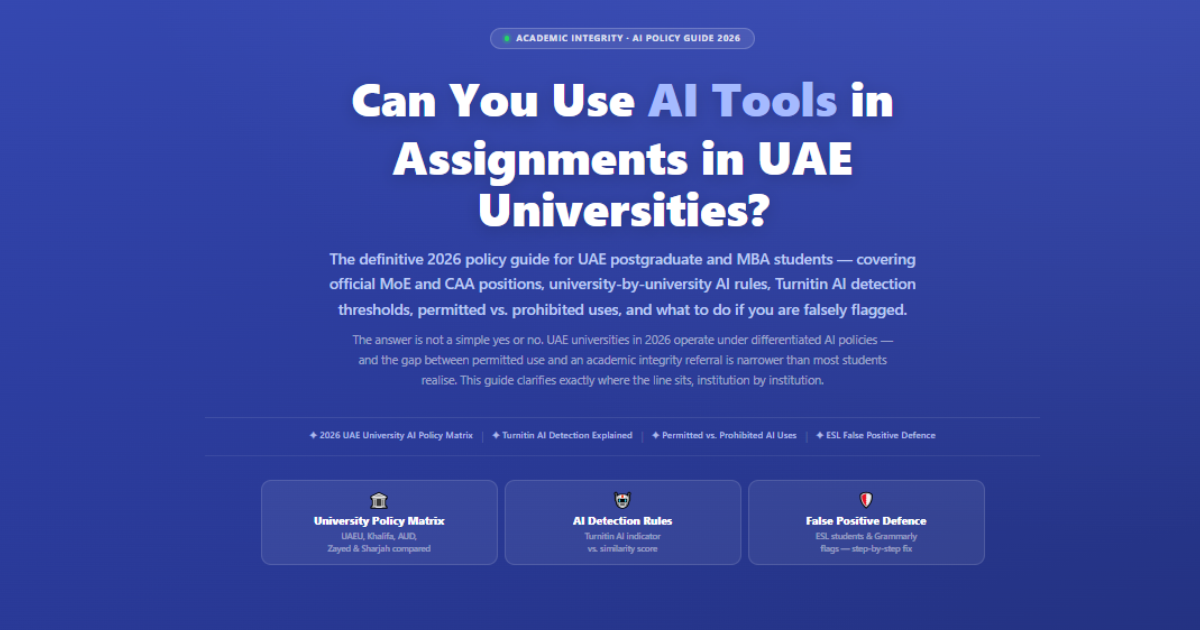
هل يمكن استخدام أدوات الذكاء الاصطناعي
في الواجبات الجامعية بالإمارات؟
دليل سياسات 2026 لطلاب الدراسات العليا وماجستير إدارة الأعمال في جامعات الإمارات — يغطي الموقف الرسمي لوزارة التعليم وهيئة الاعتماد الأكاديمي، وجدول مقارنة سياسات الجامعات، وآليات كشف Turnitin، واستخدامات الذكاء الاصطناعي المسموح بها والمحظورة.
الإجابة ليست "نعم" أو "لا" بشكل مطلق. تعمل جامعات الإمارات في عام 2026 وفق سياسات متباينة للذكاء الاصطناعي — والفارق بين الاستخدام المسموح به وبين الإحالة إلى لجنة النزاهة الأكاديمية أضيق مما يدركه كثير من الطلاب. ما يبقى ثابتاً عبر جميع المؤسسات هو المبدأ التوجيهي لوزارة التعليم: يجوز للذكاء الاصطناعي أن يدعم عملية التعلم، لكنه لا يحلّ محل الإنتاج الفكري للطالب في العمل المُسلَّم.
يعمل Turnitin في 2026 عبر طبقتي كشف مستقلتين: درجة التشابه التي ترصد النص المنسوخ أو المُقتبَس بنيوياً، و مؤشر الكتابة بالذكاء الاصطناعي الذي يحلل الأنماط اللغوية والتوزيع الإحصائي للجمل بصورة مستقلة تماماً. تظهر كلتا النتيجتين أمام أعضاء هيئة التدريس في آنٍ واحد — ودرجة تشابه صفرية لا تُشكّل أي حماية من علامة الذكاء الاصطناعي.
موقف وزارة التعليم وهيئة الاعتماد الأكاديمي — 2026
-
إطار وزارة التعليم: يجوز استخدام الذكاء الاصطناعي لدعم التفكير والبحث ومراجعة اللغة — أما أي محتوى مُولَّد بالذكاء الاصطناعي يُدرَج في التسليم النهائي دون إفصاح وموافقة صريحة، فيُصنَّف مخالفةً للنزاهة الأكاديمية وفق المبادئ التوجيهية لوزارة التعليم 2026.
-
اشتراط هيئة الاعتماد الأكاديمي: تُلزم هيئة الاعتماد الأكاديمي جميع المؤسسات المعتمدة بامتلاك سياسات نزاهة أكاديمية صريحة تتناول المحتوى المُولَّد بالذكاء الاصطناعي وتطبيقها فعلياً — وهذا ما يُفسّر تحرك الجامعات الإماراتية من اللغة التحذيرية إلى منظومة الكشف القابلة للتنفيذ في 2026.
-
تباين السياسات بين الجامعات: لا توجد سياسة إماراتية موحدة للذكاء الاصطناعي في المهام الأكاديمية. تُطبّق جامعة الإمارات وجامعة خليفة وجامعة زايد وجامعة الشارقة قيوداً صارمة على استخدام الذكاء الاصطناعي في الصياغة، بينما تُتيح الجامعة الأمريكية في دبي مرونةً محدودة على مستوى المقررات في بعض برامج ماجستير إدارة الأعمال.
الاستخدامات المسموح بها والمحظورة — الإطار الأخضر والأحمر
- العصف الذهني واستكشاف الأفكار الأولية
- رسم هيكل الفصول والمحاور البحثية
- مراجعة القواعد اللغوية والإملائية فقط
- استيعاب مفاهيم SPSS وأخطاء الكود
- اكتشاف الكلمات المفتاحية البحثية الأولية
- صياغة أي فقرات أو أقسام للتسليم
- إعادة صياغة مصادر مراجعة الأدبيات
- توليد قوائم المراجع والاستشهادات
- تفسير نتائج SPSS أو NVivo للتسليم
- الترجمة غير المُعلَنة من العربية إلى الإنجليزية
الأخطاء الثلاثة التي تُفضي إلى لجنة النزاهة الأكاديمية
-
الاستخدام غير المُعلَن: عدم الإفصاح عن استخدام أي أداة ذكاء اصطناعي حين يستوجب ذلك نظام المؤسسة يُصنَّف إخفاءً متعمداً — وهو أشد خطورةً من مخالفة الانتحال الأدبي وتحمل عقوبات أكثر صرامة في جامعة الإمارات وجامعة خليفة.
-
المراجع الوهمية: تقديم قوائم مراجع مُولَّدة بالذكاء الاصطناعي دون التحقق منها يُصنَّف غشاً أكاديمياً لا مجرد خطأ في التوثيق — ومعلم واحد غير قابل للتحقق كافٍ لإطلاق تحقيق شامل في النزاهة.
-
التفاوت الأسلوبي: وجود فجوة واضحة في مستوى الطلاقة والدقة بين فصول العمل الواحد يُثير تساؤلات حول الكاتب الحقيقي — حتى حين تكون درجة الذكاء الاصطناعي في Turnitin ضمن الحد المقبول.
تقدم Labeeb Writing & Designs دعماً أكاديمياً تكوينياً متوافقاً مع إطار وزارة التعليم الإماراتية 2026 ومعايير هيئة الاعتماد الأكاديمي — يشمل مراجعة درجة الذكاء الاصطناعي في Turnitin، والتحقق من المراجع عبر Scopus، ومراجعة الاتساق الأسلوبي، وصياغة إفصاحات الذكاء الاصطناعي المناسبة لكل مؤسسة — وكل ذلك قبل موعد التسليم مع الحفاظ التام على ملكيتك الفكرية لعملك.
Need AI Compliance Review Before Your Submission Deadline?
Send your draft on WhatsApp — Labeeb reviews your AI writing score, verifies every reference, and returns a fully compliant submission-ready draft before your deadline.