
Group Assignments in UAE Universities:
Challenges & Solutions
Collaborative work carries significant academic weight at UAEU, Khalifa University, AUD, and Zayed University — yet most students are underprepared for the real risks that come with it in 2026.
From free-rider conflicts and AI liability exposure to Turnitin group submission rules and peer evaluation scoring, this guide covers every critical challenge — and the strategies that actually resolve them at the postgraduate and MBA level.
group submission rules
compliance for groups
& referencing strategy
What UAE Students Must Know About Group Assignments in 2026
Group assignments carry 25%–40% of final grades at many UAE universities. Yet few students enter collaborative work with a clear understanding of the academic, technical, and integrity risks involved — particularly at the postgraduate and MBA level.
The biggest challenges in UAE group assignments are unequal contribution, AI-use liability under the 2026 MoE framework, Turnitin’s Match Group detection, and multicultural communication gaps. Addressing these early — through structured role division, shared referencing, and pre-submission integrity checks — is what separates high-scoring groups from those facing academic risk.
Group assignments form a substantial portion of final module grades — making failure within the group a serious academic risk for every member.
If one group member uses generative AI without disclosure and a prompt log, all members are collectively liable under current UAE Ministry of Education guidelines.
Turnitin now categorises shared text across group submissions separately from plagiarism — but collusion flags remain a risk when sections are drafted collectively without proper attribution.
Multinational cohorts at AUD, Zayed University, and University of Sharjah introduce communication dynamics that directly affect workload distribution and submission consistency.
⚠️ The Five Risks Most Groups Underestimate
- Free-rider exposure: Peer evaluation rubrics at UAE universities increasingly carry individual grade weight — poor documentation of contribution can lower personal scores even when the group performs well.
- AI liability without consent: A single teammate using ChatGPT without group agreement or disclosure can trigger an integrity review for the entire submission.
- Inconsistent writing styles: When sections are written by different members and merged without editing, Turnitin may flag stylistic inconsistencies — and supervisors notice quality gaps that affect marks.
- Referencing inconsistency: Mixed APA 7th and Harvard citations within a single submission are among the most common reasons for grade deductions in MBA capstone group projects.
- Late data analysis: Groups that assign SPSS or NVivo work to one member without a shared timeline routinely submit incomplete or incorrectly interpreted results — a critical flaw at the postgraduate level.
The Real Challenges Behind Group Assignments in UAE Universities
Group assignments are not simply shared workloads. At the postgraduate level in the UAE, they involve coordinated academic integrity, policy compliance, cross-cultural communication, and technical output — all assessed under increasingly rigorous university standards.
How UAE Universities Structure Group Assessments
Group assignments at UAE institutions are not informal collaborations. They are formally assessed components with defined rubrics, contribution expectations, and in many cases, individual peer evaluation scores that affect personal grades independent of the group outcome.
At institutions such as Khalifa University, UAEU, and the American University in Dubai, group work typically contributes between 25% and 40% of a module’s total grade. MBA capstone and research methods courses often assign even greater weight, particularly where the deliverable includes primary data collection or SPSS-based analysis.
| Assessment Type | Typical Weight | Common at |
|---|---|---|
| Group Research Report | 25–35% | UAEU, Zayed University, AUD |
| MBA Capstone Group Project | 30–40% | Khalifa University, BUiD, AUD |
| Group Presentation + Written Report | 20–30% | University of Sharjah, Zayed University |
| Peer Evaluation Component | 5–15% (individual) | Increasingly standard across UAE institutions |
Peer evaluation scores are now weighted individually at several UAE universities — meaning a student can score lower than their group even when the final submission is strong, if documented contribution is poor.
The Free-Rider Problem: Why It Is Worse at Postgraduate Level
Unequal contribution — commonly called the free-rider problem — is the most frequently cited source of conflict in UAE group assignments. At undergraduate level it is disruptive. At postgraduate and MBA level, it carries direct academic and professional consequences.
Working professionals enrolled in part-time MBA programmes at institutions such as BUiD or Khalifa University often have asymmetric availability. When one member’s workload capacity is significantly lower than others, the imbalance tends to concentrate on the most capable members — increasing their risk of rushed, lower-quality output under deadline pressure.
The most effective protection against free-rider risk is a documented Role Division Matrix created at the outset — assigning tasks, internal deadlines, and individual accountability markers before a single word is written.
Multicultural Dynamics on UAE Campuses
UAE university cohorts are among the most nationally diverse in the world. Campus groups at AUD, University of Sharjah, and Zayed University routinely include students from 15 to 30 different nationalities within a single intake.
This diversity is academically enriching but operationally complex. Differences in academic writing conventions, communication norms, time management expectations, and attitudes toward group hierarchy can silently undermine collaboration — particularly in the absence of a structured workflow.
The most common friction point is not intent but expectation: students from different educational backgrounds hold different assumptions about what constitutes adequate contribution, acceptable referencing style, and appropriate writing register for a formal academic submission.
AI Use in Group Submissions: The 2026 Liability Gap
The UAE Ministry of Education’s 2026 framework permits the use of generative AI as a “supportive tool” in higher education — but only when disclosed with a documented prompt log and approved by the course instructor. This creates a specific liability gap in group contexts.
If one group member uses ChatGPT or a similar tool to draft their assigned section without informing others or obtaining instructor approval, the entire group’s submission can be flagged under academic integrity policies. The fact that other members were unaware provides limited protection once a Turnitin AI report or ZeroGPT indicator returns a high score.
At institutions including Khalifa University and UAEU, undisclosed AI use in a group submission is treated as a collective integrity violation. All members may face the same academic misconduct process regardless of individual responsibility.
The practical solution is a group AI agreement — a documented internal policy the group agrees on before starting, specifying whether AI tools will be used, under what conditions, and how disclosure will be handled in the submission.
A Structured Framework for High-Scoring Group Work
Most group assignment failures are not academic failures — they are process failures. The three-step framework below addresses the operational gaps that cause the majority of grade losses and integrity risks in UAE university group submissions.
The Role Division Matrix
Before any writing begins, every group member must have a documented role with specific deliverables and internal deadlines. This is not an informal agreement — it is a written matrix shared across the group and referenced during peer evaluation.
The Role Division Matrix should assign the following for each member:
- Specific sections or subsections they are responsible for drafting
- Internal submission deadline (minimum 72 hours before the university deadline)
- Data or research tasks they own (literature search, SPSS runs, survey design)
- AI agreement status: whether generative AI tools will be used and how disclosure will be handled
- Peer evaluation self-log: a running record of contributions each member maintains throughout the project
Shared Data Analysis Protocol
For MBA capstone and research-based group assignments, data analysis is the highest-risk component. Assigning it to a single member without a shared protocol routinely produces two problems: incorrect interpretation if that member lacks SPSS or NVivo proficiency, and bottleneck delays that compress the rest of the group’s writing time.
The shared data analysis protocol requires that:
- All raw data files (SPSS .sav, Excel, or NVivo .nvp) are stored in a shared drive accessible to every member
- The analysis plan (which tests, which variables, which thresholds) is agreed in writing before running any outputs
- Results are reviewed collectively before being integrated into the written report — interpretation errors caught early save significant revision time
- A second member independently verifies the statistical outputs against the written findings section before submission
Centralised Referencing System
Mixed referencing styles are among the most common reasons for mark deductions in group submissions across UAE universities. When each member manages their own citations independently, inconsistencies in APA 7th edition formatting, Harvard punctuation, and in-text citation style are almost inevitable.
A centralised referencing system resolves this by establishing one shared Zotero, Mendeley, or Endnote library at the start of the project. All members add sources to this single library, and one designated member is responsible for final reference list compilation and format verification before submission.
- One shared reference library (Zotero or Mendeley recommended for UAE students)
- Referencing style confirmed with course instructor before writing begins
- One member designated as reference auditor for the final submission check
- In-text citations cross-checked against the reference list for completeness and accuracy
Turnitin 2026: What Groups Need to Understand
Turnitin’s Match Group categorisation distinguishes shared text between group members from external plagiarism — but it does not eliminate collusion risk. Understanding the difference is critical before submission.
Sections drafted collectively in one shared document and then split between members — Turnitin may flag this as collusion even when intentional sharing was permitted.
Each member drafts their section independently, with shared data and referencing managed separately. Final unification editing done post-merge by one designated editor.
Undisclosed AI-generated text within any section — Turnitin’s AI writing indicator operates at the individual paragraph level and will flag sections regardless of which member wrote them.
Running a group draft through Turnitin’s draft submission feature (where available) before the final upload — allows the group to identify and resolve similarity issues proactively.
What High-Scoring Groups Actually Do Differently
The difference between a group that scores a distinction and one that narrowly passes rarely comes down to individual knowledge. It comes down to coordination, documentation, and submission readiness. These are the practical habits that separate the two.
Every member submits their section to the shared draft at least 72 hours before the university deadline. This window allows the designated editor to unify tone, fix referencing gaps, and run a final Turnitin draft check without time pressure.
Deadline ManagementDesignate one group member as the final editor — responsible for merging all sections, standardising tone, and eliminating inconsistencies in writing style. This role is separate from writing responsibilities and is critical for a coherent submission.
Quality ControlKeep a brief written record of every group meeting: what was decided, who is responsible, and by when. This log serves as evidence during peer evaluation disputes and provides protection if a free-rider issue escalates to faculty level.
AccountabilityDraft a one-paragraph internal AI agreement at the group’s first meeting. State clearly whether AI tools will be used, under what conditions, and how disclosure will appear in the submission. Share it with all members via the group chat so there is a timestamped record.
Integrity ComplianceWork in one shared Google Doc or Microsoft 365 file from the outset. Version-controlled, cloud-based collaboration eliminates the confusion of multiple file copies, tracks individual contributions automatically, and simplifies the final merge process.
Collaboration ToolsBefore merging individual sections, each member checks their contribution against the agreed word allocation. Over-written sections need trimming before the editor receives the full draft — catching this early prevents the common problem of submissions that exceed the word limit after merging.
Submission Readiness🔧 Recommended Collaboration Tools for UAE Students
Real-time collaborative editing with version history and contribution tracking. Accessible on any device — the most widely used tool among UAE postgraduate students for multi-author documents.
Free reference management tool with shared group library functionality. All members add sources to one library — eliminating the referencing inconsistency that commonly costs marks in group submissions.
For MBA and research-based capstone groups, SPSS output files (.spv) should be shared alongside the .sav data file so all members can review results independently before they are written into the report.
Where permitted by the course instructor, submit the merged draft to Turnitin at least 48 hours before the final deadline. Review the similarity report as a group and resolve flagged sections before the graded submission.
Suggested Group Assignment Timeline (3-Week Project)
Days 1–3
Setup: Role Division Matrix completed, shared document created, referencing library opened, AI agreement documented, analysis plan agreed.
Days 4–7
Research: Literature review sources added to shared Zotero library, data collection tools designed or sourced, SPSS variables defined.
Days 8–14
Writing: Each member drafts their assigned section independently. Data analysis runs completed and shared with the group for collective review by Day 12.
Days 15–18
Merging & Editing: All sections submitted to the designated editor. Full document merged, tone unified, referencing audited, word count verified.
Days 19–20
Final Check: Turnitin draft submission reviewed, similarity resolved, formatting confirmed against university guidelines. Final version uploaded by Day 20 — 72 hours before the actual deadline.
The 72-hour internal deadline rule is the single most effective habit high-scoring groups share. It converts deadline pressure into editing time — and editing time into distinction-level submissions.
Why Group Assignment Support Requires UAE-Specific Expertise
Generic academic advice does not account for the CAA accreditation standards, Turnitin policies, and MoE AI frameworks that govern submissions at UAE universities. The strategic gap most groups face is not effort — it is knowing exactly what the local academic environment requires.
The Real Reason Groups Lose Marks in UAE Universities
At the postgraduate and MBA level, the most common source of group assignment grade loss is not weak individual knowledge — it is a submission that lacks cohesion. Sections written by different members, with different citation styles, different tones, and inconsistent depth, signal to the examiner that the group did not function as an academic unit.
UAE university assessors, particularly at CAA-accredited institutions, apply rubrics that explicitly grade for consistency, integration of argument, and structural flow across the whole document. A technically strong individual section does not compensate for a submission that reads as a collection of unrelated parts.
This is the gap that professional editing and academic support directly addresses — not by writing for students, but by ensuring the submission meets the standard the group’s effort deserves.
All support follows Commission for Academic Accreditation guidelines applied at UAE-licensed institutions
Editing that improves cohesion and academic register without altering the group’s original arguments or data
Support structured around UAE university academic calendars and submission deadlines — not generic global timelines
Why UAE Students Choose Labeeb for Group Assignment Support
Labeeb Writing & Designs works exclusively within the UAE academic context — understanding the specific requirements, policies, and expectations of each institution our students attend.
-
Group Submission Editing
We unify tone, standardise referencing, and ensure the full document reads as a single coherent academic submission — eliminating the multi-author inconsistency that costs marks at postgraduate level.
-
Data Analysis for Capstone Groups
SPSS and NVivo analysis support for MBA and research-based group projects — including output interpretation and findings-to-text alignment to ensure statistical results are accurately reported.
-
Pre-Submission Integrity Review
We identify unintended similarity, inconsistent citation patterns, and potential AI-detection flags before the group submits — giving every member confidence in the integrity of the final document.
-
University-Specific Formatting
Formatting aligned to the exact guidelines of AUD, UAEU, Khalifa University, Zayed University, BUiD, and University of Sharjah — including citation style, cover page requirements, and submission format.
Need Help With Your Group Assignment?
Whether your group needs editing support, data analysis, referencing unification, or a pre-submission integrity review — Labeeb provides UAE-specific academic support built around your deadline.
Replies within 15 minutes during working hours (Dubai time)
The Mistakes UAE Groups Make — and How to Avoid Them
Most group assignment failures at UAE universities are predictable and preventable. The eight mistakes below account for the majority of grade losses, integrity flags, and submission rejections seen at the postgraduate and MBA level.
Starting Without a Written Role Division Agreement
Verbal agreements about who does what dissolve under deadline pressure. Without a written Role Division Matrix, contribution disputes surface late — often after the submission — and peer evaluation scores become contested with no documentary basis.
Fix: Document the role matrix in the shared Google Doc at the first meeting. Include section ownership, internal deadlines, and data responsibilities. Share it in the group chat to create a timestamped record.
Merging Sections on the Day of the Deadline
Last-minute merging is among the most common causes of formatting errors, referencing inconsistencies, and word count violations in group submissions. When sections arrive from multiple members simultaneously, the editing quality collapses under time pressure.
Fix: Set a firm internal merge deadline 72 hours before submission. The designated editor needs uninterrupted time to unify tone, check formatting, and run a Turnitin draft review before the final upload.
Allowing One Member to Handle All Referencing Independently
When each member manages their own in-text citations in isolation, the final reference list almost always contains mixed styles, missing entries, and inconsistent formatting. At CAA-accredited UAE universities, referencing errors directly reduce marks under academic writing rubrics.
Fix: Use a shared Zotero or Mendeley group library from day one. One member audits the final reference list against in-text citations before submission — catching omissions and style errors before the examiner does.
Not Addressing AI Use as a Group Before Writing Begins
Under the UAE MoE 2026 framework, undisclosed AI use in a group submission exposes all members to an integrity review — regardless of who used the tool. A single paragraph flagged by Turnitin’s AI indicator can trigger a misconduct process for the entire group.
Fix: Draft a one-paragraph internal AI agreement at the first meeting. State clearly whether AI tools will be used, under what conditions, and how disclosure will appear in the submission. All members must acknowledge this in writing before drafting begins.
Assigning SPSS or Data Analysis to One Member Without Oversight
When data analysis is siloed to a single member and that member lacks SPSS proficiency — or runs out of time — the consequences affect the entire submission. Incorrect statistical tests, misread outputs, or findings that do not align with the written discussion are among the most penalised errors at MBA level.
Fix: Store all raw data files in the shared group drive. A second member independently reviews the SPSS or NVivo outputs before they are written into the report. If the group lacks confidence in the analysis, professional support is a legitimate and widely used option.
Submitting Without a Pre-Submission Integrity Review
Most UAE university groups submit the merged document directly without running it through a draft Turnitin check. Similarity issues that could have been resolved in 30 minutes become permanent marks on the academic record once the graded submission is uploaded.
Fix: Where the course allows draft submissions, use that function at least 48 hours before the deadline. Review the full similarity report as a group — not just the percentage — and address any flagged sections before final upload.
Ignoring University-Specific Formatting Requirements
Formatting requirements vary between UAE institutions and sometimes between departments within the same university. Groups that apply generic formatting — or replicate formatting from a previous assignment — routinely lose marks on cover page, margin, heading hierarchy, and appendix structure requirements.
Fix: Download the current assignment brief and cross-reference every formatting requirement against the final merged document before submission. This check should be part of the designated editor’s final review — not an afterthought.
Failing to Keep a Record of Individual Contributions
Peer evaluation at UAE universities increasingly carries individual grade weight. Without a contemporaneous contribution log, students who worked disproportionately hard have no evidence to present if a dispute arises — and students who under-contributed cannot be held academically accountable.
Fix: Each member maintains a brief weekly contribution log in the shared document. This records what was done, when, and by whom. Google Doc edit history provides automatic corroboration at the version level.
Academic Strategy: How to Approach Group Work at Postgraduate Level
The strategic shift that separates high-performing postgraduate groups from the rest is treating the group assignment as a professional project — not a shared homework task. These four principles underpin that shift.
Treat every decision, task, and deadline as a formal project record. Documentation protects every member and raises the quality of the submission.
The final submission must read as a single document, not a collection of individual sections. Designate one editor and give them time to do the job properly.
Do not wait for Turnitin to flag problems. Address AI use, similarity risk, and citation accuracy before the submission deadline — not after.
The 72-hour internal deadline rule is non-negotiable at distinction level. Every high-scoring group builds editing and review time into the schedule from the outset.
A group assignment that is well-coordinated, integrity-compliant, and consistently formatted will consistently outscore a group with stronger individual knowledge but weaker process discipline. At UAE postgraduate level, process is part of the assessment.
Group Assignments Are Won Before the Writing Starts
The outcome of most UAE university group assignments is determined not by what happens at the keyboard, but by the decisions made in the first meeting — or the absence of those decisions entirely.
Key Takeaways from This Guide
- 1 Group assignments carry serious academic weight at UAE postgraduate level — typically 25–40% of final module grades, with peer evaluation components that affect individual scores independently of the group outcome.
- 2 The 2026 UAE MoE AI framework creates collective liability. Undisclosed AI use by any single member can trigger an integrity review for the entire group. A documented internal AI agreement is now a non-negotiable first step.
- 3 A written Role Division Matrix eliminates the free-rider problem before it starts. Document section ownership, internal deadlines, and data responsibilities at the first meeting — not after conflict arises.
- 4 Data analysis is the highest-risk component in MBA and research-based group projects. Shared data files, a collective analysis plan, and independent verification of outputs are the standard at distinction level.
- 5 The 72-hour internal deadline rule is the single most effective habit of high-scoring groups. It converts last-minute pressure into editing time — and editing time into a cohesive, consistently formatted submission.
- 6 Process discipline separates distinction groups from borderline passes. UAE university assessors at CAA-accredited institutions grade for cohesion, integration, and structural consistency across the full submission — not just individual section quality.
Group assignments at Khalifa University, UAEU, AUD, Zayed University, and BUiD reward students who treat collaborative academic work as a structured professional exercise. The framework, tools, and strategies outlined in this guide are not theoretical — they are the operational habits consistently demonstrated by UAE students who perform at the top of their cohort.
If your group is approaching a submission deadline and needs editing support, data analysis, referencing unification, or a pre-submission integrity review, Labeeb Writing & Designs provides UAE-specific academic support built around your exact university requirements and timeline.
Need Help With Your Group Assignment?
From group submission editing and referencing unification to SPSS data analysis and pre-submission integrity checks — Labeeb provides expert academic support for UAE postgraduate and MBA students.
Replies within 15 minutes during working hours (Dubai time)
Group Assignments in UAE Universities (2026): FAQs
Clear answers for UAE postgraduate and MBA students on Turnitin, AI use, grading policies, and academic integrity.
In most UAE universities, group assignments contribute 25% to 40% of final grades, especially in MBA and postgraduate modules.
Many CAA-accredited universities (UAEU, Khalifa University, AUD, University of Sharjah) also include peer evaluation (5–15%), meaning your individual contribution directly impacts your final score.
Under UAE academic integrity policies (aligned with Ministry of Education AI frameworks), undisclosed AI usage is treated as a group violation.
This means:
- All group members may face penalties
- Turnitin AI detection can flag specific sections
- Entire submission may be investigated
Even if only one student used AI, the responsibility is shared across the group.
Turnitin identifies shared content using Match Group filtering, but risks still exist.
Common issues include:
- Shared drafting → flagged as collusion
- AI-generated sections → flagged regardless of similarity
- Poor referencing → increases similarity score
Recommended approach:
- Assign sections individually
- Use one editor to merge final document
- Run Turnitin draft check before submission
UAE universities require documented evidence to take action against non-contributing members.
- Track tasks using a role division matrix
- Keep written communication (WhatsApp/email)
- Use Google Docs edit history as proof
- Inform instructor before submission deadline
Peer evaluation systems are specifically designed to penalize free-riders.
Yes — academic support services are allowed within ethical limits at UAE universities.
Permitted support includes:
- Editing & proofreading
- Formatting & referencing (APA / Harvard)
- SPSS / NVivo data analysis guidance
- Turnitin review & improvement
However, ghostwriting or full assignment writing is prohibited.
For MBA and postgraduate research projects in UAE, SPSS should follow a shared and transparent workflow.
- Store datasets in shared drive
- Agree on statistical tests beforehand
- Share SPSS outputs (.spv files)
- Cross-check results before writing
Students must understand and interpret results — not just generate outputs.
Yes — many UAE postgraduate students use pre-submission review services to improve quality and reduce risk.
- Turnitin similarity reduction
- Reference audit (APA / Harvard)
- Structure and flow improvement
- Final proofreading before submission
This is especially useful for MBA group projects where grades carry high weight.
Stuck on your group assignment or Turnitin issue?
Get quick guidance before your deadline — our academic team responds within 15 minutes (Dubai time).
Ask on WhatsApp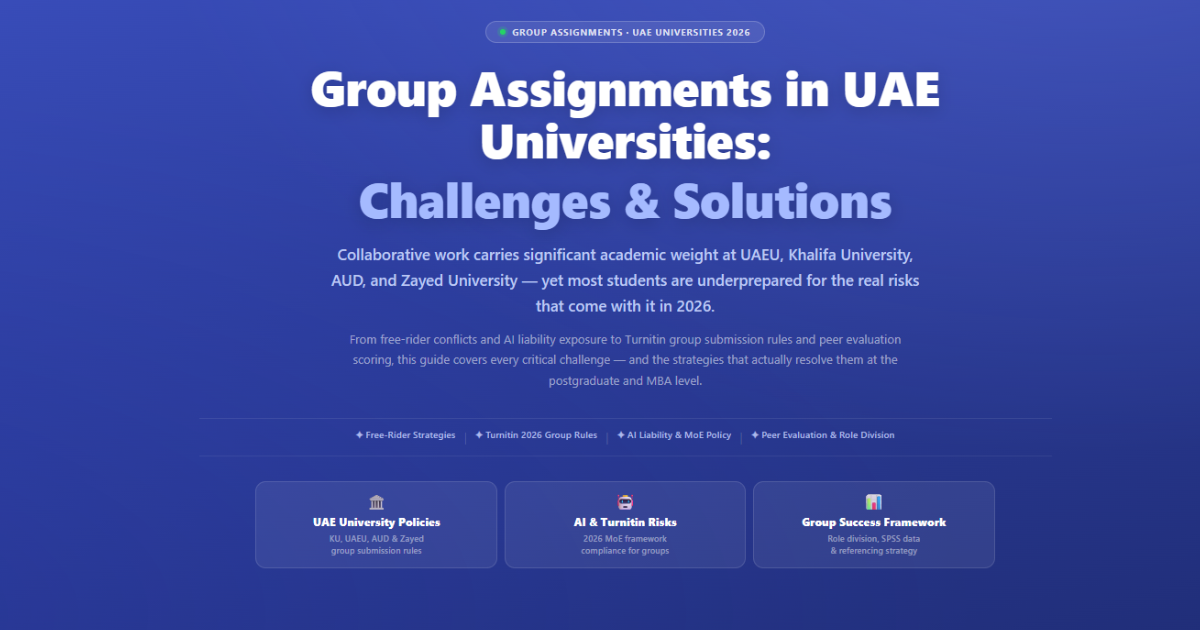
العمل الجماعي في الجامعات الإماراتية: التحديات والحلول
تُشكّل مهام العمل الجماعي ما بين ٢٥٪ و٤٠٪ من الدرجات النهائية في كثير من جامعات الإمارات، من بينها جامعة الإمارات العربية المتحدة وجامعة خليفة والجامعة الأمريكية في دبي وجامعة زايد. غير أن كثيرًا من الطلاب في مرحلة الدراسات العليا وبرامج الماجستير في إدارة الأعمال يواجهون هذه المهام دون استعداد كافٍ للمخاطر الأكاديمية والتقنية التي تنطوي عليها.
-
مصفوفة تقسيم الأدوار: قبل البدء في الكتابة، يجب توثيق مسؤوليات كل عضو في المجموعة وتحديد المواعيد الداخلية والمهام البحثية في وثيقة مشتركة، وذلك منذ الاجتماع الأول. يُعدّ هذا الإجراء الأكثر فاعلية في الحدّ من ظاهرة التقاعس عن المشاركة وتجنّب النزاعات المتعلقة بالتقييم بين الأقران.
-
المسؤولية الجماعية عن استخدام الذكاء الاصطناعي: وفقًا لإطار عمل وزارة التربية والتعليم الإماراتية لعام ٢٠٢٦، يُعدّ استخدام أدوات الذكاء الاصطناعي التوليدي دون الإفصاح عنه انتهاكًا جماعيًا لنزاهة الأعمال الأكاديمية. وإذا أقدم أحد أعضاء المجموعة على ذلك دون إخطار الآخرين أو الحصول على موافقة الأستاذ المسؤول، فقد يُعرّض جميع الأعضاء لإجراءات المساءلة الأكاديمية.
-
قواعد تورنتن للمجموعات في ٢٠٢٦: يتيح نظام تورنتن الجديد تصنيف المحتوى المشترك بين أعضاء المجموعة بمعزل عن الاقتباس الخارجي، إلا أن ذلك لا يُلغي خطر الاشتباه في التواطؤ. كما يعمل مؤشر الكتابة الآلية بالذكاء الاصطناعي على مستوى الفقرة، ويُحدّد المحتوى المُنشأ آليًا في أي قسم من أقسام المستند الموحّد.
-
بروتوكول التحليل الإحصائي المشترك: يُعدّ تحليل البيانات باستخدام برنامج SPSS أو NVivo أعلى مكوّنات مشاريع ماجستير إدارة الأعمال خطورةً حين يُحال إلى عضو واحد دون إشراف. يتعين تخزين جميع ملفات البيانات الخام في مساحة تخزين مشتركة، ومراجعة نتائج التحليل جماعيًا قبل إدراجها في التقرير.
-
نظام التوثيق والمراجع المركزي: يُفضي اعتماد كل عضو على مصادره الخاصة بصورة منفردة إلى تضارب أنماط التوثيق وثغرات في قائمة المراجع. يُوصى باستخدام مكتبة مشتركة في Zotero أو Mendeley منذ بداية العمل، مع تكليف عضو واحد بمراجعة قائمة المراجع النهائية قبل التسليم.
-
قاعدة المهلة الداخلية الـ٧٢ ساعة: تُسلّم جميع الأقسام المكتوبة إلى المحرر المعيّن قبل ٧٢ ساعة على الأقل من الموعد النهائي للجامعة. تمنح هذه المهلة وقتًا كافيًا لتوحيد الأسلوب، وتصحيح المراجع، وإجراء فحص مبدئي على تورنتن قبل التسليم الرسمي.
تتفوق المجموعات المنضبطة في عملها على المجموعات التي تمتلك معرفة فردية أعمق حين تفتقر إلى التنسيق. إذ تمنح الجامعات الإماراتية المعتمدة من هيئة الاعتماد الأكاديمي درجاتٍ صريحةً للتماسك والتكامل والاتساق في التنسيق عبر المستند بأكمله — وليس لجودة كل قسم على حدة.