
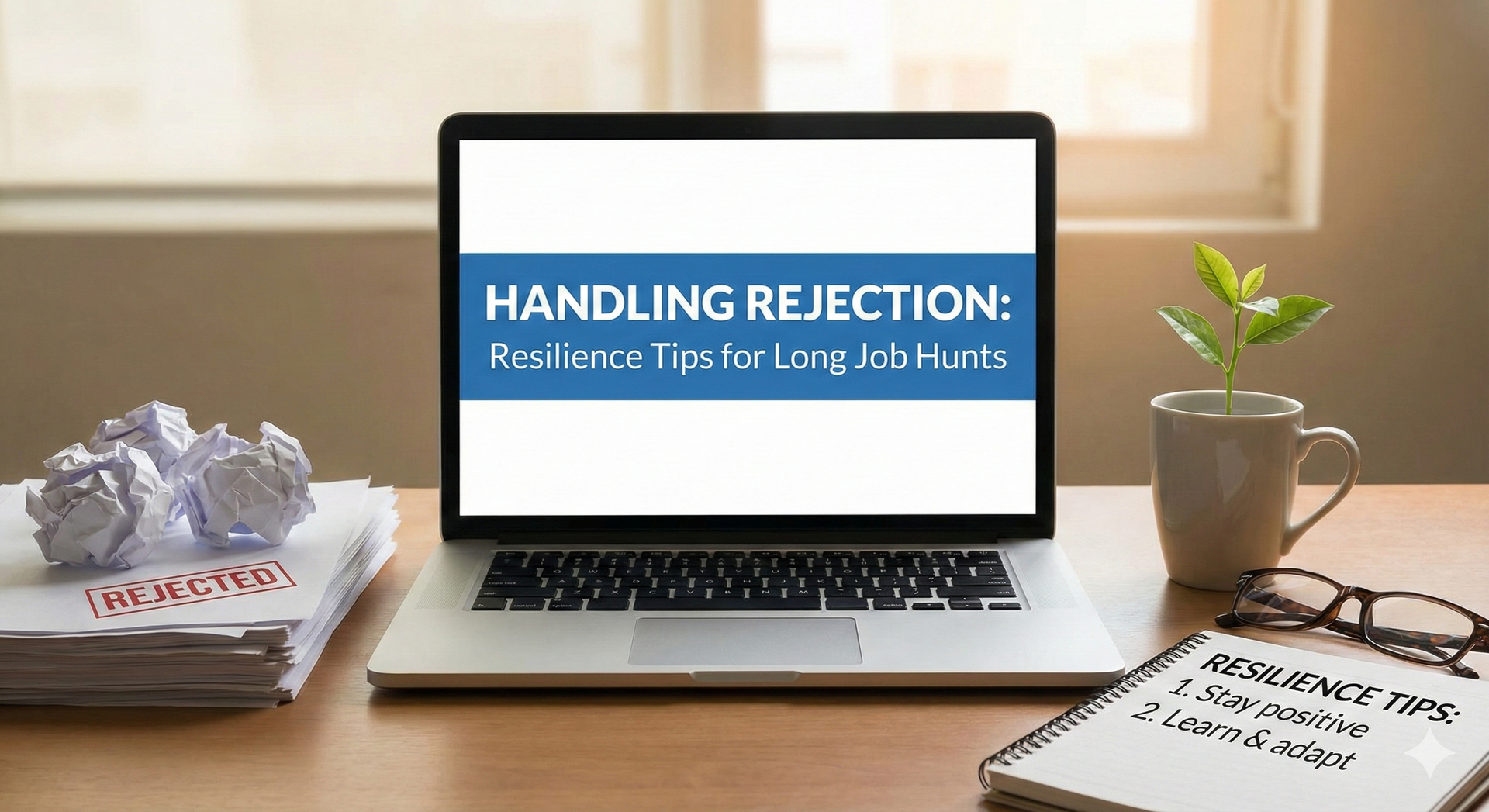
Handling Rejection: Resilience Tips for Long Job Hunts
Introduction: Why Rejection Is Part of the UAE Job Search Journey
Job rejection is one of the most emotionally draining parts of a prolonged job search—especially in the UAE, where competition is intense and feedback is limited.
From personally supporting 5,000+ UAE professionals through extended job hunts in 2025–2026, one reality is clear: rejection is not a reflection of failure. It is often a signal of misalignment, timing, or strategy gaps, not capability.
Professionals who understand how to process rejection constructively—and adjust intelligently—eventually outperform equally skilled peers who quit too early or lose confidence.
This guide focuses on resilience with strategy: how to manage rejection psychologically and correct the factors causing it.
Why Job Rejection Feels Harder in the UAE
Rejection in the UAE job market has unique characteristics.
Limited Feedback Increases Self-Doubt
Most UAE employers:
- Do not provide rejection reasons
- Communicate late or not at all
- Handle high applicant volumes
Silence creates uncertainty, which often leads to overthinking and self-blame.
Visa, Time, and Financial Pressure Amplify Stress
Unlike many markets, UAE job searches often involve:
- Visa timelines
- Family responsibilities
- Relocation or housing commitments
This pressure makes rejection feel personal—even when it is procedural.
The Most Important Reframe: Rejection Is Data, Not Judgment
High-performing job seekers treat rejection as feedback signals, not verdicts.
Every rejection answers at least one question:
- Was the role aligned?
- Did the CV pass ATS?
- Was the interview positioning strong?
- Was timing a factor?
Without this mindset shift, resilience turns into frustration instead of progress.
Step 1: Separate Emotional Response From Strategic Action
Feeling disappointed is normal. Acting while emotional is damaging.
What to Do Immediately After Rejection
- Pause before reacting
- Avoid impulsive CV changes
- Do not send emotional messages
- Record the rejection objectively
Professionals who respond calmly preserve confidence and clarity.
Step 2: Identify the Type of Rejection
Not all rejections mean the same thing.
Application-Stage Rejection
Often indicates:
- ATS misalignment
- Keyword gaps
- Seniority mismatch
Interview-Stage Rejection
Often indicates:
- Communication issues
- Weak value articulation
- Cultural fit concerns
Understanding the stage helps determine the fix.
Step 3: Audit Your CV and Role Targeting
Repeated early-stage rejections often trace back to the CV.
Ask:
- Is my CV aligned to this role category?
- Am I targeting the correct seniority level?
- Are achievements clearly quantified?
An ATS-aligned CV dramatically reduces silent rejections.
👉 Internal reference: https://www.labeeb.ae/professional-cv-writing
Step 4: Reassess LinkedIn Visibility and Positioning
Many professionals overlook LinkedIn as a rejection signal.
Low recruiter reach often means:
- Weak headline keywords
- Misaligned job titles
- Inconsistent experience presentation
If recruiters are not viewing or contacting you, visibility—not experience—is the issue.
👉 Internal reference: https://www.labeeb.ae/linkedin-profile-optimization
Step 5: Evaluate Interview Performance Objectively
Interview rejection hurts most—but it is also the most valuable data point.
Post-Interview Self-Review Questions
- Did I answer concisely or over-explain?
- Did I quantify impact clearly?
- Did I align answers to business outcomes?
- Did I demonstrate confidence without arrogance?
Structured reflection prevents repeated mistakes.
Step 6: Avoid the Most Dangerous Reaction—Overcorrection
After rejection, many professionals:
- Rewrite CVs excessively
- Change job targets impulsively
- Lower standards prematurely
These reactions reduce consistency and credibility.
Smart adjustments are measured, not emotional.
Step 7: Build Psychological Resilience During Long Searches
Resilience is not motivation—it is stability.
Practical Resilience Techniques
- Maintain a daily routine
- Separate job search hours from personal time
- Avoid constant job portal scrolling
- Track progress objectively
Sustainable energy matters more than intensity.
Step 8: Use Rejection to Strengthen Strategy, Not Ego
Professionals who succeed eventually:
- Refine role targeting
- Improve storytelling
- Sharpen interview answers
- Strengthen networking relevance
Each rejection, when used correctly, improves alignment.
Step 9: Know When Rejection Is About Timing, Not You
Many UAE roles are paused, restructured, or filled internally.
Signs rejection is timing-related:
- Late-stage interviews
- Positive recruiter feedback
- Long decision delays
Do not internalize external constraints.
Step 10: Rebuild Confidence Without Denial
Confidence is not pretending rejection does not hurt. It is continuing with clarity.
Strong professionals:
- Acknowledge disappointment
- Reset mentally
- Return to structured execution
Confidence grows from discipline, not emotion.
Common Rejection Mistakes UAE Job Seekers Make
From extensive case reviews, the most damaging behaviors include:
- Taking rejection personally
- Applying randomly after rejection
- Comparing progress with others
- Losing interview composure
- Quitting networking efforts
Each mistake extends the job search unnecessarily.
How Networking Helps Buffer Rejection
Networking reduces dependency on cold applications.
Benefits include:
- Context behind decisions
- Early role visibility
- Human advocacy
Candidates who network consistently experience fewer unexplained rejections.
When to Seek Professional Career Support
Rejection becomes harmful when it repeats without insight.
Expert support helps with:
- CV and ATS audits
- Interview diagnostics
- Role targeting clarity
- Emotional detachment with strategy
👉 Career support overview:
https://www.labeeb.ae/expert-career-support
👉 Packages:
https://www.labeeb.ae/packages
Frequently Asked Questions (FAQ Schema Ready)
Is frequent rejection normal in the UAE job market?
Yes. Competition and ATS filtering make rejection common—even for strong candidates.
Should I change my career direction after rejection?
Only after structured evaluation, not emotional response.
How long should I wait after rejection before reapplying?
Typically 6–12 months, unless role requirements change.
Can rejection hurt my future applications?
Only if applications are irrelevant or repetitive.
Does resilience really affect job search outcomes?
Yes. Stable, focused candidates perform better in interviews and networking.
Recent Relevant Blogs (Read More)
- Salary Negotiation Tactics for Tax-Free UAE Roles – Read More
- Interview Day Strategy: From Prep to Follow-Up in the GCC – Read More
- Networking Mastery: Turning Connections into UAE Job Offers – Read More
- Mastering Job Applications: Quantity vs. Quality in Dubai – Read More
Final Thoughts: Rejection Is a Filter, Not a Verdict
In the UAE job market, rejection does not define capability—it refines direction.
Professionals who remain disciplined, reflective, and strategic eventually convert effort into offers.
If rejection has become repetitive or emotionally draining, structured guidance can shorten the journey significantly.
📩 Contact:
https://www.labeeb.ae/contact
📱 WhatsApp:
https://wa.me/+971522617846