
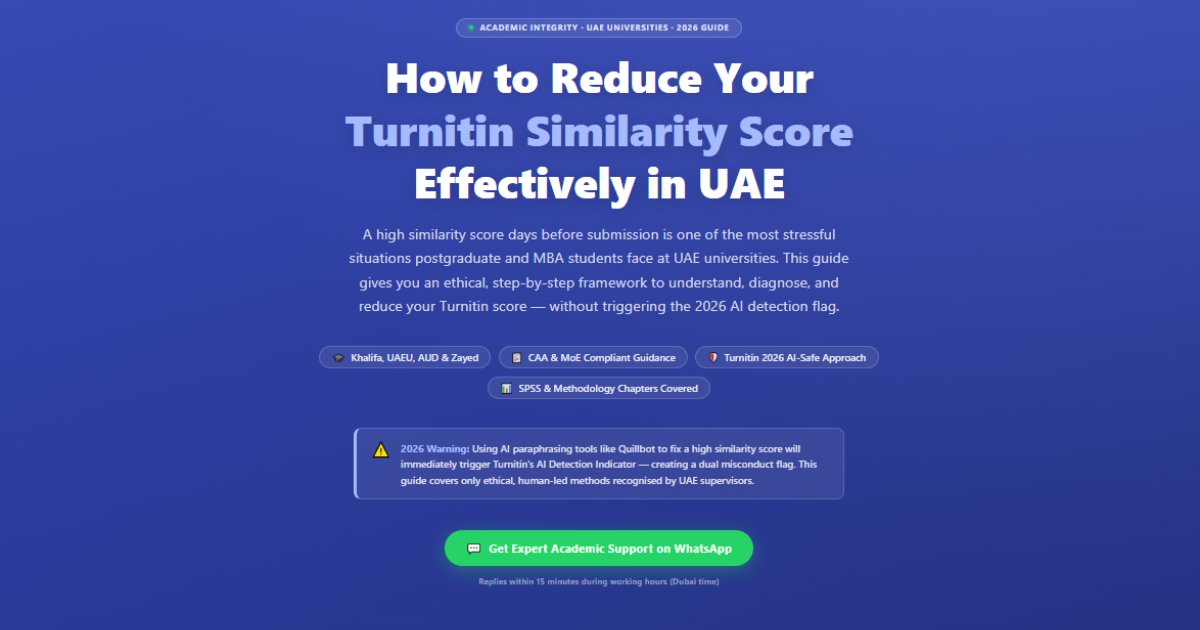
How to Reduce Your
Turnitin Similarity Score
Effectively in UAE
A high similarity score days before submission is one of the most stressful situations postgraduate and MBA students face at UAE universities. This guide gives you an ethical, step-by-step framework to understand, diagnose, and reduce your Turnitin score — without triggering the 2026 AI detection flag.
2026 Warning: Using AI paraphrasing tools like Quillbot to fix a high similarity score will immediately trigger Turnitin's AI Detection Indicator — creating a dual misconduct flag. This guide covers only ethical, human-led methods recognised by UAE supervisors.
Replies within 15 minutes during working hours (Dubai time)
What Every UAE Student Must Know Before Resubmitting
Reducing your Turnitin similarity score is not about shortcuts — it is about understanding what the report is actually measuring and addressing the root cause correctly. These five principles apply across all UAE universities in 2026.
5 Core Insights
- 1
Similarity ≠ Plagiarism. Turnitin detects matched text, not intent. A score of 22% with properly cited sources is academically sound; a score of 9% with uncited paraphrasing is a misconduct risk.
- 2
The 2026 AI Indicator is a separate flag. Using Quillbot, ChatGPT, or any spinner to rewrite flagged text will lower your similarity score while simultaneously raising your AI detection score — producing a dual misconduct flag.
- 3
Chapter risk is not equal. Literature Review and Methodology chapters naturally carry higher similarity due to formulaic academic phrasing. These require targeted intervention — not blanket rewriting.
- 4
Filters matter before you panic. Many high scores are caused by a missing "Exclude Bibliography" or "Exclude Quoted Text" filter setting. Check your filter configuration before rewriting a single sentence.
- 5
UAE university thresholds differ by institution and level. Khalifa University enforces a strict sub-15% threshold for dissertations. AUD and Zayed University apply different standards for undergraduate versus postgraduate work.
University
Threshold
Strictness
Khalifa University
<15% (PG / PhD)
StrictUAE University (UAEU)
<20% (dissertation)
StrictAmerican University in Dubai
<25% (UG) / <20% (PG)
ModerateZayed University
<20% (UG) / <15% (PG)
ModerateUniversity of Sharjah
<25% (general)
FlexibleHeriot-Watt Dubai / BUiD
<20% (PG default)
ModerateIdentify whether matches are coming from sources, your own prior work, or a missing filter. This determines the correct fix — not guesswork.
The Read–Hide–Analyse–Write method is the only safe approach UAE supervisors recognise. Software-based spinning is a misconduct trigger in 2026.
Methodology and data chapters use formulaic language that Turnitin frequently matches. These require interpretive rewriting, not deletion.
Correct APA 7th or Harvard referencing, combined with active "Exclude Bibliography" filters, can significantly reduce an inflated score without touching your content.
Key benchmark: A score between 10–20% with all sources properly cited is considered acceptable at most UAE universities. Scores above 25% on a dissertation — even with citations — are flagged for supervisor review under CAA compliance frameworks.
What Turnitin Is Actually Measuring in 2026
Before any reduction strategy can work, you need to understand what is driving your score. Turnitin does not detect plagiarism — it detects text matches. That distinction determines how you respond to a high report.
Similarity Score vs AI Detection Score
The Turnitin Similarity Score measures the percentage of your submitted text that matches content in Turnitin's database — which includes academic journals, student papers, websites, and previously submitted work. A high score does not automatically mean misconduct. A 22% score built entirely from cited quotations and standard academic phrasing may be completely acceptable. A 12% score with uncited paraphrased passages is a direct misconduct risk.
In 2026, UAE universities are using a separate AI Detection Indicator alongside similarity. This flag identifies the probability that text was generated by an AI tool. The two scores operate independently — which is exactly why attempting to fix similarity using AI paraphrasing tools creates a compounded problem.
The Turnitin Similarity Score measures matched text against a database. The AI Detection Indicator measures the probability of AI authorship. Both are reviewed by UAE supervisors independently. Reducing one score using AI tools will raise the other — producing a dual misconduct flag under 2026 CAA-aligned policies.
Similarity Score vs AI Detection Score — Key Differences
-
Measures text overlap with Turnitin's global database
-
Shown as a percentage (e.g. 18%) with colour-coded match bands
-
Can be reduced by ethical paraphrasing and proper citation
-
Affected by filter settings(Exclude Bibliography, Exclude Quotes)
-
Measures probability that text was AI-generated
-
Shown as a percentage of AI-flagged text per submission
-
Triggered by AI drafting, AI spinners, and Quillbot-style tools
-
Not affected by filter settings — applies to all submitted text
Why Academic Integrity Directly Impacts Your UAE Career
For MBA and postgraduate students at institutions such as UAEU, Khalifa University, or AUD, a Turnitin misconduct finding is not an isolated academic event. UAE employers — particularly in DIFC-regulated financial services, government-linked entities, and multinational corporations — conduct background checks that include academic records and disciplinary history.
A misconduct flag at the postgraduate level can delay graduation, result in grade penalties, or trigger a formal investigation under CAA-mandated academic integrity frameworks. For working professionals enrolled in part-time MBA programmes, the professional consequences can arrive before the academic ones.
-
Grade penalty or zero mark on the affected submission — with no resubmission window at many institutions
-
Graduation delay while a formal academic integrity investigation is conducted under CAA protocols
-
Permanent disciplinary record retained by the university — visible during employer reference checks in regulated UAE sectors
-
Visa and sponsorship risk for students on study visas whose enrolment status is tied to academic standing
If your submission has already been flagged or you are approaching a high-risk resubmission deadline, Labeeb's Academic Integrity Editing service provides human-authored, Turnitin-compliant rewrites that address similarity without triggering the 2026 AI Detection Indicator.
The Two Frameworks UAE Students Must Apply
Reducing a high Turnitin score requires two distinct approaches working in sequence: a diagnostic self-check before you rewrite anything, followed by an ethical paraphrasing method that keeps your AI detection score at zero.
Framework 1 — The 5-Step Self-Check Before You Rewrite
The most common error UAE students make is rewriting content before diagnosing the actual source of their high score. Work through these five steps first. In many cases, steps one and two alone will bring the score within threshold — without touching a single sentence.
Open the Turnitin report and verify that Exclude Bibliography and Exclude Quoted Material are both enabled. Many UAE students submit with default settings that include the reference list and block quotations in the similarity calculation — inflating the score by 5–12% before any content issue exists.
⚙️ Do this first — before any rewritingMost UAE university platforms allow at least one draft submission before the final deadline. Submit your draft through the official portal to receive a full colour-coded Turnitin report. Never rely on third-party Turnitin checkers — their database coverage is inconsistent and their AI Detection data is unreliable.
🎓 Available at UAEU, AUD, Khalifa, Zayed & BUiD portalsTurnitin highlights matched passages in colours ranging from blue (low match) to red (high match). Work through each highlighted section systematically. Identify whether the match is: a properly cited source that can be filtered, a block quotation that should be paraphrased and cited, or a passage that requires substantive rewriting.
🔍 Address red and orange bands firstLiterature Review and Methodology chapters are the primary sources of elevated similarity scores in UAE dissertations. These chapters draw heavily from existing scholarship using shared academic phrasing. Do not apply uniform rewriting — prioritise passages where the match is unattributed or where the phrasing closely mirrors the source without transformation.
📖 Focus: Lit Review & Methodology firstBefore resubmitting, confirm the exact threshold your supervisor has communicated — not the general university policy. Supervisors at Khalifa University and UAEU sometimes apply stricter internal thresholds for research-intensive submissions than the published institutional policy. When in doubt, email your supervisor directly with the Turnitin report attached.
✅ Always verify with your supervisor before final submissionFramework 2 — The Read–Hide–Analyse–Write Method
Once you have diagnosed which passages require rewriting, you need a repeatable ethical paraphrasing process. The Read–Hide–Analyse–Write (RHAW) method is the only approach recommended for UAE postgraduate students in 2026 — it produces substantively different text without AI involvement.
Ethical Paraphrasing Framework · UAE 2026
The Read–Hide–Analyse–Write Method
Four sequential steps. No AI tools. No similarity risk. No AI detection flag.
Read the flagged source passage carefully — twice. Understand the core argument, not just the surface phrasing. Read the surrounding context so you understand what the author is contributing to the field.
Close or minimise the source entirely. Do not keep it visible while you write. This forces your brain to reconstruct the idea from comprehension rather than copying sentence structure — the most common cause of flagged paraphrasing.
Before writing, ask: what is the single key point this passage makes? How does it connect to your research question? What is your position relative to it — do you agree, disagree, qualify, or extend the idea?
Write your version from memory using your own sentence structure and academic voice. Then add the in-text citation. Only then reopen the source to verify factual accuracy — never to copy phrasing.
2026 Reminder: Quillbot, ChatGPT rewrites, and AI spinners replace your writing process — they do not support it. UAE universities using Turnitin's AI Detection Indicator will flag text produced by these tools even after minor human edits.
Which Dissertation Chapters Carry the Highest Similarity Risk?
Not all chapters contribute equally to a high score. Understanding chapter-level risk allows you to direct your time where it will have the most impact on your final report.
Draws extensively from existing scholarship. Shared theoretical terminology and frequently cited frameworks generate repeated database matches — even when properly cited.
Research methodology language is inherently formulaic. Descriptions of SPSS procedures, sampling methods, and validity tests use near-identical phrasing across thousands of submissions.
Background context and problem statements often echo published literature. Particularly vulnerable when students use a source's framing of the research problem without sufficient transformation.
Risk increases when students mirror the language of their Literature Review to link findings back to theory, creating self-similarity across chapters — a pattern Turnitin now detects.
The Literature Review chapter accounts for the largest proportion of similarity flags in UAE dissertation submissions. If your Literature Review is driving a high score, Labeeb's Literature Review Support service delivers a fully restructured, synthetically written chapter that substantially reduces matched passages while maintaining academic rigour.
Targeted Actions That Lower Your Score Immediately
Once your self-check and RHAW rewriting are underway, these targeted techniques address the most persistent sources of elevated similarity in UAE dissertation and MBA submissions — from referencing errors to SPSS output formatting.
Tip Set 1 — Referencing and Citation Corrections
Incorrect or missing citation formatting is responsible for a significant portion of avoidable similarity. These four corrections are the fastest wins available before any content rewriting begins.
Activate Exclude Bibliography and Exclude Quoted Material in your Turnitin settings before generating any report you intend to act on. A reference list alone can inflate a dissertation score by 5–12% depending on the number of sources cited. This single step is the highest-return action available before any rewriting.
Every direct quotation over 40 words contributes to your similarity score — even when correctly cited. Review all block quotations in your Literature Review and Discussion chapters. Where the quotation is not essential as a verbatim extract, apply the RHAW method to paraphrase it into your own analytical voice and retain only the in-text citation.
Malformed references — missing DOIs, inconsistent author formatting, incorrect publication year placement — cause Turnitin to partially match your reference entries to source metadata in its database. A correctly formatted APA 7th reference list, combined with the Exclude Bibliography filter, eliminates this source of false similarity entirely.
When a single source is cited repeatedly across multiple paragraphs using the same phrasing pattern, Turnitin treats the surrounding text as a matched block — even if the content is paraphrased. Break up citation clustering by varying your synthesis approach: combine multiple sources into a single referenced paragraph rather than citing one source per paragraph in sequence.
Before & After — Paraphrasing a Flagged Methodology Passage
The example below illustrates the difference between a flagged passage and an acceptable rewrite for a UAE MBA dissertation methodology section — one of the highest-risk chapters in any Turnitin submission.
Real-World Example — UAE MBA Methodology Chapter
"A quantitative research design was adopted for this study. Data was collected using a structured questionnaire distributed to a sample of 120 participants. The responses were analysed using SPSS version 26 to test the hypotheses."
Flagged: High similarity match — formulaic phrasing mirroring thousands of methodology chapters in Turnitin's database. No meaningful transformation from source templates.
"To address the study's hypotheses, this research applied a post-positivist quantitative approach. Primary data was generated through a purpose-built structured instrument administered to 120 purposively selected respondents within UAE-based SMEs. Statistical analysis was conducted in SPSS 26, with regression and correlation procedures applied per the research objectives."
Compliant: UAE-specific context, varied sentence structure, and interpretive framing differentiate this passage from generic methodology templates.
Tip Set 2 — Handling SPSS and Data Analysis Chapters
Data Analysis chapters present a unique similarity challenge. The procedural language around SPSS, NVivo, and Excel outputs is inherently repetitive across submissions. The solution is not to remove technical terminology — it is to shift from procedural description to critical interpretation.
Do not copy SPSS output descriptions verbatim. Instead, interpret the result in the context of your research question — state what the finding means for your study population, not just what the p-value is.
Raw SPSS-generated tables pasted into Word match Turnitin's database entries for identical test types. Rebuild tables manually in APA 7th format — this removes the matched block while maintaining full academic rigour.
Generic result statements ("the results indicate a significant positive relationship") are heavily matched. Ground each finding in your specific UAE research context — the sector, institution, or population studied — to break the match pattern.
Where full SPSS output tables are required for transparency, relocate them to an appendix and reference them in-text. The appendix is excluded from many university Turnitin configurations — check your institution's submission policy first.
-
Exclude Bibliography and Exclude Quoted Text filters are confirmed active in the Turnitin portal
-
All block quotations reviewed — only those essential as verbatim extracts are retained; remainder paraphrased using RHAW
-
Reference list formatted to APA 7th edition — all DOIs present, author names consistent, year placement correct
-
Literature Review and Methodology chapters self-checked against the colour-coded Turnitin match report
-
SPSS tables rebuilt in Word to APA 7th format — raw output tables moved to appendix where policy allows
-
No AI paraphrasing tools used at any stage of the revision — all rewriting completed using RHAW method only
-
Draft submission run through the official university portal — not a third-party checker — to confirm the revised score before final submission
If your reference list is incorrectly formatted or your APA 7th citation structure is inflating your Turnitin score, Labeeb's Academic Formatting service provides a full APA 7th or Harvard referencing audit and correction — a common and highly effective first step before any content rewriting begins.
When to Seek Professional Academic Integrity Support
There is a clear and consequential distinction between ethical academic editing and the unregulated essay-writing industry. Understanding that boundary — and knowing when professional support is both appropriate and safe — is essential for every UAE postgraduate student facing a Turnitin challenge.
Ethical Editing vs Essay Mills — What UAE Universities Recognise
The UAE Ministry of Education and Commission for Academic Accreditation draw a clear line between formative academic support — which is permitted and encouraged — and contract cheating services, which constitute a Category A misconduct offence at all accredited UAE institutions. Understanding which side of that line any service operates on is a non-negotiable due diligence step.
Ethical Editing vs Essay Mills — The Key Distinctions
-
Write the submission on the student's behalf — the student submits work that is not their own
-
Guarantee a specific grade or Turnitin score — academically fraudulent and verifiably false
-
Use AI-generated content as the basis for the delivered work, exposing students to dual misconduct flags
-
Operate anonymously with no verifiable academic credentials, UAE registration, or editorial accountability
-
Review and improve the student's own written work — structure, clarity, citation accuracy, and language
-
Provide formative feedback that the student uses to make their own informed revisions and decisions
-
Apply human-authored paraphrasing that addresses flagged similarity using approved ethical methods — no AI tools
-
Operate transparently with verifiable credentials, UAE-based editorial team, and a clear academic support mandate
How Labeeb Protects Your Degree and Your Professional Future
Labeeb Writing & Designs operates exclusively within the ethical editing boundary recognised by UAE accredited universities. Every intervention is human-authored, Turnitin-transparent, and structured to support your learning — not replace it. For postgraduate and MBA students under submission pressure, this distinction is the difference between a safe solution and a compounded risk.
All Labeeb editorial work is produced by human academic editors. No Quillbot, ChatGPT, or spinner tools are used at any stage — your AI Detection score remains unaffected.
Our editorial team has direct experience with Turnitin submission workflows at UAEU, Khalifa University, AUD, Zayed University, BUiD, and University of Sharjah — including supervisor-specific threshold requirements.
Every service Labeeb provides is positioned as formative academic support — consistent with CAA accreditation standards and UAE MoE 2026 academic integrity frameworks.
Similarity reduction editing is available with 48–72 hour turnaround for postgraduate submissions, with urgent same-day assessment available via WhatsApp for students facing imminent deadlines.
Your Turnitin Score Is High.
Let's Fix It the Right Way.
Send us your Turnitin report on WhatsApp. Our editorial team will assess your submission, identify the exact sources of your similarity score, and confirm whether our Academic Integrity Editing service can bring you within your university's threshold — before your deadline.
Replies within 15 minutes during working hours (Dubai time)
Seven Mistakes That Keep Your Score High
Most UAE students who resubmit with an unchanged or worsening Turnitin score have made one or more of these identifiable, preventable errors. Each mistake below includes the specific fix required — not a general recommendation.
Using a Third-Party Turnitin Checker to Diagnose the Problem
High RiskStudents use free or paid third-party similarity checkers before rewriting. These tools use significantly smaller databases than Turnitin and routinely underreport actual similarity — producing false confidence that the score has been sufficiently reduced.
Use only your university's official draft submission portal to generate a Turnitin report. At UAEU, AUD, and Khalifa University, draft submissions are typically permitted before the final deadline. This is the only report that reflects the same database your supervisor will review.
Rewriting Content Before Applying Turnitin Exclusion Filters
High RiskStudents spend hours rewriting paragraphs before realising their reference list and quoted text were included in the similarity calculation. This wastes time and introduces unnecessary rewrites that may lower the quality of the original argument.
Always activate both exclusion filters first and regenerate the report. Document the before and after scores. Only begin rewriting if the filtered score still exceeds your university's threshold — and only address the specific passages highlighted in the match report.
Applying AI Paraphrasing Tools to Fix Similarity Flags
Critical RiskQuillbot, ChatGPT, and similar tools are used to rephrase flagged passages. While this often reduces the similarity score on the resubmission, it simultaneously activates Turnitin's 2026 AI Detection Indicator — escalating a manageable similarity issue into a dual-flag misconduct case.
Apply the RHAW method exclusively — Read the source, Hide it, Analyse the argument, then Write your version from comprehension. This produces text that is both similarity-compliant and AI-detection-clean. There is no shortcut that achieves both outcomes simultaneously.
Rewriting Uniformly Across All Chapters Instead of Targeting Flagged Passages
Moderate RiskFaced with a 28% score, students rewrite entire chapters from scratch — including sections that were not flagged. This dilutes well-constructed arguments and introduces new errors into submissions that were otherwise strong, consuming time better spent on the actual matched passages.
Work exclusively from the colour-coded match report. Red and orange highlighted passages are the priority. Blue and yellow passages with proper citations are typically within an acceptable range and do not require rewriting — retaining these preserves your academic argument.
Submitting SPSS Output Tables Directly Without Reformatting
Moderate RiskRaw SPSS output tables — copied directly into the dissertation — closely match the table structure and default labels present in thousands of previously submitted dissertations in Turnitin's database, inflating the Data Analysis chapter similarity score significantly.
Rebuild all SPSS tables manually in APA 7th format using Word's table tools. Rename column headers, remove SPSS default formatting, and add a table title above each. Follow each table with an interpretive paragraph that contextualises the result within your UAE research context — not a description of the statistics.
Assuming the Institutional Threshold Is the Same as the Published Policy
Moderate RiskA student at Zayed University targets the 20% published institutional threshold, submits at 19%, and is then informed by their supervisor that the programme applies a stricter 15% internal benchmark for postgraduate dissertations — requiring another round of revisions under time pressure.
Email your supervisor directly — before your resubmission — to confirm the programme-specific threshold. Request written confirmation if the deadline is within 72 hours. Where supervisors apply stricter internal benchmarks, aim for a score at least 3–4 percentage points below the stated figure to account for database variation between draft and final submission.
Leaving Self-Plagiarism from Prior Submissions Unaddressed
Moderate RiskStudents reuse passages from their own earlier coursework, literature review drafts, or proposal documents without attribution. Turnitin's database retains all prior submissions — including those from the same student — and flags self-matching text as a similarity source regardless of authorship.
Identify self-matching passages in the Turnitin report(these appear under your own name or institution in the match source list) and either substantially rewrite them using the RHAW method or add a formal self-citation. Supervisors at UAEU and Khalifa University treat unattributed self-reuse as a formal misconduct matter — identical to conventional plagiarism.
The Long-Term Academic Integrity Strategy for UAE Students
Reducing a current Turnitin score addresses an immediate problem. The following strategy prevents the same issue from recurring across every future chapter, module, or dissertation submission — and protects your professional standing in the UAE market throughout your academic career.
Long-Term Strategy · UAE Postgraduate Students
Build Academic Integrity Into Your Writing Process — Not After It
These six practices, applied consistently from the start of each chapter, eliminate the conditions that produce high Turnitin scores before submission — rather than requiring correction under deadline pressure.
-
Write in your own voice from the first draft. Resist the habit of copying source text into notes and editing it later — this is the origin of most patchwriting that Turnitin flags as high similarity.
-
Synthesise across multiple sources per paragraph rather than citing one source per sentence. Multi-source synthesis produces genuinely original analytical writing and eliminates citation clustering — the primary structural cause of elevated similarity in Literature Reviews.
-
Apply UAE-specific contextualisation in every chapter. Grounding your argument in the UAE market, regulatory environment, or institutional context differentiates your writing from global templates and significantly reduces database matches in Methodology and Discussion chapters.
-
Run a draft Turnitin check at the 50% completion stage — not only at the final submission stage. Early identification of similarity patterns in your Literature Review or Methodology chapters allows for low-pressure correction rather than high-stakes last-minute rewriting.
-
Maintain a working reference log throughout your writing. Untracked sources are the most common cause of uncited matched passages. Log every source the moment you consult it — not retrospectively during the citation audit stage.
-
Request formative editorial feedback before the final submission window. An independent review of your similarity score, citation structure, and paraphrasing approach — conducted at least one week before the deadline — provides the time needed to implement substantive corrections without academic risk.
If your Data Analysis chapter is generating high similarity due to SPSS output formatting or formulaic methodology phrasing, Labeeb's Data Analysis Support service provides chapter-level restructuring and interpretive rewriting that resolves similarity flags while maintaining full statistical accuracy and APA 7th compliance.
Reducing Your Turnitin Score Is a Process, Not a Panic Response
A high Turnitin similarity score the week before submission is a solvable problem — provided you approach it methodically, use only ethical techniques, and understand precisely what is driving the number. Every strategy in this guide is grounded in how UAE universities and their supervisors actually review Turnitin reports in 2026.
The students who successfully bring their scores within threshold are not those who rewrite the most — they are those who diagnose accurately, prioritise the correct chapters, apply the RHAW method consistently, and verify their approach against their institution's specific requirements before the final submission window closes.
For postgraduate and MBA students at institutions including Khalifa University, UAEU, AUD, Zayed University, BUiD, and the University of Sharjah, the professional stakes attached to academic integrity make a systematic approach non-negotiable. A dual misconduct flag — similarity and AI detection — is significantly harder to resolve than a straightforward similarity issue addressed before final submission.
- 1
Similarity ≠ misconduct. The score measures text matches — not intent. A cited score above threshold is manageable. An uncited score below threshold is a direct misconduct risk.
- 2
Filters before rewriting. Activating Exclude Bibliography and Exclude Quoted Text before generating any diagnostic report is the highest-return, lowest-effort action available.
- 3
The 2026 AI Detection dual-flag is a compounded risk. Using AI tools to fix similarity creates a more serious misconduct issue than the original score — with no safe reversal.
- 4
The RHAW method is the only AI-safe paraphrasing approach recognised by UAE supervisors — Read, Hide, Analyse, Write — producing compliant text with zero AI detection exposure.
- 5
Chapter-level risk is unequal. Literature Review and Methodology chapters carry the highest similarity risk. Target these first using the colour-coded match report — do not rewrite uniformly across all chapters.
- 6
Ethical editing is permitted — essay mills are a misconduct offence. Formative academic support that reviews and improves your own work is explicitly recognised by UAE MoE and CAA frameworks. Contract cheating is a Category A violation at all accredited institutions.
Target threshold for dissertations at Khalifa University & UAEU postgraduate level
Typical score reduction from activating Turnitin exclusion filters alone — before any rewriting
Labeeb Academic Integrity Editing turnaround for postgraduate submissions under deadline
The decision to seek professional editing support should be made at least five to seven days before your submission deadline — not on the day before. Earlier engagement allows for a full similarity audit, targeted chapter editing, a draft resubmission check, and any final corrections within the time available. Deadline-day requests significantly limit what can be achieved within an ethical framework.
Need to Reduce Your Score
Before Your Deadline?
Send your Turnitin report to our editorial team on WhatsApp. We will assess your submission, identify the exact passages driving your similarity score, and confirm a compliant reduction strategy — within 15 minutes during Dubai working hours.
Replies within 15 minutes during working hours (Dubai time)
Questions UAE Students Ask Most About Turnitin
The questions below address the most frequently searched Turnitin concerns from students at UAE universities in 2026 — including threshold rules, AI detection policy, SPSS flags, and the correct use of Turnitin exclusion filters.
Acceptable thresholds vary by institution and level of study. The most common benchmarks applied across accredited UAE universities in 2026 are:
-
Khalifa University: below 15% for postgraduate and PhD dissertations — one of the strictest thresholds in the UAE
-
UAE University (UAEU): below 20% for dissertation submissions
-
American University in Dubai (AUD): below 25% for undergraduate and below 20% for postgraduate work
-
Zayed University: below 20% for undergraduate and below 15% for postgraduate submissions
-
University of Sharjah: below 25% for general submissions
Always verify the exact threshold with your supervisor before resubmitting. Many programmes apply internal benchmarks that are stricter than the published institutional policy.
These are two independent metrics that UAE supervisors review separately in 2026:
The Similarity Score measures what percentage of your submitted text matches content in Turnitin's global database — academic journals, websites, previously submitted student work, and institutional repositories. A high similarity score can result from over-quotation, missing citations, patchwriting, or a missing exclusion filter on your reference list.
The AI Detection Score measures the probability that portions of your submission were generated by an AI tool such as ChatGPT, Quillbot, or similar. This score operates entirely independently — it is not affected by exclusion filters and is not reduced by paraphrasing. Text produced or substantially reworded by AI tools will be flagged even after minor human edits.
Using AI paraphrasing tools to reduce a high similarity score will simultaneously raise the AI detection score — converting a manageable similarity issue into a dual misconduct flag under 2026 CAA-aligned policies.
Yes. Turnitin's 2026 AI Detection Indicator is specifically trained to identify text that has been processed through AI paraphrasing tools — including Quillbot, ChatGPT rewrites, Spinbot, and similar platforms. The detection works by analysing sentence-level probability patterns that AI-generated or AI-modified text consistently produces, regardless of how many human edits are applied afterwards.
At UAE universities operating under CAA and MoE 2026 frameworks, a high AI detection score on a resubmission — particularly one that follows a high similarity score on the previous draft — is treated as a compounded misconduct indicator. Supervisors are specifically briefed to look for this pattern.
The only safe method of reducing similarity without triggering AI detection is human-led ethical paraphrasing — specifically the Read-Hide-Analyse-Write (RHAW) method described in this guide.
Turnitin provides two standard exclusion filters that must be activated before you generate any report you intend to act on:
-
Exclude Bibliography: Removes your reference list, works cited section, or bibliography from the similarity calculation entirely. This filter alone can reduce an inflated score by 5 to 12 percent depending on the number of sources cited.
-
Exclude Quoted Material: Removes all text enclosed in quotation marks from the similarity calculation. This applies to both inline quotations and block quotations — provided they are correctly formatted with quotation marks or indentation.
These filters are available in the Turnitin settings panel within your university's submission portal. At UAEU, AUD, Khalifa University, and Zayed University, these settings can typically be adjusted during the draft submission stage. Some portals apply these filters by default — confirm your settings before interpreting any report.
Always activate both filters and regenerate the report before beginning any rewriting. This is the single most impactful action available before any content changes are made.
Yes — both are among the highest similarity risk elements in any UAE dissertation submission. SPSS output tables pasted directly from the software closely match the default formatting and labelling used in thousands of previously submitted dissertations in Turnitin's database. This inflates the Data Analysis chapter score significantly without any intentional copying.
Methodology chapters carry high similarity risk because research methodology language is inherently formulaic — descriptions of sampling methods, validity tests, data collection instruments, and SPSS procedures use near-identical phrasing across submissions globally. This creates database matches even for entirely original work.
-
For SPSS tables: rebuild them manually in Word using APA 7th edition formatting — rename headers, remove SPSS default styling, and add a table title above each one
-
For methodology text: shift from procedural description to critical interpretation — explain what the result means for your UAE-specific research population, not just what the statistic is
-
For raw output: where full SPSS tables are required for transparency, move them to an appendix — check whether your university's Turnitin configuration excludes appendices before doing so
No — provided the support falls within the definition of ethical academic editing recognised by the UAE Ministry of Education and CAA-accredited institutions. The distinction is clear:
-
Permitted: professional review of your own written work, formative feedback on structure and citation accuracy, human-authored paraphrasing support that you review and approve, and APA 7th edition referencing corrections
-
Prohibited: having a third party write or substantially draft any portion of your submission on your behalf, submitting AI-generated content, or using any service that guarantees a specific grade or Turnitin score
Labeeb Writing & Designs operates exclusively within the permitted category — all editorial support is human-authored, formative, and structured to improve your own work without replacing your academic voice or contribution.
When in doubt, check your university's academic integrity policy directly. At UAEU, AUD, and Khalifa University, formative editing and proofreading support are explicitly listed as permitted academic support activities.
كيفية تقليل نسبة التشابه في Turnitin بفعالية
يُعدّ ارتفاع نسبة التشابه في تقرير Turnitin من أكثر المواقف ضغطاً التي يواجهها طلاب الدراسات العليا وطلاب الماجستير في إدارة الأعمال بجامعات الإمارات. يوضّح هذا الدليل الطرق الأخلاقية والمعتمدة للتعامل مع هذه النسبة وتخفيضها دون تفعيل مؤشر الكشف عن الذكاء الاصطناعي المعمول به في 2026.
الحد الأقصى المقبول في جامعة خليفة وجامعة الإمارات للدراسات العليا
نسبة التخفيض المتوقعة بمجرد تفعيل فلتر استثناء قائمة المراجع
مدة التسليم لخدمة التحرير الأكاديمي لدى Labeeb لطلاب الدراسات العليا
-
التشابه لا يعني السرقة الأدبية: تقيس Turnitin التطابق النصي وليس النية. النسبة المرتفعة مع الاستشهادات الصحيحة مقبولة، بينما النسبة المنخفضة مع غياب التوثيق تُعدّ مخالفة أكاديمية.
-
فعّل فلتري الاستثناء أولاً: قبل إعادة كتابة أي فقرة، فعّل خيار استثناء قائمة المراجع والنصوص المقتبسة في إعدادات Turnitin. قد يخفّض هذا الإجراء وحده النسبة بمقدار 5 إلى 12 بالمئة.
-
خطر العلامتين المزدوجتين في 2026: استخدام أدوات الذكاء الاصطناعي كـ Quillbot أو ChatGPT لإعادة الصياغة سيرفع نسبة الكشف عن الذكاء الاصطناعي فوراً، مما يحوّل مشكلة التشابه إلى مخالفتين منفصلتين أمام المشرف الأكاديمي.
-
طريقة RHAW الآمنة الوحيدة: اقرأ المصدر، أغلقه، حلّل الفكرة الرئيسية، ثم اكتب بأسلوبك الأكاديمي الخاص. هذه الطريقة تنتج نصاً خالياً من التشابه ومن الكشف عن الذكاء الاصطناعي في آنٍ واحد.
-
الفصول الأعلى خطورة: مراجعة الأدبيات والمنهجية هما الفصلان الأكثر عرضة للتشابه في رسائل الدكتوراه والماجستير بجامعات الإمارات. ركّز جهودك عليهما استناداً إلى تقرير التطابق الملوّن.
-
جداول SPSS تُولّد تطابقات قاعدة البيانات: إعادة بناء جداول SPSS يدوياً وفق توثيق APA الإصدار السابع، وتحويل الأوصاف الإجرائية إلى تفسيرات نقدية ضمن السياق الإماراتي، يُقلّل التشابه في فصول تحليل البيانات بشكل ملحوظ.
ملاحظة ختامية: تتفاوت حدود القبول بين جامعات الإمارات؛ إذ تُطبّق جامعة خليفة وجامعة الإمارات العربية المتحدة معايير أكثر صرامة مقارنةً بالجامعة الأمريكية في دبي وجامعة زايد. تحقّق دائماً من الحد المحدد مع مشرفك الأكاديمي قبل إعادة التقديم النهائي، واحرص على إجراء مراجعة مسوّدة عبر البوابة الرسمية للجامعة لا عبر أدوات الفحص الخارجية.
Labeeb Writing & Designs · Academic Integrity Editing · UAE
Replies within 15 minutes during working hours (Dubai time)