
Internships to Full-Time: Pathways in UAE Companies
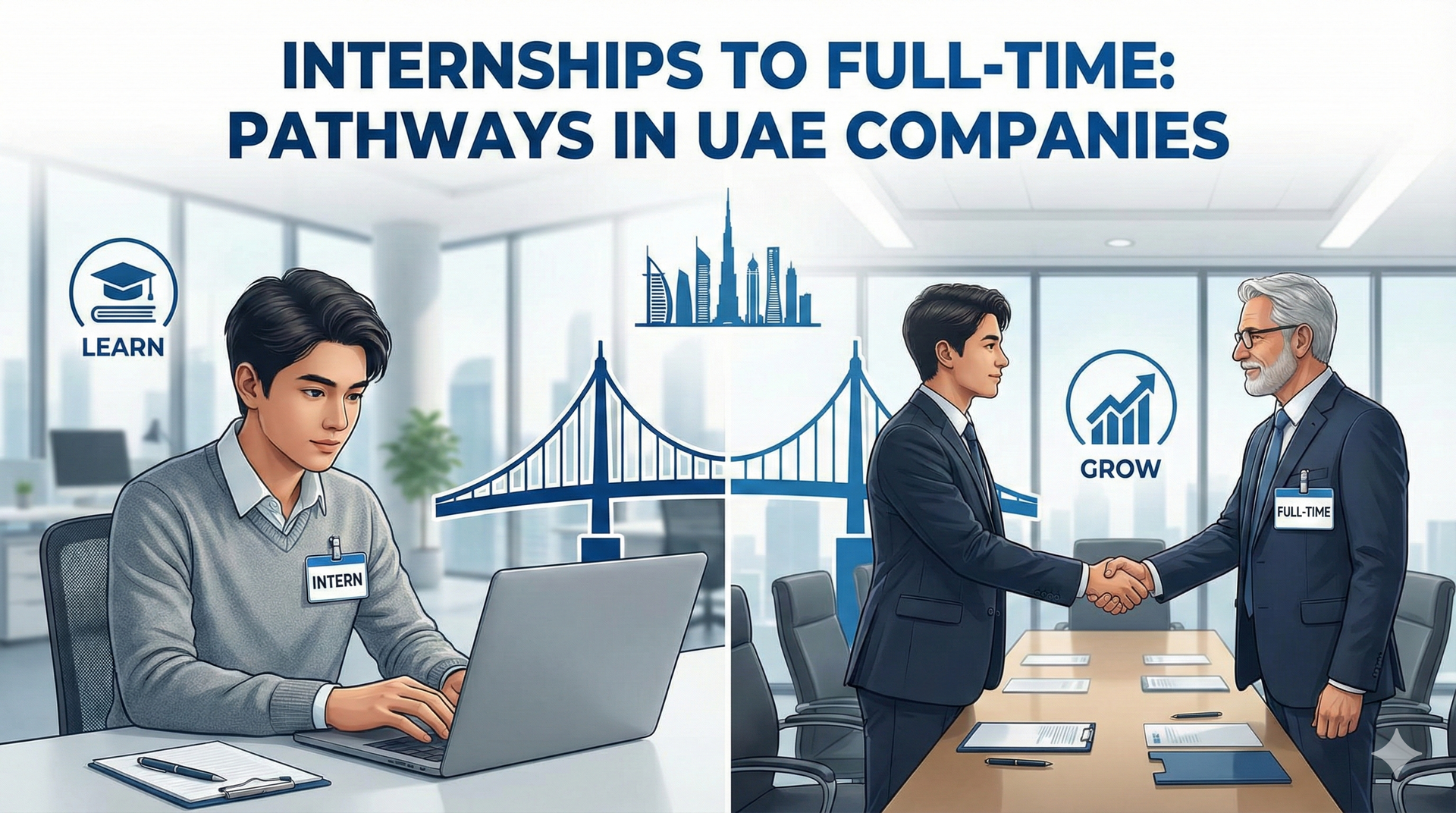
Introduction: Why Internships Matter More in the UAE Than You Think
For fresh graduates entering the UAE job market, internships are not a “backup plan” or a temporary filler. In 2026, internships have become one of the most reliable hiring pipelines across Dubai, Abu Dhabi, and the wider GCC.
From personally guiding
5,000+ UAE professionals and graduates into roles during 2025–2026, one hiring pattern is consistent:
A significant percentage of entry-level hires in the UAE start as interns or trainees before becoming full-time employees.
This blog is written for:
- Fresh graduates
- Final-year university students
- Career switchers at entry level
If your goal is to convert an internship into a permanent role in the UAE, this guide will show you how hiring really works, what employers expect, and how to position yourself strategically.
Why UAE Employers Rely Heavily on Internships
Internships as a Risk-Control Tool
UAE employers operate in a highly regulated, performance-driven environment. Hiring the wrong candidate is costly—financially and operationally. Internships allow employers to:
- Assess real workplace behavior
- Test communication and professionalism
- Evaluate cultural fit
- Reduce hiring risk
For employers, internships are extended interviews, not charity programs.
The Cultural Factor in UAE Hiring
Unlike some markets where internships are purely educational, UAE employers expect interns to:
- Follow professional etiquette
- Respect hierarchy
- Communicate clearly
- Adapt quickly
Interns who understand this are far more likely to receive full-time offers.
Industries Where Internships Commonly Convert to Full-Time Roles
In the UAE, internship-to-hire pathways are strongest in:
- Banking & Financial Services
- Technology & IT
- Marketing & Digital Media
- Hospitality & Tourism
- Logistics & Supply Chain
- HR, Admin & Operations
- Engineering & Technical Support
Large organizations and structured SMEs actively use internships as talent pipelines.
Types of Internships in the UAE (And What They Mean for Your Career)
1. Paid Internships
- Higher conversion potential
- Stronger accountability
- Clear deliverables
These are common in multinational companies and large local groups.
2. Unpaid or Stipend-Based Internships
- Still valuable if structured well
- Often used by startups and SMEs
- Conversion depends on performance and business growth
The key is not pay—it’s learning, exposure, and visibility.
3. Graduate Traineeships
These are formal programs with:
- Defined timelines
- Rotational exposure
- Evaluation milestones
Graduate traineeships often lead directly to permanent roles.
How UAE Recruiters Evaluate Interns for Full-Time Conversion
What Employers Watch Closely (But Rarely Say Out Loud)
Recruiters and managers assess interns on:
- Reliability and punctuality
- Communication clarity
- Willingness to learn
- Initiative without arrogance
- Ability to follow instructions
- Professional behavior under pressure
Technical skills can be taught. Attitude cannot.
The Biggest Internship Mistakes Graduates Make in the UAE
Mistake 1: Treating Internships Like College Assignments
Fix: Treat every task as business-critical.
Mistake 2: Staying Silent and Invisible
Fix: Ask relevant questions, seek feedback, contribute ideas respectfully.
Mistake 3: Not Updating CV and LinkedIn During the Internship
Fix: Document achievements weekly.
Mistake 4: Assuming a Job Will Be Offered Automatically
Fix: Express interest professionally and at the right time.
How to Position Yourself for Internship-to-Full-Time Conversion
Step 1: Enter the Internship with the Right Mindset
Your mindset should be:
“I am already on probation for a permanent role.”
This changes how you show up every day.
Step 2: Build Visibility Without Overstepping
In UAE workplaces:
- Respect hierarchy
- Avoid entitlement
- Be proactive but polite
Visibility comes from consistent reliability, not self-promotion.
Step 3: Ask for Feedback Midway—Not at the End
Smart interns ask:
- “What can I improve?”
- “How can I add more value?”
This signals maturity and ambition.
Step 4: Make Your Intentions Clear (Professionally)
Toward the end of your internship, communicate:
- Your interest in staying long-term
- Your willingness to grow with the company
Many interns lose offers simply because they never asked.
Translating Internships into a Strong UAE CV
Why Most Interns Undersell Themselves
Graduates often write internship experience like this:
- “Assisted the team”
- “Helped with tasks”
This language kills impact.
Instead, focus on:
- Responsibilities handled
- Tools used
- Outcomes achieved
This is where professional CV positioning becomes critical. Many graduates choose support through
https://www.labeeb.ae/professional-cv-writing
to ensure internship experience is translated into
job-ready value.
Internship Experience and ATS Reality
Why ATS Still Matters After an Internship
Even after completing an internship, your CV must still pass ATS screening.
This means:
- Correct job titles
- Keyword alignment
- Clear role descriptions
Without this, your internship experience may still be ignored.
Cover Letters: Explaining the Internship-to-Full-Time Transition
A targeted cover letter helps you:
- Explain growth during the internship
- Show readiness for permanent responsibility
- Clarify motivation
Generic letters fail. UAE-specific cover letters can be structured via
https://www.labeeb.ae/cover-letter-writing-services
LinkedIn: Where Internship Visibility Converts to Offers
How Recruiters Use LinkedIn for Interns
Recruiters check:
- Internship role clarity
- Consistency with CV
- Professional tone
A well-positioned LinkedIn profile increases inbound opportunities—especially after internship completion. Graduate-friendly optimization is available via
https://www.labeeb.ae/linkedin-profile-optimization
Interviewing for Full-Time Roles After an Internship
Why Internship Interviews Are Different
Employers now ask:
- “What did you learn here?”
- “How did you handle pressure?”
- “What would you improve?”
Your answers must reflect real exposure, not theory.
Interview preparation aligned with UAE employer expectations is available through
https://www.labeeb.ae/interview-preparation
UAE-Specific Internship Considerations Graduates Must Know
- Professional English is essential
- Cultural respect matters
- Background checks are common
- Honesty is non-negotiable
- Referrals carry weight—but performance matters more
FAQs: Internships to Full-Time in the UAE
1. Do internships really lead to jobs in the UAE?
Yes, especially when performance and professionalism are strong.
2. Are unpaid internships worth it?
Yes—if they provide real exposure and learning.
3. How long should an internship last before conversion?
Typically 3–6 months.
4. Should I ask for a job offer directly?
Yes, but professionally and at the right time.
5. Can internships help with ATS screening?
Yes, when written correctly on your CV.
6. Is UAE internship experience valued internationally?
Yes, especially with recognized employers.
Related Reads
If you want to strengthen your internship-to-career transition, continue with these expert guides:
- Resume Writing for Fresh Graduates in Dubai: Entry-Level CVs – Read More →
- Interview Coaching Strategies for Fresh Graduates in the UAE – Read More →
- How Hiring Really Works in the UAE Job Market – Read More →
- LinkedIn Optimization for UAE Recruiters: How to Get Inbound Job Calls – Read More →
Final Call to Action
If you want to turn your internship into a long-term UAE career, strategy matters as much as effort.
Explore graduate-focused career packages at:
https://www.labeeb.ae/packages
Speak directly with a UAE career expert:
https://www.labeeb.ae/contact
WhatsApp:
https://wa.me/+971522617846
An internship is not the end of your journey—it is the gateway. Use it wisely.