
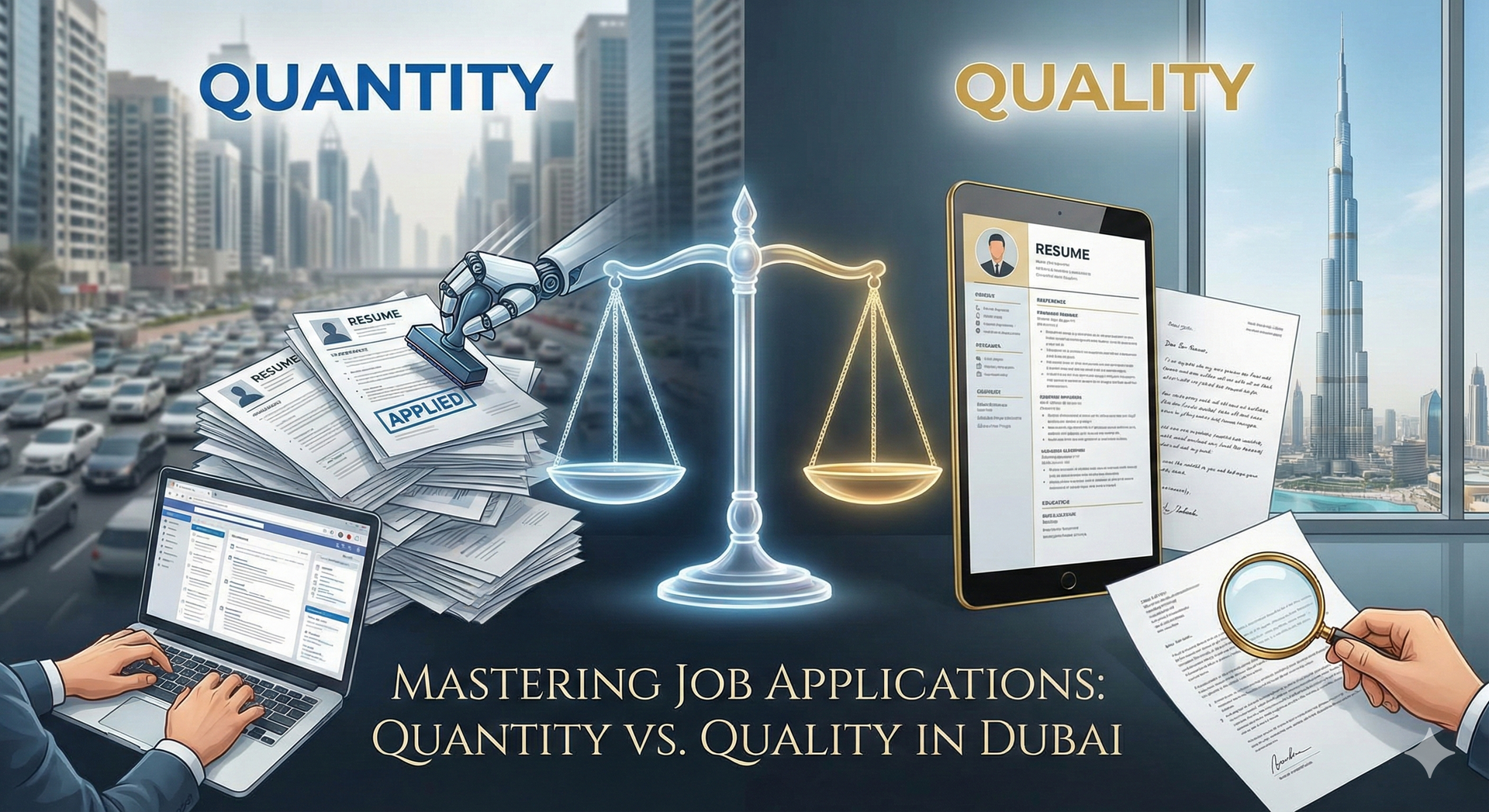
Mastering Job Applications: Quantity vs. Quality in Dubai
Introduction: Why “Apply More” Is the Wrong Advice in Dubai
One of the most damaging pieces of job search advice circulating in Dubai is simple and seductive: “Apply everywhere.”
From personally guiding 5,000+ UAE professionals through active job searches in 2025–2026, the data tells a very different story. Candidates who submit hundreds of generic applications experience lower response rates, recruiter fatigue, and prolonged unemployment—while those applying to fewer roles with precision consistently secure interviews faster.
Dubai’s hiring ecosystem in 2026 is filter-heavy, relevance-driven, and data-tracked. Quantity without strategy does not increase visibility; it often reduces it.
This article explains why quality beats quantity, how ATS systems and recruiters actually evaluate applications, and how to design an application strategy that works in the UAE market.
The Reality of Job Applications in Dubai’s Hiring Ecosystem
Before choosing a strategy, it is essential to understand how applications are processed.
Dubai Hiring Has Three Sequential Filters
- ATS / HRMS screening
Applications are first filtered automatically based on keyword relevance, job title match, and formatting. - Recruiter relevance check
Shortlisted CVs are reviewed for alignment, seniority accuracy, and sector fit. - Hiring manager validation
Only highly relevant profiles move forward to interviews.
Failing at any one stage means rejection—often without notification.
Why High-Volume Applications Backfire in the UAE
Applying to a large number of roles feels productive, but it triggers hidden penalties.
1. ATS Relevance Dilution
ATS systems score relevance based on job alignment. When the same CV is used across multiple unrelated roles:
- Keyword mismatch increases
- Relevance scores drop
- Applications are auto-rejected
ATS systems are not neutral—they reward precision.
2. Recruiter Tracking and Brand Damage
Many recruiters in Dubai use shared ATS platforms or internal notes. Repeated irrelevant applications can label candidates as:
- Unfocused
- Desperate
- Poorly aligned
Once credibility is reduced, future applications face bias—even when suitable.
3. Emotional Burnout Without Data
High-volume applicants often:
- Lose track of where they applied
- Forget CV versions used
- Miss follow-ups
- Experience psychological fatigue
Burnout reduces interview performance and decision-making quality.
What “Quality Applications” Actually Mean in Dubai
Quality does not mean slow. It means deliberate and aligned.
A quality application includes:
- A role-specific CV
- Correct seniority alignment
- Relevant industry keywords
- Targeted cover letter (when needed)
- Proper channel selection
Each application is designed to pass both machines and humans.
The Ideal Application Volume for Dubai (Reality-Based)
Based on real outcomes across mid-career and senior professionals:
- Entry to mid-level roles:
8–12 high-quality applications per week - Senior and leadership roles:
4–6 highly targeted applications per week
These ranges allow time for customization, tracking, and follow-up—without diluting relevance.
Step-by-Step: How to Build a Quality-First Application Strategy
Step 1: Define Your Target Role Precisely
Before applying, candidates must answer:
- What exact role am I targeting?
- What industries am I prioritizing?
- What seniority level fits my experience?
Ambiguity at this stage leads to rejection later.
Step 2: Align Your CV for Each Role Category
A CV optimized for one role often underperforms for another.
ATS-optimized CVs in the UAE must reflect:
- Matching job titles
- Industry-specific terminology
- Role-relevant achievements
This is why professionals benefit from multiple targeted CV versions.
👉 Internal reference: https://www.labeeb.ae/professional-cv-writing
Step 3: Decide When a Cover Letter Is Worth It
Cover letters should be used selectively, not universally.
They add value when:
- Applying to government or semi-government entities
- Transitioning industries
- Applying for senior or niche roles
When used, they must reinforce relevance—not motivation.
👉 Internal reference: https://www.labeeb.ae/cover-letter-writing-services
Step 4: Choose the Right Application Channel
Not all roles should be applied for through the same channel.
Common UAE channels include:
- Company career portals
- Job portals (Bayt, GulfTalent, Naukri Gulf)
- Recruitment agencies
- LinkedIn direct outreach
Quality strategies select the channel most likely to convert, not the most convenient.
Why ATS Strategy Is Central to Application Quality
In 2026, ATS systems are more sophisticated than ever.
They assess:
- Keyword density
- Contextual relevance
- Role similarity
- Experience chronology
Poor formatting or vague language can trigger rejection regardless of experience.
ATS-aware applications dramatically increase shortlist probability.
The Role of LinkedIn in Application Quality
LinkedIn is not just a job board—it is a validation layer.
Recruiters often:
- Review LinkedIn after shortlisting
- Cross-check titles and dates
- Assess professional branding
Mismatch between CV and LinkedIn reduces trust instantly.
👉 Internal reference: https://www.labeeb.ae/linkedin-profile-optimization
Tracking Applications: The Missing Quality Multiplier
Candidates who track their applications outperform those who do not.
Track:
- Role applied for
- CV version used
- Channel used
- Response outcome
- Follow-up status
Tracking converts guesswork into strategy.
When Quantity Has a Role (And When It Doesn’t)
Quantity can work only when:
- Roles are highly similar
- CV is tightly aligned
- ATS relevance remains high
Blind mass application never works sustainably in Dubai.
Common Application Mistakes That Kill Quality
From thousands of CV reviews, the most damaging mistakes include:
- Using one CV for all roles
- Applying outside realistic seniority
- Ignoring job description keywords
- Applying without LinkedIn optimization
- Failing to follow up
Each mistake reduces response probability.
When to Seek Professional Application Support
Candidates often seek help only after months of rejection. The most successful professionals optimize early.
Professional support helps with:
- Role positioning
- ATS alignment
- Application prioritization
- Interview conversion
👉 Career support overview:
https://www.labeeb.ae/expert-career-support
👉 Packages:
https://www.labeeb.ae/packages
Frequently Asked Questions (FAQ Schema Ready)
Is applying to more jobs better in Dubai?
No. Targeted, high-quality applications outperform mass submissions.
How many applications should I send per week?
Typically 4–12, depending on seniority and role similarity.
Do ATS systems track past applications?
Yes. Repeated irrelevant applications can reduce credibility.
Should I customize my CV every time?
You should customize by role category, not individually each time.
Can a quality-first strategy reduce job search time?
Yes. It improves response rates and interview conversion significantly.
Recent Relevant Blogs (Read More)
- The Ultimate 360° Job Hunt Plan for UAE Professionals in 2026 – Read More
- Building Your Job Search Toolkit: CV, LinkedIn, Cover Letters & More – Read More
- How ATS Software Really Works in UAE Recruitment – Read More
- Common ATS Mistakes UAE Job Seekers Make (And Fixes) – Read More
Final Thoughts: Precision Is the New Productivity
In Dubai’s competitive job market, effort without strategy leads to exhaustion. Precision leads to momentum.
Candidates who treat applications as high-value submissions, not numbers, consistently outperform peers with stronger CVs but weaker strategy.
For expert guidance aligned with real UAE hiring practices:
📩 Contact:
https://www.labeeb.ae/contact
📱 WhatsApp:
https://wa.me/+971522617846