
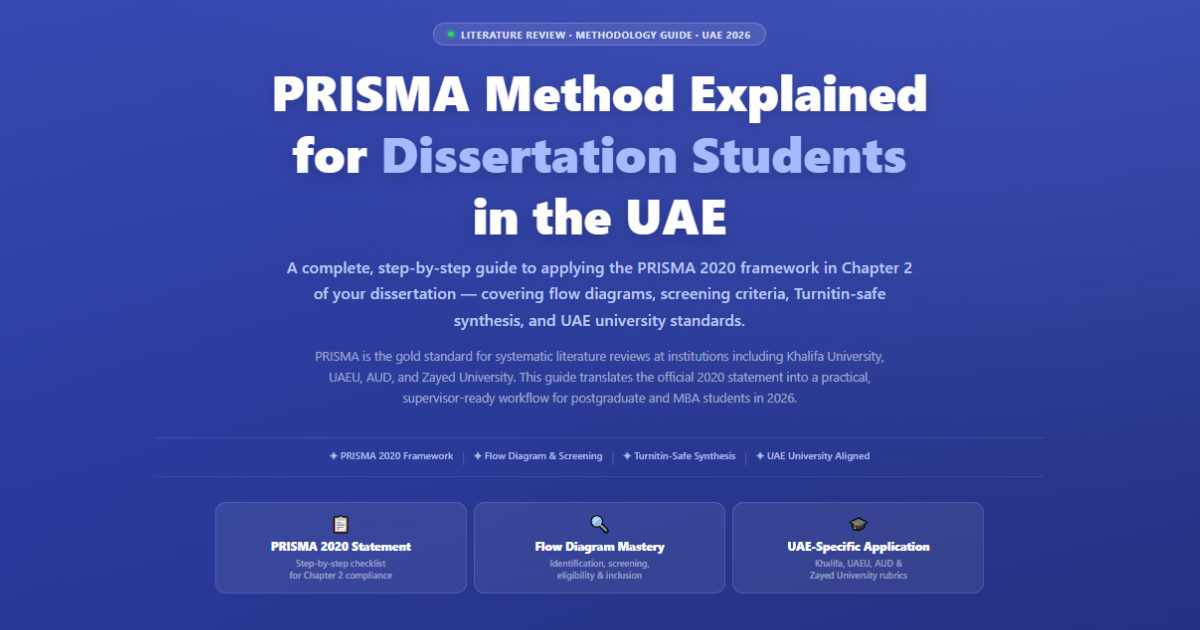
PRISMA Method Explained
for Dissertation Students
in the UAE
A complete, step-by-step guide to applying the PRISMA 2020 framework in Chapter 2 of your dissertation — covering flow diagrams, screening criteria, Turnitin-safe synthesis, and UAE university standards.
PRISMA is the gold standard for systematic literature reviews at institutions including Khalifa University, UAEU, AUD, and Zayed University. This guide translates the official 2020 statement into a practical, supervisor-ready workflow for postgraduate and MBA students in 2026.
for Chapter 2 compliance
eligibility & inclusion
Zayed University rubrics
What You Need to Know About PRISMA Before You Begin
PRISMA is not just a methodology checklist — it is the internationally recognised standard for conducting and reporting systematic literature reviews. For postgraduate students at UAE universities, applying PRISMA correctly in Chapter 2 signals methodological rigour and directly influences supervisor approval and final grading.
PRISMA(Preferred Reporting Items for Systematic Reviews and Meta-Analyses) is a structured framework that guides researchers through the identification, screening, eligibility assessment, and inclusion of studies in a systematic literature review. The PRISMA 2020 update introduced revised reporting standards that are now required by supervisors and ethics boards at institutions including Khalifa University, UAEU, and AUD.
The PRISMA 2020 statement revised 27 reporting items. Supervisors at UAE universities now expect the 2020 version — not the original 2009 framework — in all systematic reviews submitted from 2024 onwards.
PRISMA operates across four phases: Identification (database searches), Screening (title and abstract review), Eligibility (full-text assessment), and Inclusion (final study set). Every phase must be documented and counted in the flow diagram.
PRISMA is widely used in MBA, Management, Education, and Social Science dissertations across UAE universities. Business and policy students regularly apply it to synthesise Scopus and Web of Science literature systematically.
Synthesising dozens of papers through PRISMA creates a high-volume paraphrasing environment. Without a deliberate Turnitin strategy, AI detection flags can trigger during the screening and eligibility narrative — even with fully original writing.
Most UAE supervisors assess the PRISMA flow diagram as a standalone deliverable. Numerical inconsistencies between phases — a common student error — result in immediate revision requests and can delay dissertation approval significantly.
A correctly applied PRISMA review in Chapter 2 directly informs your research methodology in Chapter 3. The search strategy, inclusion criteria, and database selection you document here must align with your methodological justification.
Need structured support building your Chapter 2? Labeeb's literature review support service helps UAE postgraduate students apply PRISMA correctly — from database search strategy through to Turnitin-compliant synthesis.
The Four Phases of PRISMA — What Each Stage Requires
Understanding PRISMA begins with its four-phase structure. Each phase has specific academic requirements, and each must be numerically documented in your flow diagram. Skipping or merging phases is among the most common reasons UAE supervisors reject Chapter 2 submissions at first review.
This phase involves executing structured searches across academic databases and recording the total number of records retrieved before any filtering takes place. For UAE students, Scopus and Web of Science are the most accepted databases at Khalifa University, UAEU, and AUD.
- Define search strings using Boolean operators (AND, OR, NOT) with your core keywords
- Search a minimum of two databases — single-source reviews are routinely flagged by supervisors
- Record the exact number of results per database before combining
- Include grey literature sources if your field or supervisor requires it
After deduplication, you screen remaining records by reading titles and abstracts only — not full texts. Each record is either retained or excluded, and exclusion reasons must be pre-defined in your inclusion and exclusion criteria table.
- Remove all duplicate records first and document the number removed
- Apply your eligibility criteria consistently — do not make ad hoc exclusions
- Record the number excluded at this stage with a documented reason category
- For large record sets (500+), consider double screening to satisfy ethics boards
Studies that pass screening are now read in full. This is where the majority of exclusions occur. Every study excluded at this phase requires an academically justified reason — not just "not relevant." Supervisors at UAEU and Zayed University assess the rigour of your exclusion reasoning directly.
- Read the complete paper — methodology, findings, and limitations
- Apply specific exclusion criteria: date range, study design, language, context
- Document each excluded study's reason in a separate appendix table if required
- Track the exact count excluded here — this number feeds directly into the flow diagram
The studies that survive all three prior phases form your included set. This is the literature you will synthesise, analyse, and reference throughout Chapter 2. The number of included studies must match across your flow diagram, reference list, and synthesis table — any mismatch is flagged immediately.
- Confirm the included count matches the reference list and synthesis matrix
- Categorise studies by theme, methodology, or finding for structured synthesis
- Aim for a defensible number — typically 15 to 40 studies for an MBA or postgraduate dissertation
- Document whether any studies were added through citation chaining (backward/forward search)
The 2020 update expanded the framework to include automation tools and AI-assisted screening, revised the flow diagram to separate database and register searches, and introduced new reporting items for assessment of certainty. It also placed greater emphasis on search reproducibility — meaning your search strings must be documented in enough detail that another researcher could replicate your exact results. UAE supervisors and CAA-accredited programs now treat PRISMA 2020 compliance as a baseline requirement, not an optional enhancement.
📍 UAE Context: Students submitting systematic literature reviews at Khalifa University, UAEU, and AUD are increasingly required to submit the PRISMA flow diagram as a standalone figure within Chapter 2 — separate from the written narrative. Confirm this requirement with your supervisor before submission, as formatting expectations vary by program and department.
How to Build Your PRISMA Flow Diagram and Search Strategy
The PRISMA flow diagram is the most scrutinised element of a systematic literature review. It must account for every record — from initial database retrieval through to final inclusion — with numerically consistent counts at every stage. This section covers the diagram structure, inclusion and exclusion criteria design, and search string construction used by UAE postgraduate students in 2026.
at screening (n=___)
with reasons (n=___)
Designing Your Inclusion and Exclusion Criteria Table
Criteria must be defined before you begin searching — not adjusted after retrieving results. Retroactive criteria are a methodological integrity issue that supervisors at UAEU and AUD are trained to identify. The table below reflects a standard criteria framework for a Management or Business dissertation using PRISMA in the UAE context.
| Criterion | Inclusion | Exclusion |
|---|---|---|
| Publication Date | ✔ 2014–2024 (10-year range) | ✗ Published before 2014 |
| Language | ✔ English-language publications | ✗ Non-English with no translation |
| Study Design | ✔ Peer-reviewed empirical studies | ✗ Editorials, opinion pieces, grey reports |
| Geographic Scope | ✔ GCC, MENA, or global comparative studies | ✗ Single-country studies outside scope |
| Relevance to Topic | ✔ Directly addresses research question | ✗ Tangentially related or peripheral focus |
| Database Source | ✔ Scopus, Web of Science, Elsevier | ✗ Non-indexed or predatory journals |
| Access | ✔ Full text available via UAE university portal | ✗ Abstract only, no full-text access |
Constructing a Reproducible Search String
PRISMA 2020 requires your search strategy to be fully reproducible. This means documenting the exact search string used in each database — including Boolean operators, truncation symbols, and field tags. The example below reflects a search string for a management dissertation examining leadership and organisational performance in the GCC.
("leadership style*" OR "transformational leadership" OR "servant leadership") AND ("organisational performance" OR "employee performance" OR "firm performance") AND ("GCC" OR "UAE" OR "Saudi Arabia" OR "Gulf") AND PUBYEAR > 2013
Key rules: Use asterisks (*) for word truncation — "style*" captures style, styles, styling. Use quotation marks for exact phrases. Separate alternative terms with OR within a concept group. Connect concept groups with AND. Log the exact string and the number of results returned per database in your methodology appendix.
Working on a dissertation that requires a systematic literature review? Labeeb's dissertation writing support covers PRISMA search strategy design, flow diagram construction, and Turnitin-compliant Chapter 2 synthesis for UAE postgraduate students.
Eight Practical Actions That Strengthen Your PRISMA Review
Knowing the PRISMA framework in theory is not enough. UAE postgraduate students who score highly on systematic literature reviews apply specific practical habits — before, during, and after the screening process. These eight actions address the most common failure points identified by supervisors across Khalifa University, UAEU, AUD, and Zayed University.
Search results change as new publications are indexed. Running Scopus and Web of Science searches days apart produces inconsistent record counts. Complete all database searches within a single session and document the exact date — PRISMA 2020 requires this for reproducibility.
Do not manage your screening process from memory or paper notes. Build a screening matrix in Excel with columns for title, author, year, database, screening decision, and exclusion reason. Your flow diagram numbers must reconcile precisely with this tracker — supervisors may request it as an appendix.
The same study often appears in multiple databases. Remove duplicates first and record the count removed. Failing to deduplicate inflates your identification number and creates a mathematically impossible flow diagram — a red flag for any supervisor reviewing Chapter 2.
Define your exclusion reason categories in the methodology section before beginning screening — not after. Standard categories include: outside date range, not peer-reviewed, outside geographic scope, and insufficient relevance. Ad hoc exclusion reasons assigned retrospectively are a methodological integrity issue at UAEU ethics boards.
After completing inclusion, count the studies in your reference list. This number must match the inclusion count in your flow diagram exactly. A mismatch of even one study triggers an immediate revision request. Build this cross-check into your final pre-submission review.
Backward searching (reviewing the reference lists of included studies) and forward searching (finding papers that cite your included studies) often surface high-value literature missed by database searches. PRISMA 2020 has a dedicated node for this — document it separately from your database search count.
The PRISMA 2020 statement is a published academic paper. Cite it directly in your methodology chapter. The correct APA 7th citation is: Page, M. J., et al. (2021). PRISMA 2020 explanation and elaboration. BMJ , 372, n160. Failing to cite the framework you are applying is a common oversight flagged during supervisor feedback at AUD and Khalifa University.
Some UAE programs require the PRISMA flow diagram as a separate figure with a caption. Others embed it within the narrative. Confirm this before submission — producing the wrong format after your review is complete creates avoidable revision work close to your submission deadline.
Write synthesis before re-reading sources. Draft your thematic analysis from memory and notes first. Returning directly to the source text while writing increases the risk of unconscious phrasing transfer — a common trigger for AI detection flags.
Paraphrase at the concept level, not the sentence level. Restructure the idea — not just the words. Sentence-level paraphrasing with synonym replacement is reliably flagged by Turnitin's 2026 AI detection layer as machine-altered text.
Group studies thematically, not sequentially. Summarising each paper one by one produces repetitive syntactic patterns that both Turnitin and supervisors identify as low-quality synthesis. Group by theme, finding, or contradiction instead.
Run a pre-submission Turnitin check before your supervisor does. UAE universities including UAEU and Khalifa University allow students to self-submit drafts. Use this facility on your Chapter 2 specifically — PRISMA-based chapters are statistically among the highest-flagged sections in dissertation submissions.
After PRISMA: Transitioning to Data Analysis
Once your included study set is finalised, Chapter 2 transitions into synthesis and Chapter 3 establishes your own methodology. For students conducting primary research, the analytical tool selected must align with the gap your PRISMA review identified.
Use SPSS or Excel for statistical analysis. Your PRISMA review should have identified a measurable variable or relationship that lacks sufficient empirical evidence in the GCC context.
Use NVivo for thematic or content analysis. Your PRISMA review should have surfaced a contextual, experiential, or interpretive gap that warrants in-depth exploration through interviews or focus groups.
Struggling with Turnitin similarity after completing your PRISMA synthesis? Labeeb's academic integrity editing service provides human-reviewed, Turnitin-compliant restructuring for UAE dissertation chapters — without altering your research content.
Why Most UAE Students Struggle With PRISMA — and What Changes When You Have Expert Support
PRISMA is methodologically straightforward when the framework is applied correctly from the start. The problems arise when students attempt to reverse-engineer a flow diagram after completing their reading, or construct inclusion criteria after screening has begun. These are structural errors — and they require more than editing to fix.
Supervisors at UAE universities do not reject PRISMA-based literature reviews because of poor writing. They reject them because of methodological inconsistency — flow diagram numbers that do not reconcile, exclusion criteria applied selectively, search strings that cannot be reproduced, and synthesis that summarises papers sequentially rather than analysing them thematically.
These are not writing problems. They are structural and procedural decisions made at the very beginning of the review — often before a single sentence of Chapter 2 is drafted. By the time a student recognises the error, they have completed hundreds of hours of work on a flawed foundation.
Students at Khalifa University, UAEU, AUD, and Zayed University who receive Chapter 2 revision requests typically face a minimum of three to six additional weeks of work — not because the content is wrong, but because the PRISMA architecture was never properly established. In 2026, with Turnitin AI detection active across all UAE programs, rewriting under deadline pressure also introduces new similarity risks.
- Flow diagram numbers fail to reconcile
- Criteria defined after screening begins
- Search strings undocumented or irreproducible
- Synthesis reads as sequential summary
- Turnitin flags synthesis narrative
- Supervisor returns Chapter 2 for full revision
- Submission deadline missed or extended
- PRISMA architecture designed before searching
- Flow diagram built and verified at each phase
- Search strings documented and reproducible
- Synthesis structured thematically by finding
- Chapter 2 reviewed for Turnitin compliance
- Submitted with supervisor confidence
- On-time delivery maintained
Labeeb's academic team works exclusively with postgraduate students at UAE institutions. Our PRISMA support is aligned to the specific rubrics and submission requirements of UAEU, Khalifa University, AUD, Zayed University, BUiD, and University of Sharjah — not generic international templates.
Every Chapter 2 produced with Labeeb support is reviewed against Turnitin's 2026 detection parameters before delivery. We identify high-risk synthesis patterns and restructure them — preserving your argument while eliminating similarity flags before your supervisor sees the document.
We establish your search strategy, inclusion and exclusion criteria, and flow diagram scaffold before any synthesis writing begins. This prevents the structural errors that cause Chapter 2 revision requests — and ensures the numbers reconcile correctly across every phase of the diagram.
Working professionals and part-time DBA or Executive MBA students cannot afford open-ended revision cycles. Labeeb delivers structured Chapter 2 support with clear turnaround timelines — managed around your submission window, not a generic production schedule.
Get Your PRISMA Review Built Correctly — From the Start
Speak directly with Labeeb's academic team about your Chapter 2 requirements. We will assess your current stage and advise on the fastest path to a supervisor-ready systematic literature review.
Seven PRISMA Mistakes UAE Students Make — and How to Fix Each One
The majority of Chapter 2 revision requests at UAE universities trace back to a small set of recurring PRISMA errors. These mistakes are not the result of poor research ability — they result from applying the framework without a structured execution plan. Each error below is drawn from the patterns most commonly flagged by supervisors at UAEU, Khalifa University, AUD, and Zayed University in 2025 and 2026.
Many students download a PRISMA flow diagram template from a general internet search and unknowingly use the outdated 2009 format. The 2009 version has a different node structure and does not account for database vs. register searches — a distinction required by PRISMA 2020. Supervisors at UAE universities are aware of this discrepancy and will flag it.
Download the official PRISMA 2020 flow diagram template directly from prisma-statement.org. Confirm your supervisor's preferred format — editable Word or PowerPoint — before building the diagram.
This is the single most common PRISMA error. Students report, for example, 847 records identified, 312 screened, 48 assessed for eligibility, and 22 included — without accounting for the 535 records excluded at screening or the 26 excluded at eligibility. Every number removed must appear explicitly in the diagram with a documented count.
Build a simple arithmetic check: Identification total minus duplicates = screened. Screened minus excluded at screening = full texts assessed. Full texts assessed minus excluded at eligibility = included. All four equations must balance before submission.
Some students begin screening records immediately after the database search, then write their inclusion and exclusion criteria table to justify the papers they have already chosen. This is a methodological integrity issue — not a formatting one. Retroactive criteria construction is identifiable by supervisors who review the internal logic of the criteria against the included study set.
Draft and finalise your inclusion and exclusion criteria table in your methodology section before running a single database search. Share it with your supervisor for approval before screening begins.
A systematic review conducted from a single database lacks the breadth required to satisfy PRISMA's identification phase. Scopus alone, for example, does not index all Web of Science journals — and vice versa. Single-source reviews are routinely flagged as methodologically insufficient at postgraduate level across all UAE universities.
Search a minimum of two databases — Scopus and Web of Science are the standard pairing at UAE universities. For social science or education dissertations, adding EBSCOhost or PsycINFO may be required. Document each database searched and the number of records retrieved per source.
The most common Chapter 2 writing error is structuring the synthesis as: Study A found X. Study B found Y. Study C found Z. This is a summary — not a review. Systematic synthesis requires grouping studies by theme, finding, contradiction, or theoretical alignment and analysing relationships across the body of literature, not describing papers one by one.
Build a synthesis matrix before writing. List each included study as a row and your thematic categories as columns. Write Chapter 2 from the matrix — moving thematically across studies rather than paper by paper through your list.
Students apply PRISMA as a method without citing the paper that defines and validates the framework. This is equivalent to applying APA referencing without acknowledging its source. In APA 7th edition — the standard at most UAE universities — the PRISMA 2020 statement is a citable academic paper and must appear in your reference list.
Add this citation to your methodology chapter and reference list: Page, M. J., et al. (2021). PRISMA 2020 explanation and elaboration: Updated guidance and exemplars for reporting systematic reviews. BMJ, 372, n160. https://doi.org/10.1136/bmj.n160
In 2026, many UAE students use AI-assisted tools such as Consensus, Elicit, or ResearchRabbit to speed up literature discovery. These tools are not PRISMA-compliant databases. Using them as your primary search source produces a flow diagram that cannot reference indexed database records — and fails PRISMA's reproducibility requirement entirely.
Use AI literature tools only for discovery and citation chaining — not as your primary database source. All records counted in your PRISMA flow diagram must originate from indexed, searchable databases such as Scopus or Web of Science. Document this distinction clearly in your methodology.
Academic Strategy: A Pre-Submission PRISMA Checklist
Before submitting Chapter 2 to your supervisor, work through this sequential validation checklist. Each stage must be confirmed in order — completing later stages before earlier ones introduces the structural errors described above.
Inclusion and exclusion criteria written, shared with supervisor, and locked before any database search is executed.
Exact search strings documented per database. Total records retrieved per source recorded. Search date confirmed and logged.
Number of duplicates removed confirmed. Title/abstract exclusions logged with reason categories. Screening matrix complete.
Each excluded full text listed with a named exclusion reason. Count confirmed against screening number minus eligibility number.
All four phase equations checked and balanced. Inclusion count cross-referenced against reference list. PRISMA 2020 statement cited in methodology.
Need your Chapter 2 reviewed before supervisor submission? Labeeb's academic formatting and review service includes a dedicated PRISMA compliance check — covering flow diagram arithmetic, criteria consistency, synthesis structure, and APA 7th edition citation accuracy.
What Every UAE Dissertation Student Should Take Away From PRISMA
PRISMA is not a bureaucratic requirement to satisfy on the way to writing Chapter 2. Applied correctly, it is the structural foundation that gives your entire literature review methodological credibility — and makes every argument you build in subsequent chapters defensible. The students who struggle are not those who lack research ability. They are those who begin without a framework in place.
Use PRISMA 2020 — not the 2009 version. Confirm the correct template with your supervisor before building the flow diagram.
Verify flow diagram arithmetic at every phase. All four equations must balance before Chapter 2 is submitted.
Write inclusion and exclusion criteria before running a single database search — never retroactively.
Search a minimum of two indexed databases. Document your exact search strings for full reproducibility.
Synthesise thematically — not sequentially. Group studies by finding, contradiction, or theory rather than paper by paper.
Apply a Turnitin strategy to your synthesis narrative before submission. PRISMA-based chapters are among the highest-flagged sections in UAE dissertations in 2026.
At institutions including Khalifa University, UAEU, AUD, and Zayed University, the postgraduate dissertation timeline does not accommodate prolonged Chapter 2 revision cycles. A single revision request — even for a correctable PRISMA error — can cost three to six weeks under a fixed submission deadline. The students who submit on time are those who build the architecture correctly before they write.
In 2026, that architecture must also satisfy a second layer of scrutiny: Turnitin's AI detection system, which is now active across all UAE university dissertation submissions. A PRISMA synthesis that is methodologically sound but structurally repetitive in its phrasing can still produce a similarity score that requires explanation to an academic integrity board.
Getting the framework right from the start — before the search, before the screening, and before the writing — is not a shortcut. It is the only path that consistently leads to first-attempt supervisor approval.
Need Your PRISMA Chapter 2 Built Right the First Time?
Speak with Labeeb's academic team today. We will review your current stage, identify structural risks in your search strategy or flow diagram, and advise on the fastest path to a supervisor-ready Chapter 2.
Approaching your submission deadline with Chapter 2 still in progress? Labeeb's data analysis support service helps UAE postgraduate students transition from a completed PRISMA review into SPSS or NVivo analysis — with full methodological alignment between chapters.
PRISMA Method — Questions UAE Students Ask Most
These are the questions most commonly raised by postgraduate and MBA students at UAE universities when applying PRISMA for the first time. Each answer is written to be directly usable in a supervisor conversation or a methodology section.
PRISMA stands for Preferred Reporting Items for Systematic Reviews and Meta-Analyses. In a dissertation, it is the structured framework used to conduct and report a systematic literature review — typically in Chapter 2. It guides researchers through four phases: Identification (database searches), Screening (title and abstract review), Eligibility (full-text assessment), and Inclusion (final study set). The results of each phase are documented in a PRISMA flow diagram, which supervisors at UAE universities assess as a standalone methodological deliverable. The current version is PRISMA 2020, which updated the 2009 framework with revised reporting items and an expanded flow diagram structure.
The PRISMA flow diagram is inserted into Chapter 2 immediately after your search strategy narrative and before your synthesis begins. The standard placement is:
- Introduce the systematic review approach and justify PRISMA as your chosen framework
- Present your inclusion and exclusion criteria table
- Describe your database search strategy and present the flow diagram as a numbered figure (e.g., Figure 2.1)
- Briefly narrate each phase of the diagram — identification, screening, eligibility, and inclusion — in one to two sentences each
- Transition into your thematic synthesis of the included studies
Confirm the preferred format — standalone figure with caption vs. embedded in text — with your supervisor before submission, as requirements vary by program at UAEU, Khalifa University, and AUD.
Yes — and this is one of the most common misconceptions among UAE students. PRISMA was originally developed in a health sciences context but is now widely applied in Business, Management, Education, Social Sciences, and Policy dissertations. MBA students at UAE universities regularly apply PRISMA to synthesise Scopus and Web of Science literature on topics including leadership, organisational performance, supply chain management, and digital transformation.
The framework is field-neutral. What changes between disciplines is the choice of databases searched, the study design criteria in your inclusion table, and the nature of the evidence being synthesised — not the four-phase PRISMA structure itself. Many UAE supervisors across business schools now actively recommend PRISMA for any dissertation where a systematic approach to literature is required.
PRISMA-based literature reviews carry specific Turnitin risks that do not apply to other dissertation chapters. The two main triggers are:
- Similarity flags: Synthesising large volumes of papers produces dense citation clusters. Without careful paraphrasing at the concept level — not the sentence level — phrase patterns from source texts can appear in your writing and generate similarity scores
- AI detection flags: Turnitin's 2026 AI detection layer identifies syntactic regularity and predictable sentence structures. Sequential paper-by-paper summaries produce exactly this pattern — even when written entirely by a human
The safest approach is to synthesise thematically, draft from notes rather than directly from source texts, and run a pre-submission Turnitin self-check on Chapter 2 specifically before your supervisor submission. UAE universities including UAEU and Khalifa University allow students to self-submit drafts for this purpose.
Not necessarily — it depends on whether your dissertation includes primary data collection in addition to the systematic review. There are two common scenarios for UAE students:
- PRISMA as your entire Chapter 2 with primary data in Chapter 3: After completing the systematic review, you conduct your own data collection. If your research gap is quantitative, you will use SPSS or Excel for statistical analysis. If qualitative, NVivo for thematic or content analysis
- PRISMA as the complete study (meta-analysis or scoping review): If your dissertation is purely a systematic review with no primary data, PRISMA itself is your methodology and no additional analysis software is required — though some students use Excel to build synthesis matrices
Confirm with your supervisor which model applies to your program and research design before your proposal is approved.
APA 7th edition is the standard referencing format at most UAE universities including UAEU, Khalifa University, AUD, and Zayed University. The correct APA 7th citation for the PRISMA 2020 statement is:
Page, M. J., McKenzie, J. E., Bossuyt, P. M., Boutron, I., Hoffmann, T. C., Mulrow, C. D., Shamseer, L., Tetzlaff, J. M., Akl, E. A., Brennan, S. E., Chou, R., Glanville, J., Grimshaw, J. M., Hróbjartsson, A., Lalu, M. M., Li, T., Loder, E. W., Mayo-Wilson, E., McDonald, S., ... Moher, D. (2021). The PRISMA 2020 statement: An updated guideline for reporting systematic reviews. BMJ , 372, n71. https://doi.org/10.1136/bmj.n71
Cite this in your methodology chapter the first time you introduce PRISMA as your framework, and include the full reference in your reference list. Failing to cite the framework you are applying is a consistency error flagged during supervisor review at most UAE institutions.
There is no universally fixed minimum — the defensible number depends on your research question, field, and program level. However, the following ranges reflect what UAE supervisors typically expect at postgraduate level:
- MBA dissertations: 15 to 25 included studies is generally considered sufficient for a focused, well-scoped systematic review
- MSc or MA dissertations: 20 to 35 studies, depending on the breadth of the research question and availability of indexed literature
- DBA or PhD level: 30 to 60+ studies, with a proportionally larger identification pool and more granular exclusion documentation
What matters more than the raw number is that your inclusion set is defensible against your criteria — every included study should satisfy every inclusion criterion, and every excluded study should fail at least one. Supervisors assess the logic of inclusion more than the count itself.
Have a question about your PRISMA review that is not answered here? Visit Labeeb's academic support hub or contact our team directly on WhatsApp — we respond within 15 minutes during Dubai working hours.
منهجية PRISMA
للطلاب في الإمارات
دليل مراجعة الأدبيات المنهجية
دليل شامل لتطبيق إطار PRISMA 2020 في الفصل الثاني من رسالتك الأكاديمية — يغطي مخطط التدفق وبروتوكول البحث والتوليف المتوافق مع معايير جامعات الإمارات.
ما هي منهجية PRISMA؟ تعني PRISMA "البنود المفضلة للإبلاغ عن المراجعات المنهجية والتحليلات التلوية"، وهي الإطار المعياري الدولي لإجراء مراجعة منهجية للأدبيات في رسائل الدراسات العليا. تمر بأربع مراحل: التحديد، الغربلة، الأهلية، والإدراج. يجب استخدام نسخة PRISMA 2020 وليس الإصدار القديم لعام 2009.
مخطط التدفق وأهميته: يُعدّ مخطط PRISMA التدفقي من أكثر العناصر التي يدققها المشرفون في جامعة خليفة وجامعة الإمارات وجامعة أمريكان في دبي. يجب أن تكون الأرقام في كل مرحلة متسقة رياضياً — أي خطأ في الحساب يستوجب مراجعة فورية من المشرف.
معايير الإدراج والاستبعاد: يجب تحديد معايير الإدراج والاستبعاد قبل تنفيذ أي عملية بحث في قواعد البيانات. تحديدها بعد الانتهاء من البحث يُعدّ خللاً منهجياً يرصده المشرفون الأكاديميون في جامعات الإمارات، ويؤدي إلى طلبات مراجعة شاملة.
البحث في قواعد بيانات متعددة: يستلزم إطار PRISMA البحث في قاعدتَي بيانات على الأقل — Scopus وWeb of Science هما المعيار المعتمد في الجامعات الإماراتية. توثيق سلاسل البحث الدقيقة في كل قاعدة بيانات شرط أساسي لضمان قابلية الاستنساخ وفق معايير PRISMA 2020.
التوليف الموضوعي لا التلخيص المتسلسل: الخطأ الأكثر شيوعاً في الفصل الثاني هو تلخيص الدراسات ورقةً بعد ورقة بدلاً من تحليلها ضمن محاور موضوعية. التوليف الموضوعي الحقيقي يقارن النتائج والتناقضات والأطر النظرية عبر مجموعة الدراسات المُدرجة.
PRISMA وكشف الذكاء الاصطناعي في 2026: تُعدّ فصول مراجعة الأدبيات القائمة على PRISMA من أكثر الأقسام التي تُثير تنبيهات كشف الذكاء الاصطناعي في Turnitin. ينتج هذا عن الأنماط اللغوية المتكررة في التلخيصات المتسلسلة. يُوصى بصياغة التوليف من الملاحظات لا من النص المصدر مباشرةً.
الاستشهاد بإطار PRISMA بأسلوب APA الإصدار السابع: يجب الاستشهاد بورقة PRISMA 2020 العلمية في فصل المنهجية وقائمة المراجع. الإغفال عن ذلك يُعدّ خللاً في الاتساق المنهجي يُلاحظه معظم المشرفين في الجامعات الإماراتية.
تطبيق إطار PRISMA بشكل صحيح من البداية — قبل البحث، وقبل الغربلة، وقبل الكتابة — هو المسار الوحيد الذي يُفضي باستمرار إلى قبول أول مرة من قِبل المشرف الأكاديمي. طلاب الدراسات العليا وبرامج الماجستير في إدارة الأعمال في الجامعات الإماراتية من جامعة خليفة وجامعة الإمارات وجامعة أمريكان في دبي وجامعة زايد وغيرها، يستحقون بنية منهجية راسخة تُعزز مصداقية بحثهم بأكمله.
هل تحتاج إلى دعم متخصص في منهجية PRISMA؟
Get expert PRISMA support from Labeeb's academic team — UAE postgraduate specialists available via WhatsApp.