
Turnitin Similarity in UAE:
What Percentage
Is Acceptable?
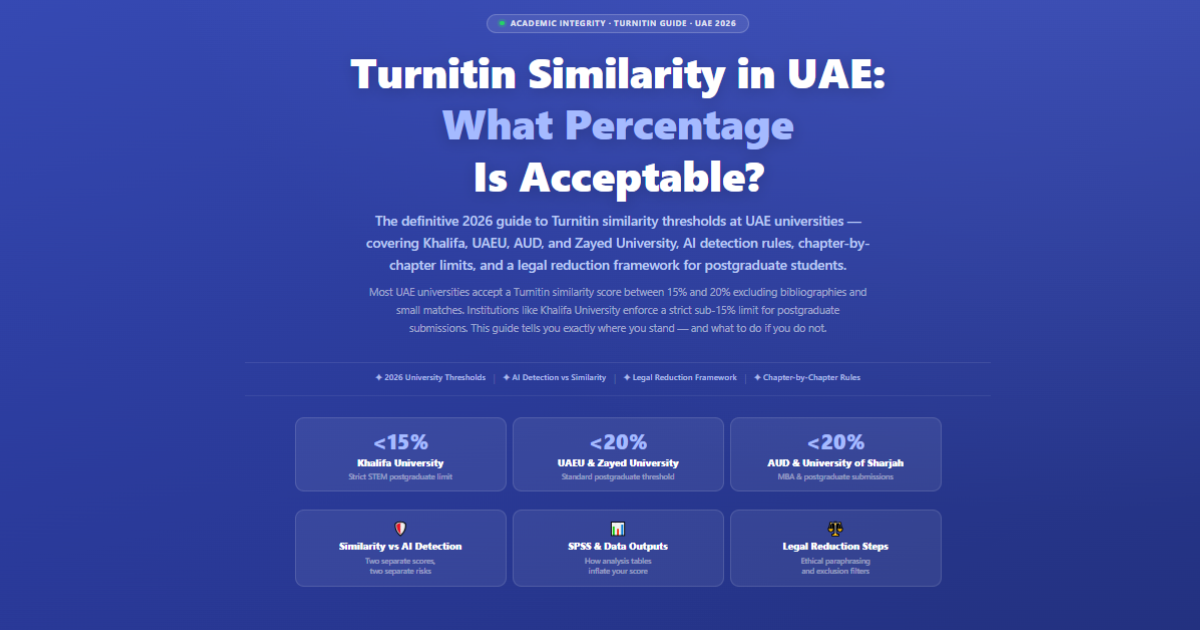
The definitive 2026 guide to Turnitin similarity thresholds at UAE universities — covering Khalifa, UAEU, AUD, and Zayed University, AI detection rules, chapter-by-chapter limits, and a legal reduction framework for postgraduate students.
Most UAE universities accept a Turnitin similarity score between 15% and 20% excluding bibliographies and small matches. Institutions like Khalifa University enforce a strict sub-15% limit for postgraduate submissions. This guide tells you exactly where you stand — and what to do if you do not.
two separate risks
inflate your score
and exclusion filters
What Your Turnitin Score Actually Means — Before You Panic
A Turnitin similarity score is not a plagiarism verdict. It is a percentage showing how much of your submitted text matches content in Turnitin's database — which includes published papers, student submissions, and web content. Understanding what that number represents, and what it does not, is the first step to responding to it correctly at any UAE university.
A Turnitin similarity score is the percentage of text in a submitted document that matches sources already in Turnitin's database. It is not a plagiarism score — it is a similarity indicator that requires human interpretation. Most UAE universities accept a similarity score of 15% to 20% after excluding bibliographies, quotes, and small matches. Khalifa University enforces a stricter sub-15% threshold for postgraduate STEM submissions. A high score is a flag for review, not automatic evidence of misconduct.
Turnitin does not detect plagiarism — it detects similarity. A 30% score could reflect heavy quoting with proper citations. A 5% score could still contain a plagiarised paragraph. The similarity report requires human review by your supervisor or academic integrity office before any determination is made.
Since 2023, Turnitin has produced a separate AI writing detection score alongside the similarity score. In 2026, all UAE universities using Turnitin Originality receive both scores. A paper can have 8% similarity but a 42% AI writing flag — these are independent metrics and both are reviewed by supervisors.
A correctly formatted APA 7th or Harvard reference list contains dozens of author names, journal titles, and publication details that match sources in Turnitin's database exactly. Before interpreting any score, activate the "Exclude Bibliography" filter — this is the single most impactful adjustment available and is expected at all UAE universities.
Statistical output tables generated by SPSS, standardised survey questions, and Excel data grids contain repeated numeric and textual patterns that match other students' submissions. These outputs can add 3–8% to your similarity score without any actual plagiarism present — a recognised issue at UAEU and Khalifa University postgraduate programs.
Many students use free online Turnitin-style checkers to preview their score before official submission. Most of these tools store submitted documents in a global repository. When you then submit officially through your university, Turnitin may return a near-100% match against your own previously stored draft — triggering a self-plagiarism flag.
Turnitin scores are not uniform across a dissertation's chapters. Chapter 2 (Literature Review) consistently produces the highest similarity scores due to the volume of academic sources cited and synthesised. Supervisors at UAE universities generally apply greater tolerance to Chapter 2 than to original-contribution chapters such as methodology, findings, and discussion.
Critical Warning — The Repository Trap: Never use a free online Turnitin checker, essay scanner, or similarity tool that does not explicitly state it uses a "no-repository" or "draft-only" mode. If your draft is stored, your official submission will match it — producing a self-plagiarism flag that is difficult and time-consuming to appeal, especially at UAEU and Khalifa University under their 2026 academic integrity frameworks.
Already over the threshold and facing a submission deadline? Labeeb's academic integrity editing service provides ethical, supervisor-safe similarity reduction for UAE postgraduate students — without altering your research content or argument.
Official Turnitin Thresholds at UAE Universities — 2026 Breakdown
No single threshold applies across all UAE universities. Each institution sets its own acceptable similarity limit — and some vary further by program level, department, and submission type. The table below reflects the most current published and operationally observed thresholds for postgraduate dissertation and MBA submissions across the UAE's primary accredited institutions in 2026.
| University | Threshold | Level | Notes |
|---|---|---|---|
| Khalifa University | <15% | Postgraduate / STEM | Strict enforcement. Bibliography and quote exclusions expected before assessment. IEEE formatting standard. |
| UAE University (UAEU) | <20% | Postgraduate / MBA | Standard CAA-aligned threshold. Self-submission draft check available for students before final upload. |
| Zayed University | <20% | Postgraduate / MBA | Applies after bibliography and small match exclusions. AI detection reviewed separately by faculty. |
| American University in Dubai (AUD) | <20% | Postgraduate / MBA | Supervisor discretion applied for Chapter 2 (Literature Review). Overall submission threshold is 20%. |
| University of Sharjah (UOS) | <20% | Postgraduate | Faculty-reviewed. Engineering and science programs may apply stricter internal departmental limits. |
| Canadian University Dubai (CUD) | <20% | Undergraduate / Postgraduate | Consistent 20% applied across programs. Referencing and quoted material exclusions applied by default. |
| British University in Dubai (BUiD) | <20% | Postgraduate / MBA | UK-aligned academic integrity framework. Both similarity and AI detection scores reviewed at submission. |
ⓘ Thresholds reflect operationally observed postgraduate standards as of 2026. Individual departments and supervisors may apply stricter internal limits. Always confirm your program's exact threshold with your supervisor before submission.
Similarity Score vs AI Detection Score — Two Separate Reviews
In 2026, UAE university Turnitin submissions generate two independent reports. Students who focus exclusively on reducing their similarity percentage are frequently surprised when their supervisor raises concerns about the AI writing score. Understanding both — and how they interact — is now a baseline requirement for postgraduate submission.
Measures text overlap between your submission and content in Turnitin's database — published papers, student work, and web sources. Expressed as a percentage of total submitted text.
- Can be reduced through paraphrasing, exclusion filters, and referencing correction
- Inflated by bibliographies, SPSS tables, and standardised survey instruments
- Reviewed against your university's published or operational threshold
- High score alone does not constitute academic misconduct
Analyses sentence-level predictability, syntactic uniformity, and statistical language patterns to estimate the proportion of text likely generated by an AI language model.
- Independent of similarity score — a low similarity score does not guarantee a low AI flag
- Non-native English writers with formal academic phrasing are at elevated false-positive risk
- Cannot currently be reduced by paraphrasing — only by substantive human rewriting
- All UAE universities receiving this score treat it as a separate academic integrity matter
Non-native English speakers writing at postgraduate academic register — a description that applies to a significant proportion of UAE university students — use formal, structured phrasing that Turnitin's AI detection layer can misidentify as machine-generated. A UAE student writing entirely original, human-drafted content can receive an AI flag of 15–30% simply due to the syntactic regularity expected in academic writing.
If you receive an AI detection flag you believe is a false positive, your first step is to document your drafting process — save version histories, note outlines, and retain any research notes. UAE universities including UAEU and BUiD have formal appeal processes for disputed AI detection results, but these require evidence of human authorship. Preparation before submission is significantly more effective than appeals after the fact.
Chapter-by-Chapter Turnitin Expectations — UAE Dissertations
Supervisors at UAE universities do not apply the same similarity tolerance uniformly across all dissertation chapters. The nature of each chapter — and the volume of external sources it necessarily engages — determines what is considered acceptable at the section level.
Unsure how your dissertation submission aligns with UAE university guidelines? Labeeb's UAE university dissertation support service includes a pre-submission Turnitin compliance review — covering chapter-by-chapter similarity risk before your supervisor sees the document.
The Three-Step Framework for Legally Reducing Your Turnitin Score
Reducing a Turnitin similarity score is a structured process — not a guessing game. The three steps below address the most impactful reduction levers available to UAE postgraduate students, in the correct order of execution. Applying them out of sequence or skipping earlier steps wastes time and produces unpredictable results on resubmission.
Before attempting any rewriting, apply Turnitin's built-in exclusion filters to your existing submission. This single step reduces most scores by 5–12 percentage points without changing a single word of your content. Many students discover they are already within threshold once exclusions are correctly applied — and have been rewriting unnecessarily.
- Open your Turnitin report and select the filter icon in the top toolbar
- Enable Exclude Bibliography — removes your reference list from the similarity calculation
- Enable Exclude Quoted Material — removes correctly attributed direct quotes
- Enable Exclude Small Matches — set to exclude matches under 10 words
- Re-read your adjusted score — this is the number your supervisor and university will assess
After applying exclusion filters, identify the highest-contributing sources in your similarity report — Turnitin displays these ranked by percentage contribution. Open each flagged passage and rewrite it by reconstructing the idea entirely from your own understanding, not by swapping synonyms sentence by sentence. Synonym replacement is detected by Turnitin's 2026 AI layer as machine-altered text.
- Read the flagged passage and close the source — do not write while looking at it
- Write the idea from memory using your own sentence structure and academic voice
- Cite the original source correctly in APA 7th or Harvard after rewriting
- Do not use AI tools to rephrase — this produces AI detection flags alongside reduced similarity
- Work through flagged passages from highest contributor to lowest for maximum efficiency
After rewriting, verify your revised score using a no-repository draft check before submitting through your university portal. Most UAE universities — including UAEU and Khalifa University — allow students to self-submit draft versions to a personal Turnitin folder that does not store the document in the global database. Confirm this facility with your university library or academic office before using it.
- Never use free third-party Turnitin checkers — these store your document in shared repositories
- Use only your university's official Turnitin student portal for draft checks
- Allow 24 hours between draft resubmissions — Turnitin's system requires processing time
- Confirm your score is within threshold on the draft check before final submission
Turnitin Exclusion Filters — What Each One Does and How Much It Saves
Removes your entire reference list from the similarity calculation. APA 7th and Harvard reference lists contain exact author names, journal titles, and DOIs that match Turnitin's database directly. Always activate this first.
Removes text within quotation marks from the similarity check. Only applies to correctly formatted direct quotes. Does not excuse over-quotation — supervisors review quote volume independently of Turnitin.
Filters out matches shorter than a set word count — typically 10 words. Removes common academic phrases, methodology terminology, and short cited fragments that generate false matches without any actual plagiarism present.
Allows manual exclusion of a source URL or submission — for example, if Turnitin flags a match against your own previously submitted chapter or coursework. Used carefully and with supervisor knowledge only.
Ethical Paraphrasing — What UAE Supervisors Accept vs What Turnitin Flags
The distinction between acceptable paraphrasing and problematic rewriting is not subjective. Turnitin's 2026 detection layer identifies specific linguistic patterns — and so do experienced supervisors at UAE universities. The comparison below shows the difference between surface-level synonym substitution (which fails) and genuine concept-level paraphrasing (which succeeds).
Substitution attempt:"Transformational leadership considerably enhances worker performance results in organisational environments."
Substitution attempt:"The research discovered a statistically noteworthy connection between motivation and output."
Substitution attempt:"Digital transformation necessitates powerful leadership dedication and corporate change management."
How to Handle SPSS, NVivo, and Survey Instrument Similarity Flags
SPSS statistical output tables, standardised Likert-scale survey questions, and NVivo coding frameworks contain standardised text and numerical patterns that match identically across thousands of student submissions. These are not plagiarism — but Turnitin treats them as similarity matches. Apply the following actions to mitigate their impact without removing essential content from your submission.
Place SPSS and NVivo output tables in appendices — not in the main body. Turnitin calculates similarity as a proportion of total submitted text. Appendix placement reduces the proportional weight of table-driven matches significantly.
Reproduce only key summary statistics in the body — narrative-style rather than full table format. Describe your SPSS output in your own analytical language and cross-reference the appendix for complete tables.
For standardised survey instruments(e.g., validated Likert scales), cite the original instrument source in your methodology and note that the questionnaire is a validated, published tool — supervisors and academic integrity offices at UAEU and Khalifa University recognise this distinction.
Use the "Exclude Small Matches" filter to remove numeric sequences and short standardised fragments before interpreting your score. Most SPSS-driven false matches fall below the 10-word threshold and are eliminated by this filter alone.
Need your reference list restructured to remove Turnitin similarity flags? Labeeb's academic formatting services cover APA 7th edition and Harvard referencing correction for UAE dissertation and assignment submissions — eliminating bibliography-driven similarity scores before you resubmit.
Nine Practical Actions UAE Students Can Take Right Now
The following tips are sequenced from the highest-impact, lowest-effort actions to the more involved interventions required when a score is significantly over threshold. Apply them in order — most students discover they need only the first three or four to reach an acceptable submission level at their UAE university.
Before rewriting a single sentence, activate Exclude Bibliography, Exclude Quoted Material, and Exclude Small Matches in your Turnitin report. Most students are already within their university's threshold once these filters are applied — and have been rewriting unnecessarily.
Do not rely on forum posts or peer advice for your threshold figure. Thresholds vary by university, department, program level, and submission type. Email your supervisor directly and ask for the applicable percentage — and whether it applies before or after exclusion filters.
Statistical output tables in the main body inflate similarity scores by 3–8% without any actual plagiarism. Relocate full SPSS and NVivo outputs to numbered appendices and reference them from the body text. Summarise key statistics narratively in the findings chapter instead.
Incorrectly formatted reference lists are not excluded by Turnitin's bibliography filter — only correctly structured references are. An improperly formatted bibliography can contribute 5–10% to your score even with the filter active. Fix your referencing format first, then recheck.
Turnitin lists matched sources ranked by their percentage contribution to your overall score. Work from the highest contributor downward — rewriting the top three sources typically accounts for 60–70% of a student's reducible similarity. Do not waste time on sources contributing 1% or less.
Using ChatGPT, Quillbot, or any AI paraphrasing tool to rewrite flagged passages reduces similarity but simultaneously increases your AI writing detection score. In 2026, UAE university supervisors review both scores. Trading a similarity problem for an AI detection problem is not a solution — it is an escalation.
UAEU, Khalifa University, and most UAE institutions provide a student-facing Turnitin portal for draft checking that does not store your document in the global repository. Use this — never a third-party checker — to verify your revised score before final submission. Confirm the facility exists at your institution with your academic office first.
If you receive an AI detection flag you believe is a false positive, your ability to appeal depends on evidence of human authorship. Save dated drafts, outline notes, and research annotations throughout your writing process — not after the fact. Cloud storage with automatic version history (Google Docs, OneDrive) provides timestamped evidence that supports appeals at all UAE universities.
Turnitin does not process resubmissions instantly for similarity comparison — the system requires time to index changes against its database. Submitting a revised draft immediately after an initial check produces unreliable results. Wait a minimum of 24 hours between draft checks for an accurate updated score.
APA 7th and Harvard Referencing — How to Format So Turnitin Excludes Them
Turnitin's bibliography exclusion filter works only when references follow the correct structural format for the citation style in use. Incorrectly formatted references — missing fields, wrong punctuation, or non-standard formatting — are not recognised as bibliography entries and are included in the similarity calculation. The examples below show correct formatting for the two most common citation styles at UAE universities.
Key fields required: Author surname, initials, year in parentheses, title in sentence case, journal in italics, volume(issue), page range, DOI. Missing any field breaks bibliography exclusion.
Key fields required: Author surname, initials, year in parentheses, title in single quotes, journal in italics, volume(issue), pp. page range. Harvard uses "and" not "&" between authors.
Key fields required: Author(s), year, title in italics with edition in parentheses, publisher. No location required in APA 7th — its omission is correct, not an error.
Key fields required: Author(s), year, title in italics, edition, place of publication, publisher. Harvard retains location — its inclusion is required and differentiates Harvard from APA 7th.
Last-Minute Turnitin Action Plan — If Your Submission Is in 48 Hours
Apply all exclusion filters immediately and recalculate your score. Note how much the score drops — this determines whether rewriting is actually needed.
Move all SPSS, NVivo, and Excel output tables to numbered appendices and replace main-body tables with narrative summaries. Recheck score impact.
Verify your reference list formatting against APA 7th or Harvard standards. Fix any incomplete entries — these may not be excluded by the bibliography filter if malformed.
Identify the top three contributing sources in your report. Rewrite only these flagged passages — concept-level rewriting only, no AI paraphrasing tools.
Run a draft check via your university portal — not a third-party tool — and wait 24 hours for an accurate score. If still over threshold, contact Labeeb immediately for same-day academic integrity editing support.
Postgraduate students writing in their second or third language — a majority at many UAE institutions — naturally produce formal, structured academic prose that Turnitin's 2026 AI detection layer can misread as machine-generated. If you receive an AI flag on content you wrote entirely yourself, do not panic and do not attempt to rewrite it using informal language to lower the score. Instead, document your drafting process, retain all version histories, and submit a written explanation with your draft if your university's submission system permits it. Supervisors at UAEU, AUD, and BUiD are aware of this false-positive pattern for non-native writers and have formal review processes in place.
Synthesising your literature review ethically while keeping Turnitin scores low? Labeeb's literature review support service helps UAE postgraduate students build Turnitin-compliant Chapter 2 synthesis from the ground up — structured thematically and reviewed before supervisor submission.
Why UAE Students Get This Wrong — and What Professional Support Actually Changes
Most students approaching a Turnitin problem make the same error: they treat it as a writing problem when it is a structural and procedural one. The decisions that determine your final similarity score are made long before you submit — in how you paraphrase, how you format references, how you place data outputs, and whether you use the correct checking tools. By submission day, the damage is already done or it is not.
A Turnitin score over threshold does not simply mean rewriting a few paragraphs. At UAE universities in 2026, an above-threshold submission can trigger a formal academic integrity review — a process that, even when resolved in the student's favour, adds weeks to the submission timeline and places the student's academic record under scrutiny. The reputational and deadline consequences are disproportionate to the original problem.
The situation is compounded when a student who has already failed a similarity check attempts to fix it using an AI paraphrasing tool — inadvertently adding an AI detection flag to an already flagged submission. At institutions including Khalifa University and UAEU, both flags are reviewed simultaneously by the academic integrity office, not sequentially. The combined presence of a similarity concern and an AI writing flag significantly reduces the likelihood of an informal resolution.
Students who work with professional academic integrity support — before submission, not after — consistently avoid this compounding effect. The investment in pre-submission review is a fraction of the cost, in time and risk, of a formal integrity review process.
Score is over threshold and there is insufficient time to rewrite systematically. Requires targeted, prioritised intervention on the highest-contributing flagged passages only.
A false-positive AI flag on entirely original content. Requires structural rewriting to vary syntactic patterns — without altering research content or argument — and documentation support for appeal.
Chapter 2 significantly over threshold despite applying exclusion filters. Indicates synthesis is sequential rather than thematic — requires structural reconstruction, not line-by-line edits.
- Score over threshold at submission
- AI paraphrasing tool used — adds AI flag
- Formal academic integrity review triggered
- Submission delayed by weeks
- Academic record flagged during review
- Rewriting under extreme deadline pressure
- Self-plagiarism from free checker repository
- Score reviewed and reduced before submission
- No AI tools used — no AI flag generated
- Submission passes integrity review first time
- Deadline maintained without extension
- Academic record remains clean
- Structured rewriting delivered to timeline
- Official university portal used throughout
Every similarity reduction Labeeb delivers is produced by human academic editors — not AI paraphrasing software. This ensures your revised submission does not generate a new AI detection flag alongside your reduced similarity score. In 2026, this distinction is critical at all UAE universities.
Labeeb's academic integrity editing is calibrated to the specific thresholds, submission requirements, and academic integrity frameworks of UAEU, Khalifa University, AUD, Zayed University, BUiD, and University of Sharjah — not generic global guidelines that do not reflect local enforcement practices.
For students with submission windows of 24–72 hours, Labeeb provides prioritised academic integrity editing with same-day delivery on targeted chapter sections. Our team assesses your Turnitin report, identifies the highest-impact intervention points, and delivers revised content within your deadline window.
Bibliography-driven similarity is one of the most common and most fixable Turnitin problems. Every Labeeb academic integrity editing engagement includes APA 7th edition or Harvard referencing correction as a standard component — ensuring the bibliography exclusion filter works correctly and eliminates reference-list contributions to your score.
Score Over Threshold? Get It Resolved Before Your Submission
Contact Labeeb's academic team directly on WhatsApp. Share your Turnitin report and submission deadline — we will assess your situation and advise on the fastest ethical path to a compliant submission.
Eight Turnitin Mistakes UAE Students Make — and the Fix for Each One
The errors below are drawn from the patterns most commonly seen in Turnitin submissions at UAE universities in 2025 and 2026. Each one is preventable — and each one is significantly easier to address before submission than after a formal academic integrity review has been opened. The fixes are specific, sequenced, and do not require AI tools at any stage.
The single most common error: a student receives a 28% similarity score, panics, and begins rewriting immediately — without first applying Exclude Bibliography, Exclude Quoted Material, and Exclude Small Matches. The filtered score is often 14–18%, already within threshold. Hours of unnecessary rewriting result from this sequencing error.
Always apply all three exclusion filters before interpreting or acting on your score. The filtered number — not the raw number — is what your supervisor and university assess against the published threshold.
Students use free online checkers to preview their similarity score before uploading through their university. The majority of these tools store submitted documents in a shared repository. When the student then submits officially, Turnitin matches the document against its own stored draft — returning a self-plagiarism score that can reach 80–100% and triggers an immediate integrity flag.
Use only your university's official Turnitin student portal for draft checking. Confirm with your academic office or library that the draft submission mode does not store your document in the global database before uploading.
A student with a 26% similarity score uses Quillbot or ChatGPT to rephrase flagged passages. The similarity score drops to 11% — but the AI writing detection score rises to 38%. The student now has two flags instead of one. At Khalifa University and UAEU in 2026, both scores are reviewed simultaneously by the academic integrity office.
Never use AI paraphrasing tools on flagged content. Rewrite manually using concept-level paraphrasing — close the source, reconstruct the idea from memory, and write in your own academic voice. This reduces similarity without generating AI detection flags.
Statistical output tables from SPSS and standardised Likert-scale survey questions contain repeated numeric and textual patterns that match thousands of other submissions. Placing these tables in Chapter 4 rather than in appendices can inflate similarity by 4–9% — the equivalent of a significant passage of unparaphrased text — without any actual plagiarism present.
Relocate full SPSS output tables and survey instruments to numbered appendices. Reference them from the body using "see Appendix A" notation. Present key statistics narratively in the findings chapter — in your own analytical language rather than as raw table output.
Turnitin's Exclude Bibliography filter only removes references it can structurally identify as bibliography entries. Incomplete or incorrectly formatted APA 7th or Harvard references — missing DOIs, incorrect punctuation, non-standard field order — are not recognised by the filter and are included in the similarity calculation, sometimes adding 5–8% to the overall score.
Audit your entire reference list against APA 7th or Harvard formatting standards before submission. Ensure every entry includes all required fields in the correct order. A correctly formatted reference list is fully excluded by Turnitin's bibliography filter — an incorrectly formatted one is not.
Students read their Turnitin report linearly — rewriting flagged passages in document order rather than by contribution percentage. The result: two hours spent rewriting passages that together account for 4% of the score, while a single source contributing 11% is left untouched. This is the least efficient approach possible and often leaves students over threshold after significant effort.
Open the source list panel in your Turnitin report and sort by percentage contribution. Work exclusively from the highest contributor downward. The top three sources typically account for 60–75% of all reducible similarity — address these first before touching anything else.
After rewriting flagged content, a student resubmits within minutes and receives almost the same score as before. They assume the rewriting has failed and begin rewriting again — often producing a third submission that is also inaccurate. Turnitin requires processing time to re-index a revised document against its database. Immediate resubmissions produce unreliable similarity scores.
Wait a minimum of 24 hours between draft resubmissions before interpreting the new score. This applies to both university portal draft checks and any official submission resubmissions. Plan your revision timeline to accommodate this processing window before your deadline.
A student receives a low similarity score (9%) but a high AI writing flag (41%). Believing the AI flag is caused by similar text, they attempt to rewrite flagged passages and reduce word-matching. AI detection and similarity are entirely separate systems — rewriting for similarity has no effect on AI detection scores. The student wastes time on the wrong intervention entirely.
Treat AI detection flags separately from similarity concerns. For a genuine false positive on human-written content, document your drafting process, retain version histories, and submit a written explanation if your university's portal permits it. For content that was AI-assisted, substantive human rewriting — not synonym replacement — is the only effective response.
A similarity score above threshold does not automatically result in a formal academic integrity investigation. Most UAE universities — including UAEU, AUD, and Zayed University — apply a two-stage process: an initial supervisor review, followed by referral to the academic integrity office only if the supervisor determines the similarity is not attributable to referencing, standard methodology language, or other legitimate sources.
Formal investigations are typically triggered by: scores significantly above threshold (30%+) with no apparent legitimate explanation; the presence of both a high similarity score and an elevated AI writing flag simultaneously; evidence of deliberate manipulation such as text colour matching, font size changes, or hidden characters; or a pattern of integrity concerns across multiple submissions from the same student.
At Khalifa University, where the threshold is stricter at sub-15%, any postgraduate submission exceeding 20% after exclusions is typically escalated directly to the integrity office without an informal supervisor review stage. Students at Khalifa should treat the 15% threshold as an absolute ceiling, not a guideline.
Academic Strategy: Pre-Submission Turnitin Checklist for UAE Postgraduate Students
Execute this checklist in sequence before every dissertation or major assignment submission. Each stage must be completed before the next — skipping earlier stages and attempting later ones is the root cause of most preventable Turnitin problems at UAE universities.
Email your supervisor to confirm the applicable percentage, whether it applies before or after exclusions, and whether Chapter 2 carries any additional tolerance. Document the response.
Use Google Docs or OneDrive with automatic version history enabled throughout the writing process. These timestamped records are your primary defence against a false-positive AI detection flag.
Audit every reference against APA 7th or Harvard standards. Move all SPSS, NVivo, and survey output tables to numbered appendices before running any draft check — these actions reduce your score before you submit.
Submit through your university's official no-repository portal. Apply all three exclusion filters immediately upon receiving results. Work from highest-contributing source downward if rewriting is needed. Wait 24 hours between resubmissions.
Review both the similarity percentage and the AI writing detection score before final submission. Both are assessed by UAE university supervisors. A score within threshold on one metric and over threshold on the other still constitutes a submission risk.
Need MBA assignment submissions reviewed for Turnitin compliance before your deadline? Labeeb's MBA assignment help service includes pre-submission similarity review and referencing correction for UAE university students — delivered within your submission window.
What Every UAE Student Should Confirm Before Submitting in 2026
Turnitin is not the obstacle — it is the standard. Every UAE university using it applies the same underlying principle: submitted work must be demonstrably original, correctly attributed, and free from both similarity and AI writing concerns. Students who understand that principle — and prepare for both metrics, not just one — consistently submit without incident.
Apply all exclusion filters before interpreting your score. The filtered number — not the raw number — is what your university assesses.
Confirm your university's exact threshold with your supervisor. Khalifa enforces sub-15%. UAEU, AUD, Zayed, and UOS apply sub-20% after exclusions.
AI detection and similarity are independent scores — both reviewed by UAE supervisors in 2026. A low similarity score does not protect against an AI writing flag.
Never use a free third-party checker. It stores your document in a repository and can return a near-100% self-plagiarism score on official submission.
Move SPSS and NVivo output tables to appendices and correct your reference list formatting before running any draft check — these actions reduce your score before you submit.
Rewrite flagged passages using concept-level paraphrasing only — never AI tools. Trading a similarity flag for an AI detection flag is an escalation, not a solution.
The students who navigate Turnitin successfully at UAE universities are not those who write better prose — they are those who build submission-ready habits from the start of the writing process. Saving version histories, formatting references correctly, placing data tables in appendices, and using only official university draft portals are not advanced strategies. They are baseline practices that prevent the majority of Turnitin problems before a single paragraph is submitted.
In 2026, with AI detection operating alongside similarity checking at all UAE institutions, the margin for error is narrower than in previous years. A submission that triggers both flags simultaneously — even with legitimate explanations for each — creates a compounding review burden that is significantly harder to resolve than either flag in isolation. The time to address this is during writing, not at the submission portal.
If your score is over threshold today, the most important thing you can do is stop — apply the exclusion filters, assess the actual gap, and act on the highest-contributing sources first. Most students discover the gap is smaller than the raw score suggested, and the path to compliance is shorter than they feared.
Score Over Threshold? Get Expert Help Before Your Deadline
Share your Turnitin report and submission deadline with Labeeb's academic team on WhatsApp. We will assess your situation immediately and advise on the fastest ethical path to a compliant submission — same-day support available.
Preparing your dissertation submission and need comprehensive Turnitin compliance support? Labeeb's SPSS and NVivo data analysis compliance service ensures your Chapter 4 analysis outputs are correctly structured for UAE postgraduate submissions — reducing data-driven similarity flags before your supervisor review.
Turnitin Similarity UAE — Questions Students Ask Most
These are the questions most frequently raised by postgraduate and MBA students at UAE universities when navigating Turnitin similarity and AI detection requirements. Each answer is written to be directly usable — in a supervisor conversation, an integrity office appeal, or a pre-submission checklist.
Most UAE universities accept a Turnitin similarity score of 20% or below after applying exclusion filters for bibliography, quoted material, and small matches. Khalifa University applies a stricter threshold of less than 15% for postgraduate and STEM submissions. The following reflects the operationally observed thresholds across major UAE institutions in 2026:
- Khalifa University: under 15% — strict enforcement, IEEE formatting standard
- UAE University (UAEU): under 20% — self-submission draft check available
- Zayed University: under 20% — AI detection reviewed separately
- American University in Dubai (AUD): under 20% — supervisor discretion for Chapter 2
- University of Sharjah, BUiD, CUD: under 20% — department-level variations may apply
Always confirm your program's exact threshold directly with your supervisor before submission — individual departments may apply stricter internal limits than the university-wide published standard.
Yes — 15% is acceptable at most UAE universities after exclusion filters are applied. At UAEU, AUD, Zayed University, University of Sharjah, BUiD, and CUD, a 15% filtered score is well within the sub-20% standard threshold and would not require any action before submission.
The one exception is Khalifa University, where the postgraduate threshold is strictly below 15%. A score of exactly 15% at Khalifa — even after exclusions — sits at the boundary and should be reduced further before submission to avoid a review request. At all other UAE institutions, 15% after exclusions is a comfortable, unproblematic score.
Yes — and the detection capability has expanded significantly since 2023. In 2026, Turnitin Originality produces a separate AI writing detection score alongside the similarity percentage. This score analyses sentence-level predictability, syntactic uniformity, and statistical language patterns to estimate the proportion of text likely generated by an AI language model, including ChatGPT, Claude, Gemini, and similar tools.
All UAE universities currently using Turnitin Originality receive both the similarity score and the AI writing score. Both are reviewed by supervisors — a low similarity score does not protect against an AI writing flag. There is an important caveat for UAE students: non-native English speakers writing formal academic prose can receive false-positive AI flags due to the syntactic regularity of academic register. If you receive a flag on entirely human-written content, document your drafting process and retain version histories as evidence for any appeal.
Yes — by default, Turnitin includes the reference list in the similarity calculation. A correctly formatted APA 7th or Harvard bibliography contains author names, journal titles, DOIs, and publication details that match sources in Turnitin's database exactly. Without the exclusion filter active, a reference list of 50–80 sources can contribute 5–10% to your overall similarity score.
The solution is to activate the Exclude Bibliography filter in your Turnitin report before interpreting your score. This filter identifies and removes correctly structured reference list entries from the similarity calculation. There is an important condition: the filter only works on correctly formatted references. Incomplete or incorrectly structured entries — missing DOIs, wrong punctuation, non-standard field order — are not recognised as bibliography entries and remain in the similarity count even with the filter active. Always audit your reference list formatting before running a draft check.
Yes — and this is one of the most poorly understood Turnitin issues among UAE postgraduate students. SPSS statistical output tables, standardised Likert-scale survey questions, and Excel data grids contain repeated numeric and textual patterns that match identically across thousands of student submissions. Turnitin identifies these as similarity matches — not because you plagiarised, but because the standardised format itself is shared content.
The most effective mitigation strategies are:
- Move full SPSS and NVivo output tables to numbered appendices — this reduces their proportional weight in the similarity calculation significantly
- Present key statistics narratively in the findings chapter — describe results in your own analytical language rather than reproducing raw table output
- Cite validated survey instruments formally — note in your methodology that the questionnaire is a published, validated tool and cite the original source
- Apply the Exclude Small Matches filter — most numeric sequences and short standardised fragments fall below the 10-word threshold and are removed by this filter
Khalifa University applies the strictest Turnitin similarity threshold among UAE universities — less than 15% after exclusions for postgraduate and STEM submissions. This is operationally enforced more rigidly than at other UAE institutions. Key distinctions for Khalifa students:
- The sub-15% threshold applies after Exclude Bibliography, Exclude Quoted Material, and Exclude Small Matches filters are activated
- IEEE formatting is the standard citation style at Khalifa — ensure your reference list follows IEEE conventions so the bibliography exclusion filter functions correctly
- Submissions exceeding 20% after exclusions are typically escalated directly to the academic integrity office without an informal supervisor review stage
- Both similarity and AI writing detection scores are reviewed simultaneously — a score within the 15% similarity threshold does not guarantee clearance if the AI writing score is elevated
Khalifa students should treat the 15% threshold as a hard ceiling — aim for 12% or below to provide a comfortable buffer against processing variance between draft checks and final submission.
This is almost always caused by one of three issues — and rarely indicates that the rewriting itself failed:
- You resubmitted too quickly. Turnitin requires a minimum of 24 hours to re-index a revised document against its database. Submissions checked within minutes of resubmission return the same or similar score as the original — the system has not yet processed the changes.
- You rewrote low-contributing passages and left high-contributing ones unchanged. The sources contributing most to your score may not be the ones that appear most visibly highlighted. Open the source list and sort by percentage contribution — the top three sources typically account for the majority of reducible similarity.
- Your reference list or SPSS tables are still contributing. If you have not applied exclusion filters or relocated data tables to appendices, these structural contributors remain in the calculation regardless of how much body text you rewrite.
Apply exclusion filters first, wait 24 hours between resubmissions, and work from highest-contributing source downward — in that order.
The outcome depends on the margin above threshold, the institution, and the supervisor's initial assessment. Most UAE universities apply a two-stage process:
- Stage 1 — Supervisor review: The supervisor examines the Turnitin report to determine whether the similarity is attributable to legitimate sources — referencing, methodology language, or standard academic phrasing. Many marginally over-threshold submissions are resolved at this stage with a request to revise and resubmit.
- Stage 2 — Academic integrity office referral: If the supervisor cannot explain the similarity through legitimate sources, or if the score is significantly above threshold, the submission is referred to the academic integrity office for formal review. This process adds weeks to the timeline and places the submission under official scrutiny.
- Formal investigation triggers: Scores above 30% after exclusions, simultaneous high similarity and high AI detection scores, or evidence of deliberate manipulation typically result in formal investigation rather than informal revision requests.
- Khalifa University exception: Submissions exceeding 20% after exclusions are escalated directly to the integrity office without an informal supervisor review stage.
If your score is over threshold and your submission date is imminent, the most effective course of action is to apply exclusion filters immediately, assess the true gap, and contact Labeeb for same-day academic integrity editing support if the gap cannot be closed through self-correction in the available time.
Correct referencing reduces Turnitin similarity in two ways: it ensures the bibliography exclusion filter works correctly, and it demonstrates that matched content is properly attributed rather than plagiarised. The key principles for UAE students are:
- Format every reference completely — missing fields (DOI, page range, volume/issue number) prevent the bibliography filter from recognising the entry, leaving it in the similarity count
- Use in-text citations consistently — every paraphrased idea must be cited at the point of use, not just in the reference list. Uncited paraphrasing is treated as potential plagiarism regardless of similarity score
- Do not over-quote — Turnitin's Exclude Quoted Material filter removes correctly attributed direct quotes, but supervisors review quote density independently. Excessive direct quotation is flagged as poor academic writing even when similarity is low
- Use a reference manager — tools such as Mendeley, Zotero, or EndNote generate correctly formatted APA 7th or Harvard references automatically, eliminating formatting errors that bypass the bibliography exclusion filter
Zayed University applies a sub-20% similarity threshold for postgraduate and MBA submissions after exclusion filters are applied. AI writing detection scores are reviewed separately by faculty — there is no single published AI percentage threshold, as faculty are instructed to use the AI score as one indicator within a broader academic integrity assessment rather than as an automatic pass/fail metric.
In practice, this means a Zayed University MBA student with a 6% similarity score and a 35% AI writing flag may still face a supervisor inquiry — particularly if the flagged sections correspond to passages with unusually uniform sentence structure or predictable academic phrasing. The safest approach for Zayed University students in 2026 is to treat both scores with equal seriousness: aim for under 20% similarity after exclusions, and maintain version histories and drafting notes throughout the writing process as evidence of human authorship if the AI flag is disputed.
Have a Turnitin question specific to your university or submission type that is not covered here? Contact Labeeb's academic team directly on WhatsApp — we respond within 15 minutes during Dubai working hours and provide free initial assessments of your Turnitin situation.
نسبة التشابه في Turnitin
بالإمارات
ما النسبة المقبولة في الجامعات الإماراتية؟
دليل شامل لعام 2026 حول نسب التشابه المسموح بها في Turnitin عبر جامعات الإمارات، يشمل جامعة خليفة وجامعة الإمارات وجامعة أمريكان في دبي وجامعة زايد، مع إرشادات حول كشف الذكاء الاصطناعي وخطوات التخفيض القانوني للنسبة.
النسب المقبولة في جامعات الإمارات: تقبل معظم الجامعات الإماراتية نسبة تشابه تصل إلى 20% بعد تطبيق فلاتر الاستثناء (قائمة المراجع، الاقتباسات، والتطابقات القصيرة). أما جامعة خليفة فتفرض حداً أصرم يقل عن 15% لطلاب الدراسات العليا وبرامج العلوم والتقنية، وتُحيل مباشرةً أي تقديم يتجاوز 20% إلى مكتب النزاهة الأكاديمية.
التشابه مقابل الانتحال — فرق جوهري: درجة التشابه في Turnitin ليست حكماً بالانتحال، بل هي مؤشر على التطابق النصي. درجة 30% مع استشهادات صحيحة قد تكون مقبولة، فيما يمكن أن تكون درجة 5% مشكلة إذا تضمنت فقرة منقولة دون عزو. التقرير بحاجة دائماً إلى تقييم بشري من قِبل المشرف.
كشف كتابة الذكاء الاصطناعي — درجة مستقلة ومهمة: في عام 2026، تُنتج Turnitin درجتين منفصلتين: درجة التشابه ودرجة كشف كتابة الذكاء الاصطناعي. كلتاهما تُراجَعان من قِبل المشرفين في جامعات الإمارات. درجة تشابه منخفضة لا تُعني بالضرورة إفلاتاً من علامة الذكاء الاصطناعي. الطلاب غير الناطقين بالإنجليزية معرضون لإيجابيات كاذبة نظراً لأسلوب الكتابة الأكاديمية الرسمية.
طُعم أدوات التحقق المجانية: استخدام أدوات Turnitin المجانية عبر الإنترنت يُخزّن عملك في مستودع عالمي مشترك. عند التقديم الرسمي عبر بوابة الجامعة، قد تُعيد Turnitin تطابق ورقتك مع نسختك المحفوظة مسبقاً، مما يُنتج درجة انتحال ذاتي قد تصل إلى 100%. استخدم دائماً بوابة Turnitin الرسمية لجامعتك فقط.
الخطوات الثلاث لتخفيض النسبة بشكل قانوني: أولاً، طبّق جميع فلاتر الاستثناء قبل أي إجراء آخر — فكثيراً ما يكتشف الطلاب أن نسبتهم ضمن الحد المقبول بعد تطبيق الفلاتر. ثانياً، أعد صياغة المقاطع المُعلّمة على مستوى الفكرة لا على مستوى الجملة. ثالثاً، تحقق من نسختك النهائية عبر البوابة الرسمية للجامعة فقط.
تضخيم النسبة بسبب جداول SPSS وقوائم المراجع: جداول المخرجات الإحصائية من SPSS وقوائم المراجع غير المنسقة بشكل صحيح تُضيف 5 إلى 12 نقطة مئوية لنسبة التشابه دون أي انتحال فعلي. انقل الجداول الكاملة إلى الملاحق وصحح تنسيق قائمة المراجع وفق APA الإصدار السابع أو Harvard قبل أي عملية مراجعة.
لا تستخدم أدوات الذكاء الاصطناعي لإعادة الصياغة: استخدام Quillbot أو ChatGPT لإعادة صياغة المقاطع المُعلّمة يُقلل من درجة التشابه لكنه يرفع في الوقت ذاته درجة كشف الذكاء الاصطناعي. النتيجة: علامتان بدلاً من علامة واحدة. أعد الصياغة يدوياً فقط — أغلق المصدر واكتب الفكرة بأسلوبك الأكاديمي الخاص.
الطلاب الذين يتعاملون مع Turnitin بنجاح في الجامعات الإماراتية ليسوا بالضرورة الأفضل كتابةً — بل هم الأكثر التزاماً ببناء عادات تقديم سليمة منذ بداية عملية الكتابة. حفظ نسخ المسودات وتنسيق قوائم المراجع صحيحاً ونقل الجداول إلى الملاحق واستخدام البوابات الرسمية فقط — هذه الممارسات تمنع الغالبية العظمى من مشكلات Turnitin قبل الوصول إلى بوابة التقديم النهائي.
هل نسبتك فوق الحد المسموح به؟ تواصل مع لبيب الآن
Get same-day academic integrity editing support from Labeeb's UAE specialist team — human-only rewriting, no AI tools, UAE university aligned.