
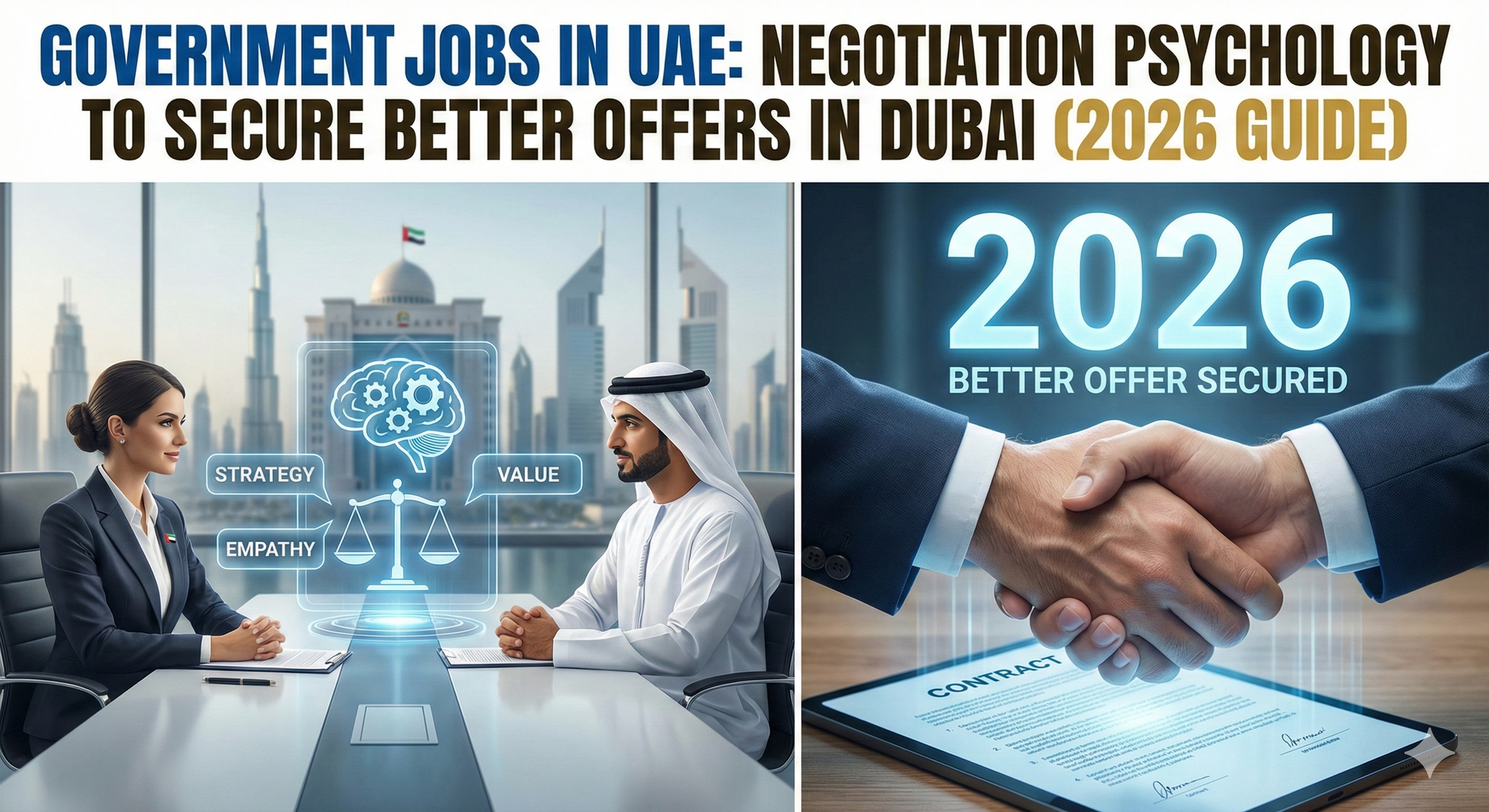
Government Jobs in UAE: Negotiation Psychology to Secure Better Offers in Dubai (2026 Guide)
Introduction: Why Negotiation Feels Different in Government Jobs in UAE
Negotiation in government jobs in UAE is unlike negotiation anywhere else. Candidates often approach public-sector offers with private-sector thinking—and that mismatch quietly costs them opportunities.
From personally advising
5,000+ UAE professionals during 2025–2026, one truth stands out:
Most government job offers are lost not because of salary demands, but because of poor negotiation psychology.
This guide is written for:
- Professionals targeting Dubai government jobs
- Specialists pursuing Abu Dhabi government jobs
- Experienced candidates applying for federal government jobs UAE and semi-government jobs UAE
You will learn how negotiation psychology actually works in the UAE public sector, what recruiters expect, and how to position yourself intelligently—without damaging trust or credibility.
Why Negotiation Psychology Matters in Government Jobs in UAE
Public Sector ≠ Private Sector
In private companies, negotiation rewards assertiveness. In government jobs in UAE, negotiation rewards emotional intelligence, patience, and structural awareness.
Government recruiters assess:
- Emotional control
- Understanding of grade systems
- Respect for policy constraints
- Long-term intent, not short-term gain
Misreading this psychology is one of the most common reasons offers stall or quietly disappear.
Understanding How Government Salary Structures Really Work
Fixed Bands, Not Open Bargaining
Unlike private roles, most federal government jobs UAE and Dubai government jobs operate on:
- Predefined salary grades
- Role-linked allowances
- Experience-based placement
Negotiation is placement-based, not demand-based.
Candidates who push aggressively signal misalignment with public-sector culture.
The Psychology Recruiters Apply During Offer Discussions
What Recruiters Are Actually Evaluating
During negotiation conversations, panels subconsciously assess:
- Maturity and realism
- Cultural fit
- Emotional discipline
- Long-term commitment
In semi-government jobs UAE, recruiters often ask indirect questions to observe psychological responses rather than extract information.
The Biggest Negotiation Mistake Candidates Make
Treating Government Offers Like Private Offers
Common damaging behaviors include:
- Quoting market salaries aggressively
- Comparing offers with private firms
- Using pressure language (“I need a decision fast”)
These behaviors create resistance rather than leverage in government jobs in UAE.
Reframing Negotiation: From Demands to Alignment
The Correct Mindset Shift
Successful candidates frame negotiation around:
- Role scope
- Grade alignment
- Long-term progression
Instead of asking:
“Can you increase the salary?”
They ask:
“How is experience typically aligned within this grade?”
This subtle shift dramatically improves outcomes.
Negotiation Timing: When to Speak—and When to Stay Silent
Silence Is a Strategic Tool
In UAE public hiring, silence often signals:
- Internal approvals pending
- Emiratisation alignment
- Budget confirmation
Pushing prematurely damages trust.
Strategic patience enhances credibility.
This is especially true in mid-career government roles UAE.
Emiratisation and Negotiation Psychology
Understanding the Policy Layer
Emiratisation 2026 shapes negotiation dynamics even when not explicitly stated.
Recruiters assess whether candidates:
- Understand national workforce priorities
- Position themselves as value-add, not competition
- Respect institutional balance
Candidates who resist this reality often appear misaligned with government jobs in UAE.
Negotiating Benefits vs Salary: Where Real Flexibility Exists
What Can Be Discussed
While base salary flexibility is limited, discussions may include:
- Grade placement based on experience
- Role scope clarification
- Development pathways
- Long-term mobility
Smart candidates focus negotiation energy here—where psychology favors collaboration.
Negotiation Body Language & Tone in UAE Public Roles
Non-Verbal Signals Matter
Even during verbal negotiations, recruiters observe:
- Tone stability
- Posture and composure
- Facial expressions when limits are explained
Negative reactions signal entitlement or rigidity—undesirable traits in public service.
Negotiation in Panel vs HR-Led Discussions
Two Very Different Settings
- Panel discussions test attitude and alignment
- HR discussions confirm policy fit and placement
Confusing these roles often leads candidates to over-negotiate too early.
Understanding this distinction is critical for government jobs in UAE.
When to Accept, When to Pause, When to Decline
Acceptance Psychology
Accepting confidently—but not eagerly—signals stability.
Pause Psychology
Asking for time to review shows professionalism when done calmly.
Decline Psychology
Declining respectfully preserves future eligibility. Burning bridges in the public sector has long memory.
ATS, Human Judgment, and Negotiation
ATS systems end at shortlisting.
Negotiation outcomes are decided entirely by human psychology.
Candidates who reach offer stage but fail negotiation often:
- Overestimate leverage
- Misread cultural signals
- Undervalue emotional intelligence
UAE-Specific Negotiation Insights You Must Know
- Government hiring favors stability over aggression
- Negotiation is placement-based, not salary-based
- Emotional reactions are evaluated
- Cultural respect outweighs market comparisons
Applications and offers typically flow through platforms such as:
- Dubai Careers
- TAMM
- Federal Authority for Government Human Resources
- Ministry of Human Resources and Emiratisation
How Labeeb Helps Clients Negotiate Government Offers
At Labeeb Writing & Designs, we prepare clients not just to get offers, but to handle them intelligently.
Our support includes:
- Government-aligned CV positioning
- Offer discussion coaching
- Negotiation mindset preparation
- Interview-to-offer transition support
Explore our services:
- https://www.labeeb.ae/professional-cv-writing
- https://www.labeeb.ae/interview-preparation
- https://www.labeeb.ae/expert-career-support
- https://www.labeeb.ae/packages
Frequently Asked Questions (FAQ)
1. Can I negotiate salary for government jobs in UAE?
Yes, but within grade placement limits—not open bargaining.
2. Is negotiation viewed negatively in public sector roles?
Only when handled aggressively or emotionally.
3. Are Dubai government jobs more flexible than federal roles?
Slightly, but still policy-driven.
4. Does Emiratisation affect negotiation outcomes?
Indirectly, yes—it shapes placement psychology.
5. Can negotiation mistakes affect future applications?
Yes. Public-sector hiring systems retain institutional memory.
Related Reads
To strengthen your strategy, explore:
- Government Jobs in Dubai: How to Secure a High-Paying Position – Read More →
- How Hiring Really Works in the UAE Job Market – Read More →
- Personal Branding in Dubai: How Your CV and LinkedIn Can Set You Apart – Read More →
- Interview Preparation in Dubai: How to Impress Recruiters – Read More →
Call to Action
If you are pursuing government jobs in UAE and want expert guidance on interviews, offers, and negotiation psychology, our team is ready to support you with clarity and confidence.
- Contact: https://www.labeeb.ae/contact
- WhatsApp: https://wa.me/+971547537303