
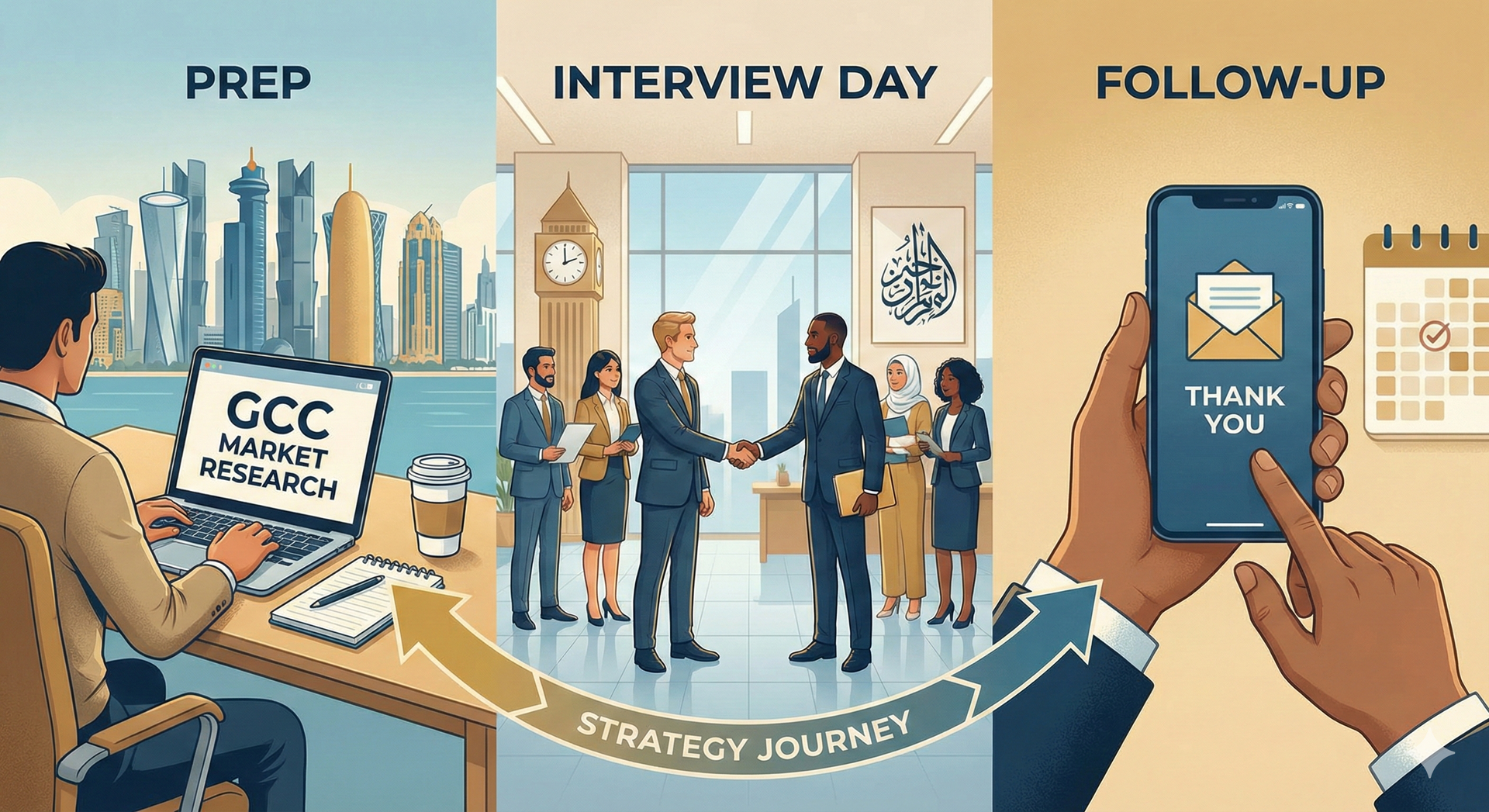
Interview Day Strategy: From Prep to Follow-Up in the GCC
Introduction: Why Interviews Fail Even for Qualified UAE Professionals
In the UAE and wider GCC job market, interviews are no longer informal conversations. They are structured evaluations of business value, cultural fit, and decision-making ability.
From personally preparing 5,000+ UAE professionals for interviews across 2025–2026, one trend stands out clearly: most candidates lose opportunities on interview day, not because they lack experience, but because they lack interview strategy.
In a competitive market, interviews are not about answering questions correctly. They are about demonstrating relevance, confidence, and impact under pressure.
This guide provides a complete interview day strategy—from preparation to follow-up—tailored specifically to UAE and GCC hiring realities.
Understanding Interview Expectations in the UAE & GCC
Before preparation begins, candidates must understand the interview context.
UAE Interviews Are Business-Focused, Not Personal
Interviewers in the GCC typically assess:
- Business impact, not task lists
- Problem-solving ability, not theory
- Communication clarity, not verbosity
- Cultural alignment, not personality alone
Even technical interviews often include commercial and scenario-based questions.
Step 1: Pre-Interview Preparation (The Hidden Differentiator)
Preparation begins days before interview day—not hours.
What Serious Preparation Looks Like
Effective candidates prepare across four dimensions:
- Role alignment
- Company context
- Achievement structuring
- Delivery practice
Skipping any one dimension weakens performance.
Align Your Experience to the Job Description
Interviewers expect candidates to:
- Speak their language
- Address their priorities
- Solve their problems
This requires mapping your experience directly to:
- Job responsibilities
- Required competencies
- Industry challenges
Your answers should feel custom-built, not recycled.
Build Structured Achievement Stories
In the UAE, vague answers are interpreted as weak impact.
Strong candidates prepare:
- 6–10 STAR-based achievement stories
- Quantified outcomes (cost, revenue, efficiency, risk)
- Leadership or ownership indicators
Preparation turns nervous responses into confident narratives.
Step 2: Documents You Must Review Before Interview Day
Candidates often forget that interviewers review documents immediately before meetings.
Revisit:
- Your CV (line by line)
- Your LinkedIn profile
- The job description
- The company’s recent news or projects
Any inconsistency creates doubt.
👉 Internal reference:
https://www.labeeb.ae/professional-cv-writing
👉 Internal reference:
https://www.labeeb.ae/linkedin-profile-optimization
Step 3: Interview Day Mindset (Confidence Without Arrogance)
Interview success in the GCC depends heavily on professional presence.
What Interviewers Observe Instantly
Within minutes, interviewers assess:
- Communication tone
- Confidence level
- Cultural awareness
- Respect and professionalism
Strong candidates project calm authority, not desperation.
Step 4: Answering Questions With Structure and Impact
Rambling answers are the fastest way to lose attention.
The Ideal Answer Structure
High-performing candidates:
- Clarify the question briefly
- Present a structured response
- Quantify outcomes
- Link back to business value
This approach works across technical, behavioral, and leadership interviews.
Step 5: Handling Common UAE Interview Question Types
Behavioral Questions
Focus on leadership, accountability, and outcomes.
Scenario-Based Questions
Assess decision-making under pressure and business judgment.
Technical Questions
Test applied knowledge, not memorization.
Cultural Fit Questions
Evaluate adaptability, respect, and communication style.
Preparation across all four categories is essential.
Step 6: Virtual vs In-Person Interviews in the GCC
Both formats remain common in 2026.
Virtual Interview Best Practices
- Professional background and lighting
- Clear audio
- Eye contact with camera
- Controlled pace
In-Person Interview Best Practices
- Conservative professional attire
- Punctuality (early arrival)
- Confident body language
- Formal greeting etiquette
Small details matter in the GCC.
Step 7: Asking Smart Questions (A Silent Power Move)
Candidates are evaluated by the questions they ask.
Strong questions focus on:
- Team structure
- Role expectations
- Performance metrics
- Growth opportunities
Avoid questions about salary or benefits at early stages unless invited.
Step 8: Managing Nerves on Interview Day
Nervousness is normal. Lack of control is not.
Effective techniques include:
- Structured preparation
- Rehearsed opening statements
- Controlled breathing
- Slower speaking pace
Confidence is built before the interview, not during it.
Step 9: Post-Interview Follow-Up Strategy
Follow-up is not optional—it is strategic.
Effective Follow-Up Includes
- A professional thank-you message
- Reinforcement of interest
- Brief value reminder
Poor follow-up—or none at all—wastes strong interviews.
Step 10: Handling Delays and Silence Professionally
In the UAE, hiring timelines can vary.
Best practices:
- Wait an appropriate period
- Send one polite follow-up
- Avoid repeated messages
Professional patience preserves credibility.
Common Interview Mistakes UAE Candidates Make
From extensive interview coaching, the most damaging mistakes include:
- Over-explaining basic answers
- Speaking negatively about past employers
- Appearing inflexible or entitled
- Ignoring cultural cues
- Failing to prepare questions
Avoiding these mistakes significantly improves outcomes.
When to Seek Interview Preparation Support
Interview preparation is not remedial—it is strategic.
Professional support helps with:
- Answer structuring
- Confidence building
- Mock interviews
- Role-specific preparation
👉 Internal reference:
https://www.labeeb.ae/interview-preparation
👉 Career support overview:
https://www.labeeb.ae/expert-career-support
👉 Packages:
https://www.labeeb.ae/packages
Frequently Asked Questions (FAQ Schema Ready)
Are UAE interviews more difficult in 2026?
They are more structured and competitive, requiring better preparation.
How many interviews does it usually take to secure an offer?
With strong preparation, many candidates convert within 2–4 interviews.
Should I negotiate salary during the interview?
Only when invited. Premature negotiation can hurt prospects.
Are mock interviews useful?
Yes. They significantly improve clarity, confidence, and performance.
Is follow-up really necessary?
Yes. Professional follow-up reinforces interest and maturity.
Recent Relevant Blogs (Read More)
- Networking Mastery: Turning Connections into UAE Job Offers – Read More
- Mastering Job Applications: Quantity vs. Quality in Dubai – Read More
- Building Your Job Search Toolkit: CV, LinkedIn, Cover Letters & More – Read More
- LinkedIn Profile Must-Haves: Headline, Summary & Experience – Read More
Final Thoughts: Interviews Are a Skill, Not a Test
In the UAE and GCC, interviews reward candidates who treat them as strategic business discussions, not interrogations.
Preparation, structure, and professional presence consistently outperform raw experience.
For expert interview preparation aligned with real UAE hiring practices:
📩 Contact:
https://www.labeeb.ae/contact
📱 WhatsApp:
https://wa.me/+971522617846