
Salary Negotiation Tactics for Tax-Free UAE Roles
Introduction: Why Salary Negotiation in the UAE Is Different
Salary negotiation in the UAE is often misunderstood. Many professionals either undervalue themselves out of fear or overplay their hand and lose offers—both outcomes are avoidable with the right strategy.
From personally advising 5,000+ UAE professionals through offer-stage negotiations during 2025–2026, one fact is consistent: successful negotiation in the UAE is structured, data-driven, and culturally aware. It is not aggressive bargaining, nor is it passive acceptance.
In a tax-free market, negotiation is not just about monthly salary. It is about total value, long-term positioning, and contractual clarity.
This guide explains how to negotiate UAE job offers professionally, confidently, and effectively—without damaging relationships or losing opportunities.
Understanding UAE Compensation Structures in 2026
Before negotiating, candidates must understand how UAE salaries are structured.
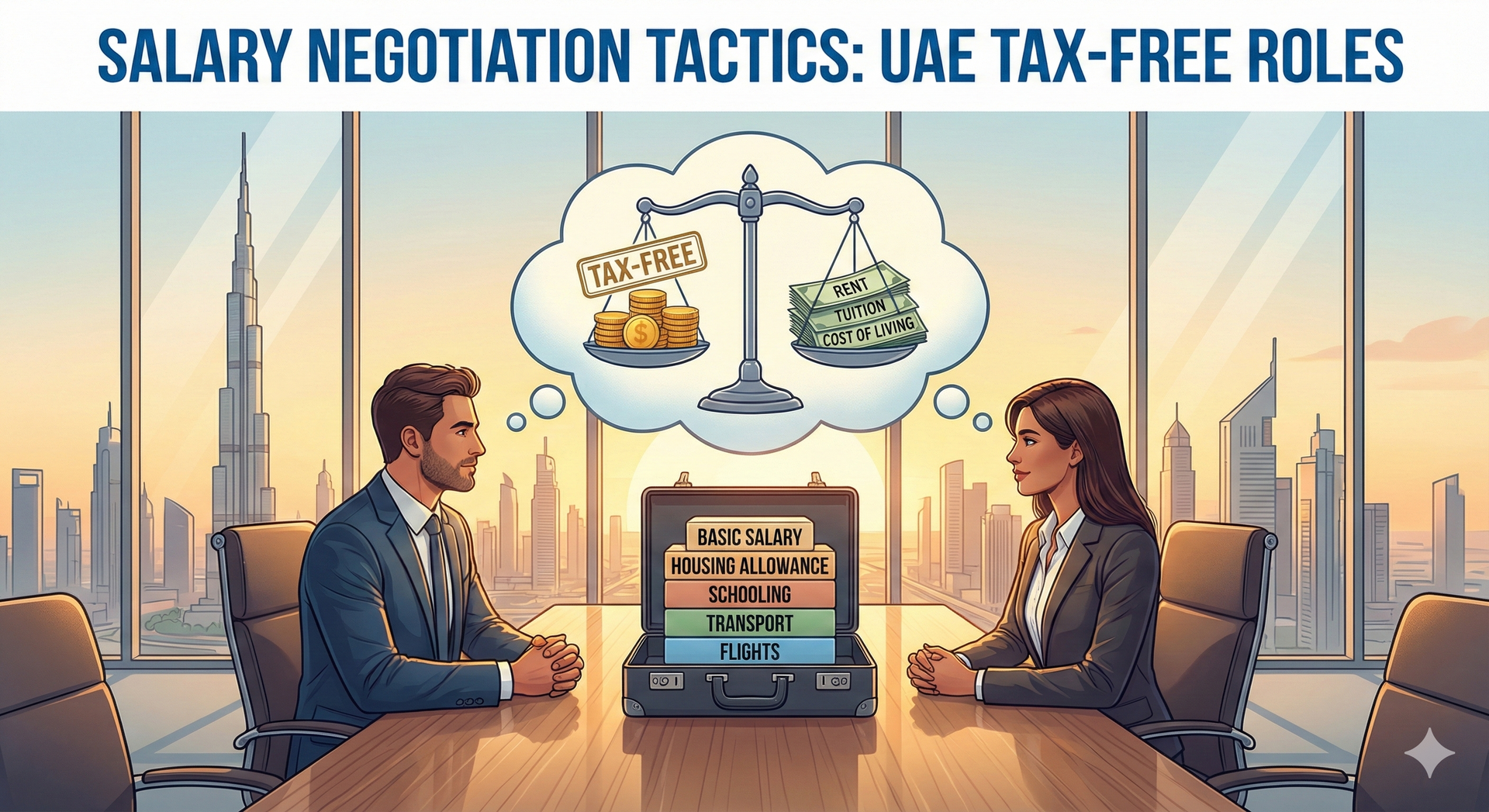
Salary Is Only One Part of the Offer
Most UAE offers include:
- Basic salary
- Allowances (housing, transport, education, etc.)
- Bonuses or incentives
- Medical insurance
- Annual leave and airfare
- End-of-service benefits
Negotiation must evaluate the entire package, not just the headline number.
Why Tax-Free Salary Changes Negotiation Psychology
Many professionals focus only on gross monthly salary. In the UAE, tax-free income means:
- Net take-home is significantly higher
- Allowances often outperform cash increments
- Long-term benefits matter more than short-term gains
Smart negotiators compare real purchasing power, not just figures.
Step 1: Know Your Market Value Before Negotiating
Negotiation without data is speculation.
What Market Research Should Include
- Role-specific salary benchmarks
- Industry averages
- Company size and sector norms
- Seniority expectations
Candidates who cite realistic ranges are taken more seriously.
Negotiation confidence comes from evidence, not entitlement.
Step 2: Understand When Negotiation Starts (And When It Doesn’t)
Negotiation timing matters.
The Right Time to Negotiate
- After a formal offer is made
- When the employer has expressed clear interest
- When role expectations are fully understood
Negotiating too early signals misalignment.
Step 3: Let the Employer Anchor First
One of the most effective negotiation principles is anchoring.
Allowing the employer to present the first offer:
- Reveals their budget range
- Prevents underselling yourself
- Provides negotiation leverage
Candidates who push numbers prematurely lose strategic advantage.
Step 4: How to Respond to an Initial Offer Professionally
Initial offers are rarely final.
A Professional Response Framework
Strong candidates:
- Express appreciation
- Confirm interest
- Ask for time to review
- Respond thoughtfully
This keeps the conversation collaborative, not confrontational.
Step 5: What to Negotiate Besides Salary
In many UAE roles, non-salary components are more flexible.
Common negotiation areas include:
- Housing allowance
- Annual bonus structure
- Joining bonus
- Leave days
- Airfare frequency
- Flexible review cycles
Professionals who negotiate holistically often gain more value.
Step 6: How Much Is Reasonable to Negotiate in the UAE?
Excessive demands reduce credibility.
Typical negotiation ranges:
- Entry to mid-level: 5–10%
- Senior roles: 10–20% (sometimes more with strong leverage)
Reasonableness signals professionalism.
Step 7: Negotiating as an Expat vs Local Hire
Negotiation dynamics vary based on residency status.
Expat Considerations
- Relocation costs
- Visa and medical coverage
- Education allowances (where applicable)
Local Hire Considerations
- Immediate availability
- Market familiarity
- Reduced onboarding costs
Understanding your position strengthens leverage.
Step 8: Handling “This Is Our Final Offer” Statements
Final offers are not always final.
Professional responses include:
- Clarifying priorities
- Exploring alternative benefits
- Requesting future review timelines
Polite persistence preserves goodwill.
Step 9: Red Flags to Watch During Negotiation
Some warning signs include:
- Vague contract terms
- Verbal promises without documentation
- Unclear bonus structures
- Delayed offer letters
Negotiation is also about risk assessment, not just value.
Step 10: Get Everything in Writing
In the UAE, clarity protects both parties.
Ensure:
- Salary breakdown is documented
- Allowances are specified
- Bonus criteria are defined
- Review timelines are stated
Verbal assurances do not replace written agreements.
Common Salary Negotiation Mistakes UAE Candidates Make
From real-world cases, the most damaging mistakes include:
- Negotiating emotionally
- Comparing offers publicly
- Issuing ultimatums
- Ignoring total compensation
- Accepting unclear contracts
Avoiding these mistakes protects long-term outcomes.
When Not to Negotiate
Sometimes, negotiation is unnecessary or risky.
Avoid negotiation when:
- Offer already exceeds market norms
- Role is highly competitive
- Employer signals limited flexibility
Strategic acceptance can outperform forced negotiation.
How Career Support Helps at the Offer Stage
Many professionals lose value at the final stage—not because they lack leverage, but because they lack strategy.
Expert support helps with:
- Market benchmarking
- Negotiation scripting
- Offer evaluation
- Contract clarity
👉 Career support overview:
https://www.labeeb.ae/expert-career-support
👉 Packages:
https://www.labeeb.ae/packages
Frequently Asked Questions (FAQ Schema Ready)
Is salary negotiation expected in the UAE?
Yes. Professional, respectful negotiation is common and accepted.
Can negotiating cause an offer to be withdrawn?
Only if handled poorly or unprofessionally.
Should I negotiate via email or call?
Initial negotiation is best in writing, followed by discussion if needed.
Are allowances negotiable?
Often yes—sometimes more flexible than base salary.
Is tax-free salary negotiable for all roles?
Negotiation depends on role demand, seniority, and budget.
Recent Relevant Blogs (Read More)
- Interview Day Strategy: From Prep to Follow-Up in the GCC – Read More
- Networking Mastery: Turning Connections into UAE Job Offers – Read More
- Mastering Job Applications: Quantity vs. Quality in Dubai – Read More
- Building Your Job Search Toolkit: CV, LinkedIn, Cover Letters & More – Read More
Final Thoughts: Negotiation Is a Professional Conversation
In the UAE, successful negotiation is calm, informed, and respectful. It strengthens—not strains—professional relationships.
Candidates who prepare, communicate clearly, and think beyond salary consistently achieve better long-term outcomes.
For expert guidance at the offer and negotiation stage:
📩 Contact:
https://www.labeeb.ae/contact
📱 WhatsApp:
https://wa.me/+971522617846